
Review · JAPAN BIKE TOURS
Hiroshima: Peace Cycling Tour with Local Guide
Hiroshima’s atomic bombing story becomes easier to grasp when you move beyond the Peace Memorial Park and see how far the damage reached. This electric-bike tour follows the city’s rivers, bridges, parks, tram lines, and suburban streets, linking famous memorials with places you could easily miss on foot.
I like two things here: the guides bring local family stories into a difficult subject, and the bicycles let you cover much more ground without turning the tour into a workout. The main consideration is that the tour remains centered on Hiroshima’s bombing history, so it is not a general city sightseeing ride.
Key points to know before you book
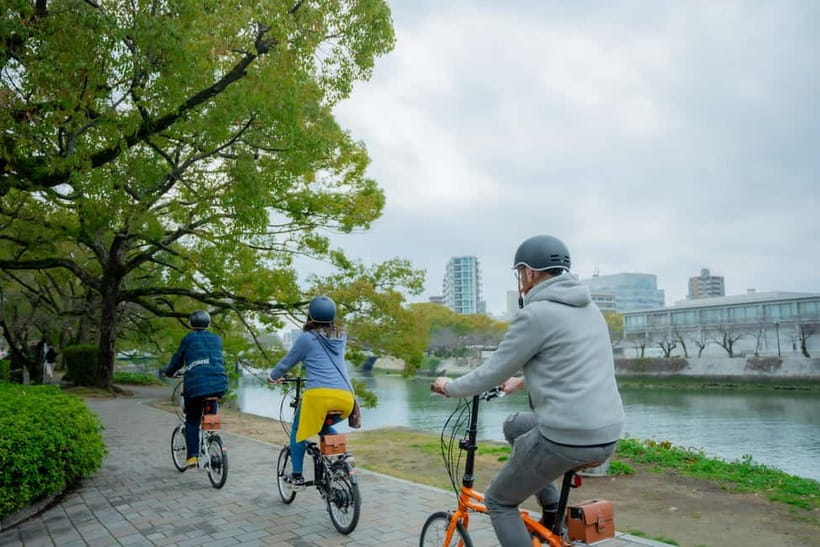
- Personal local storytelling: Guides including Shin, Kana, Moe, Mai, and Bella-Kana connect Hiroshima’s past with family stories passed down through parents and grandparents.
- Electric bicycles do the hard work: The ride is manageable for ordinary cyclists, though you still need to be comfortable riding in city traffic.
- Two route lengths: The two-hour option focuses on Peace Park, the Atomic Bomb Dome, A-bomb heritage sites, and the surviving tram system. The three-hour route adds Hiroshima Castle, Central Park, bridges, hospitals, rivers, and more.
- Small shared group: Up to 10 people join the English-language tour, with the pace adjusted to the least confident cyclist.
- A wider view of destruction: The route helps you understand that the bombing affected far more than the area now known as Peace Memorial Park.
- Practical limits: Adult electric bikes require a height of at least 145 centimeters. Tall riders may find the bicycle frame small.
Why cycling changes the Hiroshima experience
Peace Memorial Park is essential, but it can also give you a compressed view of Hiroshima. The monuments, museum, cenotaph, and Atomic Bomb Dome are gathered into one powerful district. You see the heart of the memorial story, but not always the scale of the city that was destroyed.
A bicycle gives you that scale. You cross rivers, pass ordinary streets, follow tram tracks, and stop at places tied to the bombing that are not part of the standard first visit. The route travels within the central city and nearby areas, showing how Hiroshima has rebuilt itself with trees, roads, homes, hospitals, parks, and public transport.
The electric assistance matters. You are not racing, and the distances are not extreme, but Hiroshima can be hot and humid. The motor keeps the ride comfortable and leaves you with enough attention for the guide’s stories. Several guides have also carried practical items such as cold towels, salt candies, wet wipes, umbrellas, and ice packs during hot weather. That kind of care can make a real difference in summer.
You still need basic cycling ability. This is not a bus tour with occasional photo stops. You ride between locations, wait at traffic lights, and stay with the group. The pace can be reduced if children or less experienced riders are present, but you should not book it if you cannot ride a bicycle safely.
More guided departures in Japan:
- Tokyo Guided Small-Group Biking Tour
★ 5.0 · 1,250 reviews - Tokyo Top Highlights 3h Guided E-bike Tour
★ 5.0 · 714 reviews - 3h Tokyo E-Bike Tour: Hidden Gems, and Local Life with guide
★ 5.0 · 670 reviews
Meeting at Peace Park and getting oriented
The meeting point is the Rest House in Hiroshima Peace Park. From Hiroshima Station, take the Hiroshima Electric Railway tram to Atomic Bomb Dome Station. The trip takes about 20 minutes, followed by a walk of roughly five minutes.
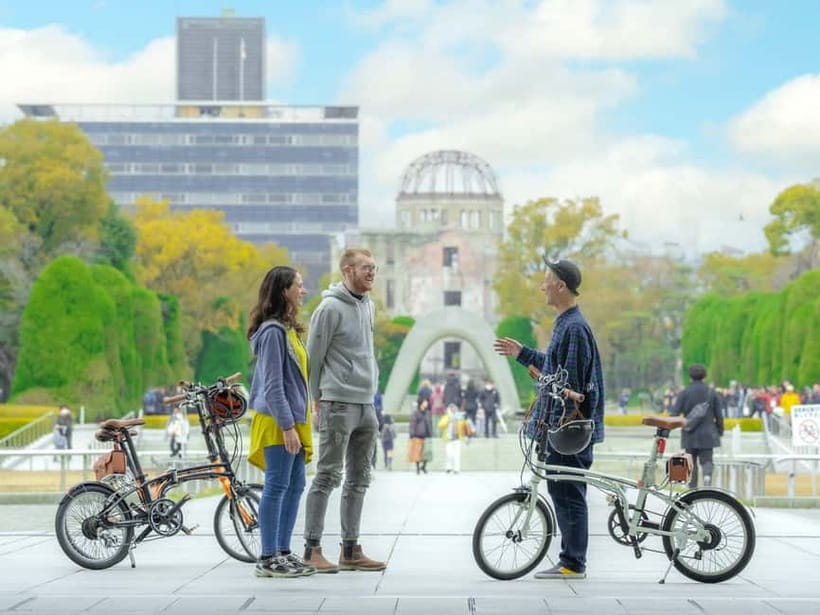
The tour begins with an explanation of Peace Memorial Park and the meaning attached to its monuments. The guide also introduces the Atomic Bomb Dome and the events of August 6, 1945. This early section gives you the basic timeline and helps you understand why the park is arranged as it is.
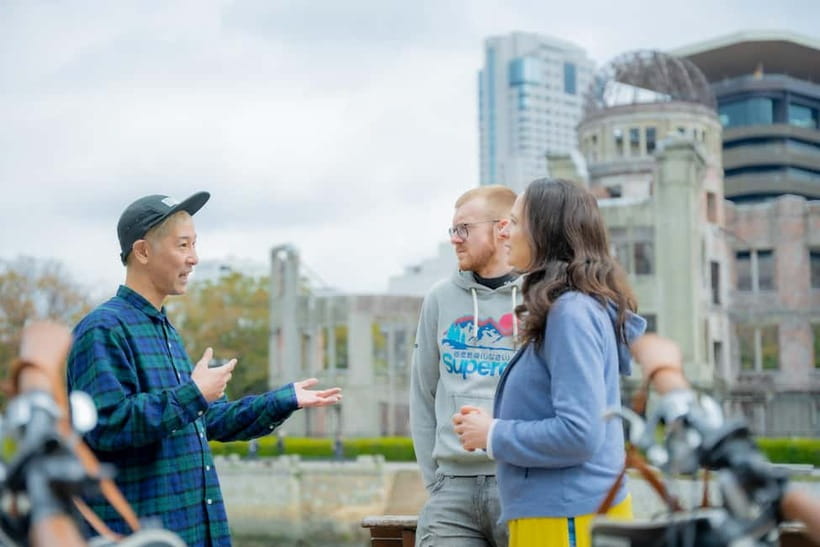
The local guides approach the subject with care. The tone is serious, but not relentlessly grim. Shin, in particular, has shared family connections to people affected by the bombing, while Kana, Moe, and other guides have brought in stories passed down through relatives or learned from people in the city. These accounts add a human scale that dates and statistics cannot provide.
You should expect emotional moments. The experience deals directly with civilian suffering, destruction, survival, and the continuing place of the bombing in Hiroshima’s memory. The guides also make room for hope, healing, and the city’s commitment to peace. That balance is one of the tour’s strongest qualities.
The two-hour route, focused and efficient
The shorter course meets at 11:00 or 15:00 and finishes at 13:00 or 17:00. It works well if you have one day in Hiroshima, want a guided introduction before visiting the museum, or need room in your schedule for Miyajima.
The first hour is spent around Peace Memorial Park. You learn what the park represents, what happened in the area around the hypocenter, and how the Atomic Bomb Dome became one of the best-known symbols of the bombing. The guide explains the memories attached to the monuments rather than simply pointing them out.
At about the one-hour mark, the ride moves away from the most visited area. You see parts of the city that many first-time visitors would pass without understanding. The guide points out A-bomb heritage sites and discusses how Hiroshima was rebuilt after the destruction.
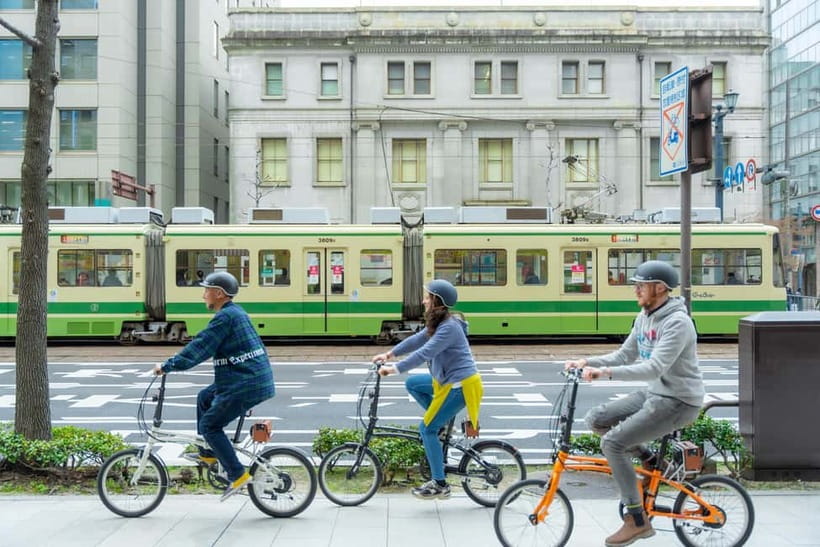
One especially distinctive subject is the A-bombed streetcar system. A tram survived the bombing and continues to operate today. Seeing the living transport network alongside the memorial sites creates a striking connection between Hiroshima’s past and present. It is not just an old object behind glass. It belongs to the working city.
The two-hour version is the better choice if you want a compact experience with a clear focus. The tradeoff is simple: you will see fewer locations than on the three-hour route, and the ride outside the central memorial area is more selective.
The three-hour route, from castle grounds to survivor trees
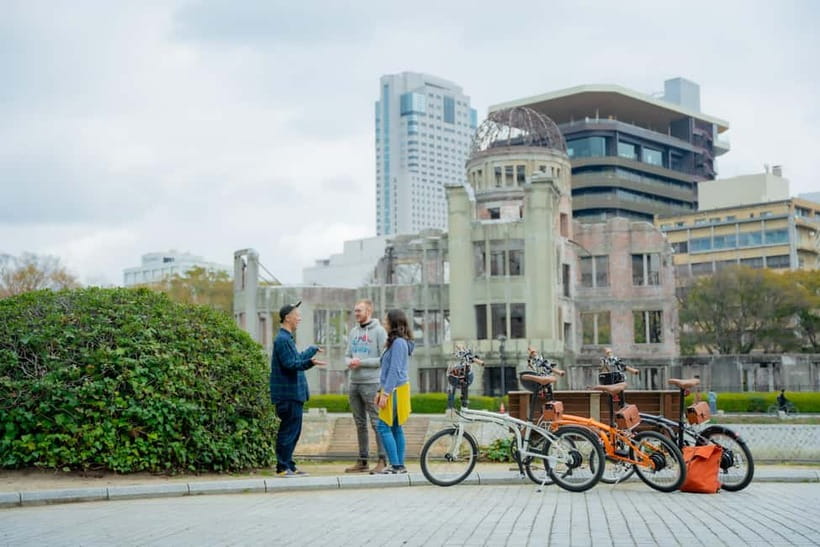
The longer course meets at 10:00 or 14:00 and finishes at 13:00 or 17:00. It makes a broad loop through central Hiroshima and includes many stops tied to the city’s prewar identity, wartime destruction, and recovery.
The route begins at Hiroshima Castle, followed by Hiroshima Gokoku Shrine and its shrine gate. These opening stops place the bombing story within the older city rather than treating 1945 as Hiroshima’s only history.
You then ride through Hiroshima Central Park toward Aioi Bridge. The bridge is especially important because it served as the intended aiming point for the atomic bomb. From there, the group reaches the Atomic Bomb Dome, where the guide explains both the building’s role before the bombing and its later place as a memorial.
Next come the Motoyasu River and Peace Bridge. Rivers are central to Hiroshima’s geography, and the route uses them to help you understand how the blast moved through the city and how residents later rebuilt around these waterways. The stops are short, but the sequence helps turn a map into a physical sense of distance.
The route continues to Higashisenda Park and the Hiroshima Red Cross Hospital. The hospital is one of the places connected with the medical response after the bombing. You may find this stop particularly useful because it shifts the story from monuments to the immediate work of treating the injured and caring for survivors.
The ride then reaches the Hiroshima Railway area and the historic tram connection. The tour also includes Miyuki Bridge and the Kobayashi River, followed by a surviving weeping willow tree. Natural objects can seem modest beside the Atomic Bomb Dome, but they give the story a different scale. A tree, bridge, or tram can show survival in a way that a large memorial cannot.
The final section includes Peace Boulevard before returning to the meeting point. The boulevard’s greenery and open space make the city’s recovery visible. Hiroshima is not preserved as a ruin. It is a functioning city, and the route asks you to hold both facts together: the enormity of the destruction and the ordinary life that followed.
The three-hour course is the stronger choice if you want a fuller historical circuit and have time for more stops. It may feel dense for young children or anyone who prefers a slow, unstructured ride. The tour can also adjust its pace when children or less confident cyclists are present, so the exact rhythm depends on the group.
More bike tours in Japan:
- Hidden Kyoto E-Biking tour
★ 5.0 · 1,843 reviews - Bike Tour Exploring North Kyoto plus Lunch
★ 5.0 · 1,087 reviews - Tokyo Great Cycling Tour
★ 5.0 · 811 reviews - Arashiyama Bamboo Forest & Hidden Gems Bike Tour (Early Bird)
★ 5.0 · 613 reviews
The guides are the heart of the tour
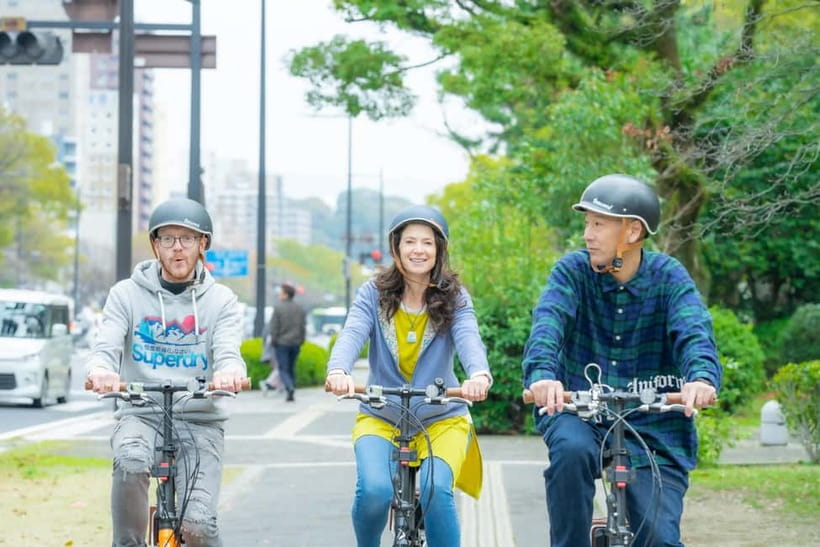
The bicycles make the route possible, but the guide determines how much you take away. The strongest part of this experience is the way local guides connect physical places with lived memory.
Shin is frequently praised for his energy, humor, clear English, and family connection to the bombing. His storytelling can make the subject feel personal without turning it into a performance. Kana is described as warm, passionate, and careful, with personal stories that bring monuments to life. Moe and Mai have also been praised for combining historical facts with thoughtful explanations of Hiroshima today.
Guide names may vary, and you cannot select a particular person from the information provided. That is worth knowing if you have read about a favorite guide. Still, the consistent pattern is clear: the tour depends on local staff who grew up in Hiroshima and can explain how the city remembers August 6 across generations.
I would expect the experience to be more conversational than a formal lecture. You can ask questions at the stops, and the three-hour schedule usually leaves some room for discussion. The guide also provides photo data taken during the day, which is useful when you want pictures of your group without relying only on phone selfies.
Electric bikes, traffic, and comfort
The adult electric bikes are for riders at least 145 centimeters tall. Children between 110 and 145 centimeters may use one of the limited children’s cross bikes, and children under 15 can use either children’s or adult bicycles at the child rate. Infants can ride free in a child seat, provided they meet the stated limit of under 22 kilograms and under 115 centimeters.
These child seats and children’s bicycles are limited. Contact the operator before booking if you need one. The experience is not suitable for anyone under 145 centimeters unless an appropriate child bicycle or seat has been arranged.
Several useful details deserve attention:
- Wear comfortable clothing and shoes.
- Bring water and a towel.
- High heels are not allowed.
- Expect outdoor riding in the weather of the day.
- Tall riders may find the adult bicycle small. One rider around 6 feet 1 inch found the frame compact.
- The group may slow down for children or people who are not used to cycling.
The bicycles are covered by insurance for bicycle accidents. That is reassuring, but it does not remove the need to ride carefully. Stay alert at crossings, follow the guide, and expect city streets rather than a fully separated cycle path for the entire route.
Is $52 good value?
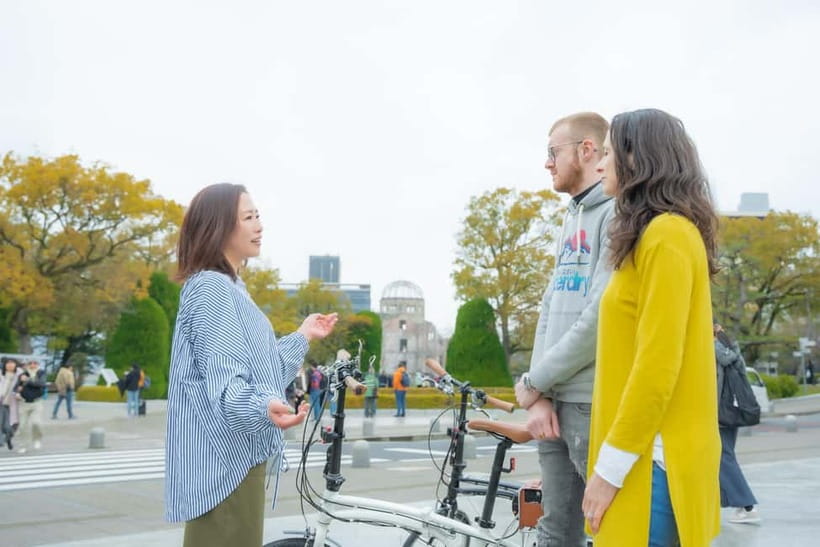
At $52 per person, the tour is reasonably priced for a two to three-hour guided experience that includes an electric bicycle, an English-speaking guide, and bicycle accident insurance. You are paying not only for transport between sights, but also for local interpretation and access to places that are easy to overlook.
The value is strongest if you have limited time. A walking tour could cover Peace Park well, but it would be harder to reach the suburban tram and river locations within the same period. A taxi or private tour would cover ground more quickly, but likely at a much higher total cost and without the shared small-group atmosphere.
Food and drinks are not included. Plan to eat before or after the ride, and bring water, especially from late spring through early autumn. The two-hour route leaves plenty of time for lunch, the Peace Memorial Museum, or another Hiroshima attraction. The three-hour route gives more history but takes a larger part of your day.
Free cancellation is available up to 24 hours before the start, and you can reserve now and pay later. Do not cut it close on arrival day. If you arrive late without prior notice, the tour can be cancelled with a full same-day charge.
Who should book this Hiroshima ride?
I would choose this tour if you want the major memorial sites explained by a local person, but also want to see how Hiroshima functions beyond the park. It suits solo visitors, couples, families with older children, and anyone who finds a moving bicycle ride more engaging than standing in one place.
It is also a good match for people who have only one day in Hiroshima. The bicycle covers ground efficiently, while the small group keeps the experience more personal than a large coach outing.
Think twice if you dislike cycling, struggle with city traffic, need a very slow walking pace, or want a general introduction to food, shopping, and modern Hiroshima. This is a history-focused ride. The city itself is part of the setting, but the atomic bombing and its legacy remain the subject throughout.
FAQ
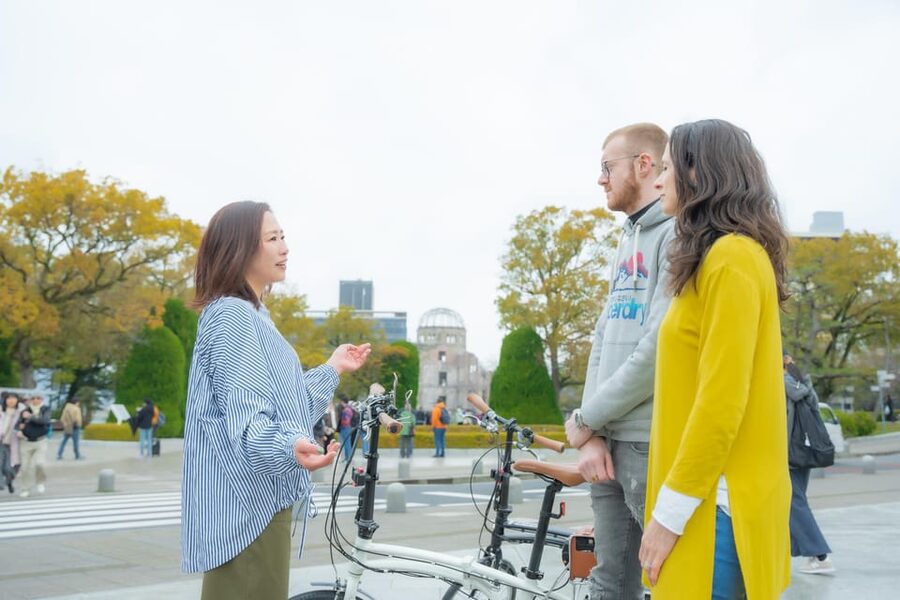
Where does the Hiroshima cycling tour meet?
It meets at the Rest House in Hiroshima Peace Park. From Hiroshima Station, take the Hiroshima Electric Railway tram to Atomic Bomb Dome Station, then walk about five minutes.
How long does the tour last?
You can choose a two-hour or three-hour course, depending on availability and the selected starting time.
What language is the tour conducted in?
The tour is conducted in English with a live English-speaking guide.
How many people can join?
It is a shared small-group tour with a maximum of 10 participants.
Does the tour include electric bicycles?
Yes. Bicycle rental is included, along with an English-speaking guide and insurance for bicycle accidents.
What height is required for an adult electric bicycle?
Adult electric bicycles are for people at least 145 centimeters tall.
Can children join the tour?
Children can join from age one. Limited child seats and children’s bicycles are available, with stated size and weight limits. Contact the operator before booking if you need this equipment.
What should I bring?
Bring comfortable shoes, comfortable clothing, drinks, and a towel. High-heeled shoes are not allowed.
What happens if I arrive late?
If you are late without contacting the operator first, the tour may be cancelled and the full same-day cancellation charge can apply.
Should you book it?
Book this tour if you want Hiroshima’s memorial sites connected to real streets, working trams, bridges, trees, hospitals, and family memories. The electric bike is comfortable, the route is efficient, and the local guides give the subject warmth as well as facts.
Choose the three-hour course if you want the fullest route and can handle a serious, concentrated history experience. Choose two hours if you need a sharper introduction or want time for the museum and other sights. Either way, bring water, arrive early, and be ready for a thoughtful ride through a city that remembers its destruction while continuing to live fully.
Latest bike tours added in Japan
- Private E-MTB guided cycling around Mt. Aso volcano & grasslands★ 5.0 · 16 reviews
- Tokyo: West-Side Cycling and Food Tour with Guide★ 5.0 · 37 reviews
- Tokyo: Private Cycling Tour with cute E-bike★ 5.0 · 11 reviews
- Tokyo Bay Area: Sunset Night View 3h E-bike Guided Bike Tour★ 5.0 · 11 reviews
- Tokyo: Hidden Gems Guided Bike Tour with Lunch★ 4.5 · 30 reviews
- Tokyo Bike Tour: Shibuya, Harajuku & Hidden Gems★ 5.0 · 20 reviews
- Tokyo: 3h Private E-bike Tours, Starting at Your Hotel★ 5.0 · 36 reviews
- Tokyo: 3-hour Guided E-Bike Tour of the City’s Hidden Gems★ 4.8 · 251 reviews
Japan Bike Tours, compared.
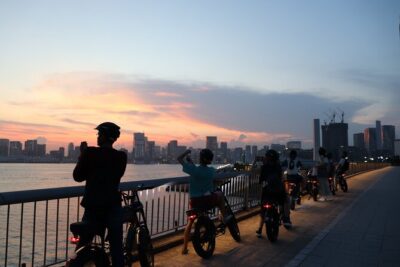

3h Tokyo E-Bike Tour: Hidden Gems, and Local Life with guide
Read our review →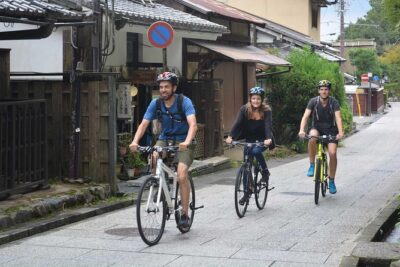
Arashiyama Bamboo Forest & Hidden Gems Bike Tour (Early Bird)
Read our review →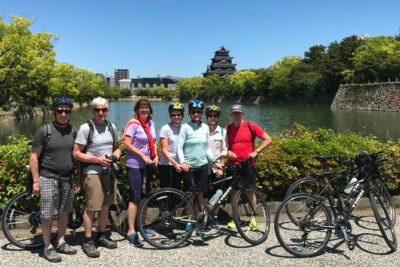
Hiroshima in a Nutshell: Morning Bike Adventure
Read our review →Browse the lists this tour appears in