
Review · BIKE TOURS WITH LUNCH
Bike Tour Exploring North Kyoto plus Lunch
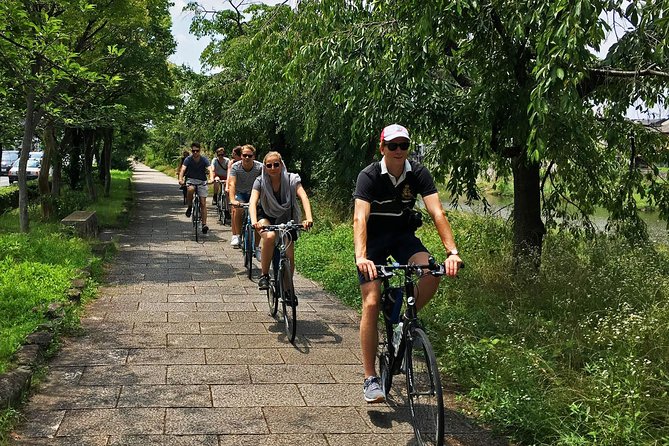
Kyoto makes more sense from a bicycle seat than through a bus window. This small-group ride links major sights with quiet streets, back alleys, and local corners, giving you a feel for how the city fits together. I especially like the stop at Nishi Honganji, which many visitors skip, and the way the guides, including Mayko, Julian, Quinn, Indra, and Jay, bring Buddhist and Shinto traditions to life.
I also like that lunch is included and that the route is paced with regular stops. The main consideration is physical: you may cycle about 13 miles, or 24 kilometers, over roughly six hours. The pace is manageable for many people, but heat, traffic, and a slight climb toward Kinkakuji can make the day feel more active than the polished tour description suggests.
Why this Kyoto bike tour earns its strong reputation
- A useful first-day orientation: You cover several major sights and learn where different parts of Kyoto sit.
- A small group of up to eight: Guides can adjust speed, answer questions, and keep an eye on the group.
- A route with both famous and overlooked stops: Nishi Honganji adds depth, while Kinkakuji supplies the postcard moment.
- Japanese lunch included: Meals have included noodles, sushi, and food at a centuries-old restaurant.
- Comfortable equipment provided: The tour supplies a high-quality Cannondale bike, bottled water, and cycling gear.
- A steady but active outing: The ride is mostly easy to moderate, with breaks and sightseeing woven into the route.
Riding North Kyoto instead of sitting on a bus
The best reason to book this outing is simple: Kyoto’s scale becomes clear when you travel through it under your own power. You pass from temple districts to ordinary streets, see small neighborhood details between the big sights, and avoid spending the day stuck in traffic.
The group is capped at eight people. That matters here. A guide can set a pace that works for the group, pause for questions, and make sure nobody gets stranded at a crossing. Quinn, Jay, Indra, Karl, Julian, and Mayko are among the guides associated with the experience, and the strongest praise consistently centers on their storytelling, warmth, and care with road safety.
You meet at Cycle Kyoto, 7 Higashikujō Nishisannōchō, at 10:00 a.m. The staff fits you to a Cannondale bike, explains the day, and supplies bottled water. Helmets are available, according to the tour information shared by participants, and bikes can be matched to rider height with extra seat padding.
The actual cycling has been described as about 2.5 hours, with the rest of the five to six hours given to temple visits, explanations, lunch, photographs, and short rests. That is a useful distinction. This is not a race or a pure cycling workout. It is a sightseeing day with a substantial ride threaded through it.
More Bike Tours with Lunch in Japan
- 4.5-Hour Kyoto Bike Tour with Lunch and UNESCO Zen Temples
★ 5.0 · 122 reviews - Kyoto: Full-Day City Highlights Bike Tour with Light Lunch
★ 5.0 · 52 reviews - Kyoto: Early Bird E-Bike Tour with Lunch
★ 5.0 · 14 reviews
Nishi Honganji gives the morning real substance
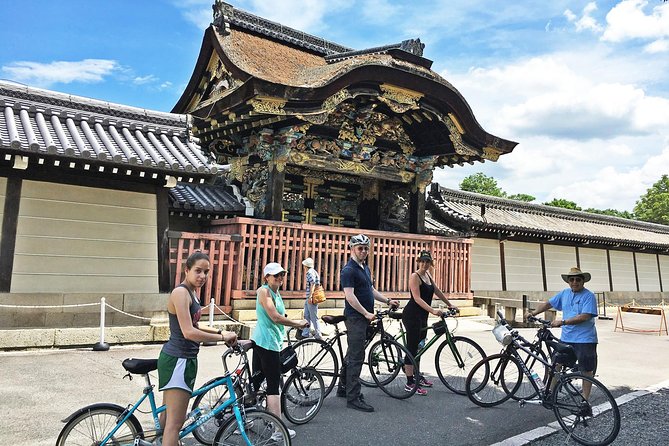
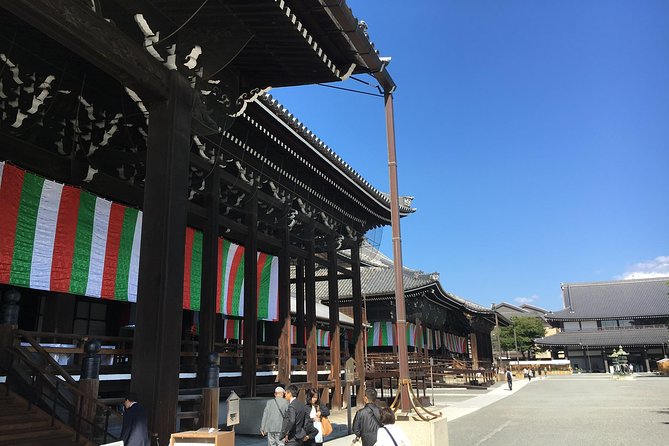
Nishi Honganji is an excellent opening stop because it is important without being as crowded as Kyoto’s best-known attractions. You enter one of the city’s major Buddhist temple compounds and see one of Japan’s largest wooden buildings.
The scale is the first thing to notice. The great wooden structures feel broad and calm, and the visit gives your guide room to explain how Buddhist institutions shaped Kyoto. You also get a chance to look closely at repairs and visible mending on the old buildings, details that can be easy to miss if you only stop for a quick photograph.
The scheduled visit is about 15 minutes, so do not expect a long, private temple study. Still, it is a smart choice early in the day. The site provides cultural context before the route reaches the more famous shrine and pavilion stops.
Kitano Tenmangu brings you close to everyday shrine life
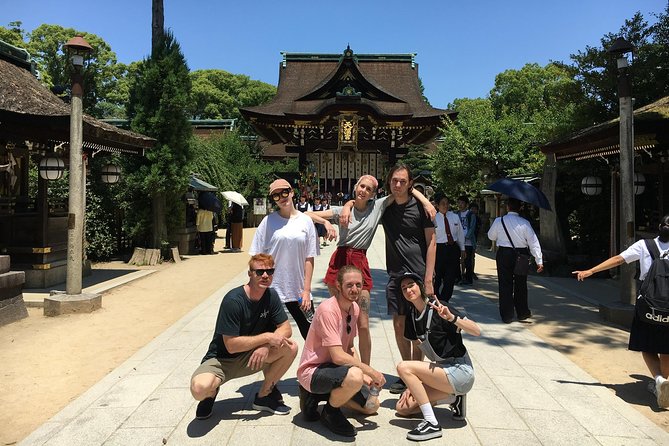
At Kitano Tenmangu, the experience shifts from grand Buddhist architecture to a Shinto shrine with a strong local presence. You spend about 20 minutes here, joining people who come to pray and enjoy the grounds.
This is where a good guide makes a large difference. A bare visit might leave you with a gate, a few buildings, and a quick photo. A guide can explain the shrine’s past, how Shinto practice differs from Buddhism, and how those traditions still shape daily life in Japan. Indra has been praised for explaining these religious differences in clear terms, while other guides have added practical details about etiquette and current customs.
The stop is also a good reminder that Kyoto is not a museum set aside for tourists. People use its shrines and temples for personal reasons, seasonal rituals, and ordinary moments of quiet. You will have time to take in the atmosphere, but the schedule keeps the group moving.
Kinkakuji is famous for a reason
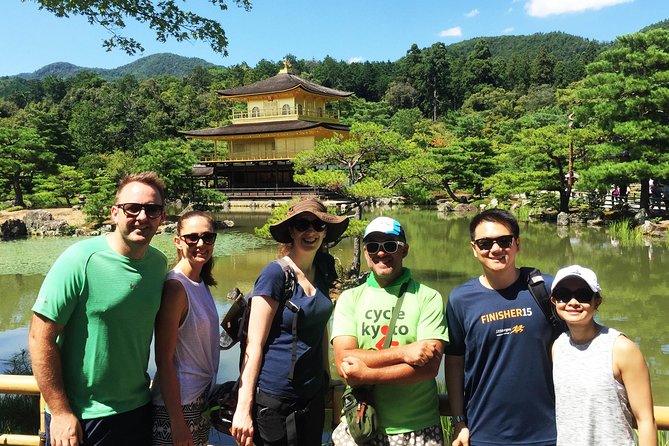
Kinkakuji, the Golden Pavilion, is the visual high point of the route. This is one of Japan’s most visited sights, and the pavilion’s bright reflection on the pond earns its fame.
You spend about 30 minutes here, including the temple entrance fee. Your guide provides commentary, then you have time to look around, take photographs, or stop for an ice cream. That small pause matters. Kinkakuji can be crowded, and a little personal time keeps the visit from feeling like a rushed march from gate to gate.
There is a practical catch: the ride toward Kinkakuji includes a slight incline. It is not described as a major hill, and the route is generally considered manageable, but this is the point where you may notice the effort. Afterward, much of the route feels easier, with one participant describing the ride as mostly downhill from there.
Kinkakuji is also the most likely place for crowds. The bicycle lets you arrive as part of a planned route, but it cannot remove the congestion around a famous monument. Enjoy the pavilion, listen to the explanation, and do not judge the whole day by the busiest stop.
More Bike Tours with Lunch in Kyoto:
- Versailles Full Day Bike Tour with Palace, Gardens, & Picnic
★ 5.0 · 2,217 reviews - From Paris: Versailles Bike Tour w/ Palace, Gardens, & Picnic
★ 5.0 · 2,150 reviews - Electric Cycling Tour of Ubud with Free Hotel Transfer and Lunch
★ 5.0 · 1,397 reviews - Bangkok: Bike and Canal Boat Tour with Lunch
★ 4.9 · 1,350 reviews
Former imperial grounds add a quieter change of pace
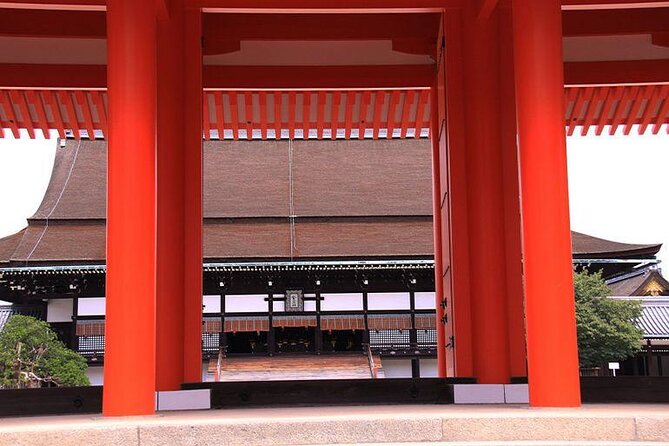
The route continues through the grounds of the former seat of Japan’s imperial family. The supplied schedule does not give the site a formal name or a fixed visit length, but the stop adds useful variety after Kinkakuji.
Here, your guide can connect Kyoto’s religious buildings with its political past. That broader frame helps you understand why Kyoto contains so many layers of Japanese culture in a relatively compact area. You are not seeing isolated attractions. You are moving through a former imperial capital where religion, government, craft, and daily life developed side by side.
This part of the ride also provides a break from the intensity of the Golden Pavilion. You can enjoy the grounds and the ride itself instead of collecting one major sight after another.
Lunch is part of the experience, not just a fuel stop
Lunch is included, and it is one of the tour’s strongest practical advantages. The exact restaurant can vary. Meals have included a noodle restaurant with roughly 400 years of history and a sushi bar when the planned noodle house was closed.
That flexibility is useful. You are not locked into a single venue if circumstances change, and the meal remains part of the cultural experience rather than an afterthought. Sushi, noodles, and other Japanese food can be easier to enjoy when your guide explains what you are ordering or helps the group settle in.
Dietary needs must be given in advance. Extra drinks are not included, so budget for anything beyond the supplied bottled water. On a hot day, you will want to pay attention to hydration. Quinn has been especially careful about keeping groups supplied with water and comfortable in high temperatures.
The lunch break also resets the day. You have been riding and standing at temples, so a proper meal gives you time to sit, talk, and recover before the final part of the route.
Gion offers a brief look at Kyoto’s geisha district
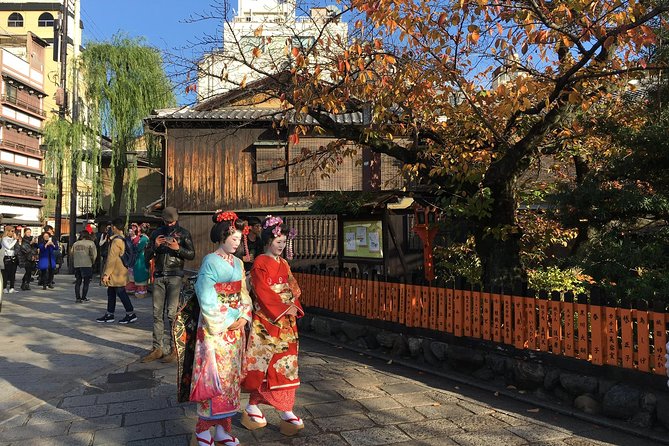
The tour ends its sightseeing route with a short stop in Gion, Kyoto’s famous geisha district. The scheduled visit is about 10 minutes, so think of it as an introduction rather than a full walking tour.
Your guide explains the character of this traditional entertainment district and the role of geisha and maiko. You might catch a glimpse of one moving between appointments, but there is no guarantee, and it is important to treat anyone you see with respect. This is a working neighborhood, not a performance stage.
Gion works well at the end because it leaves you with a different side of Kyoto. After temples, shrines, and imperial grounds, you see streets tied to tea houses, traditional arts, and formal hospitality. The stop is brief, but it can help you decide if you want to return later for a slower walk.
The activity finishes back at the Cycle Kyoto meeting point. That makes the start and end straightforward, though you should allow time to reach the shop before the 10:00 a.m. departure.
What the ride feels like over six hours
You need to be comfortable riding a bike and have a moderate level of physical fitness. The tour requires riders to be at least 13 years old. One family described the ride as suitable for teenagers and steady rather than difficult, while another found it harder than expected but still worthwhile.
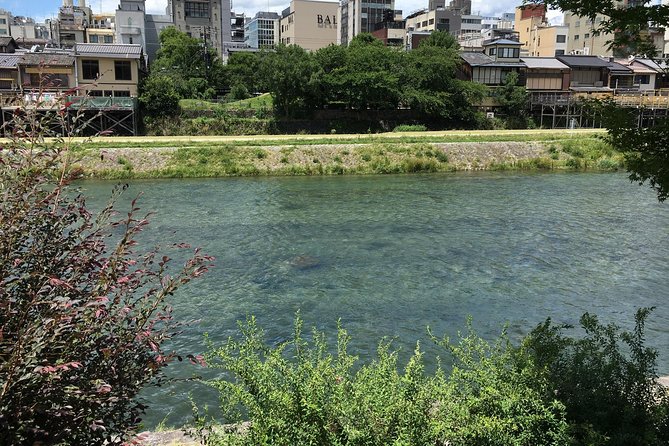
The key word is steady. The ride is spread across a full sightseeing day, with frequent stops and breaks. You are not pedaling continuously for six hours. Still, 13 miles or 24 kilometers is meaningful distance, especially in Kyoto’s heat or humidity.
I would book this for someone who rides occasionally and can remain alert around city streets. You do not need to be a serious cyclist, but you should not choose it if you dislike bike riding or tire easily after several hours out. The guide can adjust speed and route to the group’s ability, which helps, but basic comfort on a bicycle is still required.
Weather matters. The experience needs good conditions, and rain can lead to a rescheduled date or a full refund. If your Kyoto schedule allows, booking this near the start of your stay gives you more room to move the outing if the forecast turns bad.
The value of the $106.12 price
At $106.12 per person, this is not the cheapest way to see Kyoto. You could visit many of the same areas by train, bus, or on your own for less money. The price makes more sense when you count the bike, equipment, bottled water, guide, temple entrance fee for Kinkakuji, lunch, and the planning needed to connect these places efficiently.
The guide is the real value. You are paying for explanations that link Shinto, Buddhism, imperial Kyoto, and the geisha district, as well as for a route that avoids the usual problem of spending half the day figuring out directions. Guides such as Mayko, Julian, Quinn, Indra, Karl, and Jay have been praised for making the day personal, answering detailed questions, and adjusting the pace.
The 99 percent recommendation rate and 4.9 rating from 1,087 reviews suggest unusually steady satisfaction, but the price still depends on how you travel. If you want independent wandering, a slow temple visit, or total control over meals, this may feel too structured. If you want a strong first look at Kyoto and prefer active sightseeing, the cost is reasonable.
Who should book this ride
I would choose this tour for:
- First-time Kyoto visitors who want a clear orientation.
- Active couples, families with riders aged 13 and older, and solo visitors who like a social setting.
- People who want famous sights without spending the day on buses.
- Anyone interested in how Buddhist, Shinto, imperial, and entertainment traditions connect.
- Visitors who value a guide’s local advice for the rest of their Kyoto stay.
I would think twice if you have a knee problem, dislike urban cycling, cannot ride comfortably, or want long, unhurried visits at each temple. The schedule covers a lot, so each stop is an introduction rather than an exhaustive exploration.
Should you book the North Kyoto bike tour?
Book it if you want to cover a large slice of Kyoto in one active day, with a small group, a meal, and a guide who can explain what you are seeing. The route is especially useful on your first full day because it helps you locate major districts and decide where to return later.
Skip it if your ideal Kyoto day means moving slowly, avoiding exercise, or spending hours at one temple. For everyone else, this is a well-priced way to see both the postcard sights and the ordinary streets between them. Pack comfortable clothing, allow for heat, give dietary needs in advance, and leave room in your itinerary in case weather requires a change.
FAQ
How long does the Bike Tour Exploring North Kyoto plus Lunch last?
The tour lasts approximately five to six hours. It begins at 10:00 a.m. and ends back at the Cycle Kyoto meeting point.
Where does the tour start?
You meet at Cycle Kyoto, 7 Higashikujō Nishisannōchō, Minami Ward, Kyoto, 601-8003, Japan. The location is near public transportation.
What is included in the price?
The price includes a high-quality Cannondale bike, cycling equipment, guide service, bottled water, lunch, and the Kinkakuji Temple entrance fee. Extra drinks and optional gratuities are not included.
How much cycling is involved?
The cycling portion has been described as about 13 miles, or 24 kilometers, with roughly 2.5 hours spent riding. The day also includes sightseeing stops, lunch, and breaks.
Can children join the tour?
Riders must be at least 13 years old and comfortable riding a bike. The activity requires a moderate level of physical fitness.
What happens if it rains or I need to cancel?
You can cancel at least 24 hours before the local start time for a full refund. The tour requires good weather, so if the operator cancels because of poor conditions or because the minimum number of participants is not reached, you will be offered another date or experience, or a full refund.
More lunch stops in Kyoto
- Cat Ba: Lan Ha, HaLong bay full day- biking, kayaking, lunch
★ 4.8 · 1,166 reviews - Electric Bike Beach Adventure with Tequila Tasting and Lunch
★ 5.0 · 1,162 reviews - Appian Way Aqueducts Bike Tour (Catacombs & Lunch Option)
★ 5.0 · 975 reviews - Saint-Emilion Electric Bike Day Tour with Wine Tastings & Lunch
★ 5.0 · 696 reviews
Latest bike tours added in Kyoto
- Kyoto: City Secrets eBike Tour★ 4.9 · 196 reviews
- Best of Kyoto: Ginkakuji & Path of Philosophy E-Bike Tour★ 4.9 · 79 reviews
- Kyoto: Hidden Gems E-Bike Tour Through Backstreets & Temples★ 4.9 · 54 reviews
- Kyoto: Tailored E-Bike Tour to Highlights & Hidden Gems★ 4.9 · 32 reviews
- Kyoto: Hidden Gems E-Bike Tour with Local Japanese Guide★ 4.9 · 189 reviews
- Kyoto: Half-day Guided Bike Tour with Fushimi Inari★ 4.9 · 21 reviews
- Kyoto: Full Day Bike Tour★ 4.9 · 39 reviews
- Kyoto: Early Bird E-Bike Tour with Lunch★ 5.0 · 14 reviews
Bike Tours with Lunch, compared.

Versailles Full Day Bike Tour with Palace, Gardens, & Picnic
Read our review →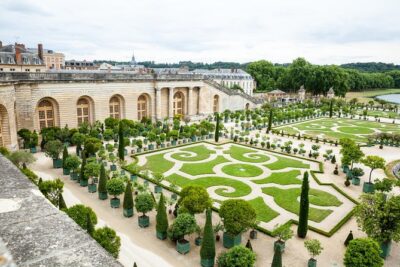
Versailles Bike Tour w/ Palace, Gardens, & Picnic
Read our review →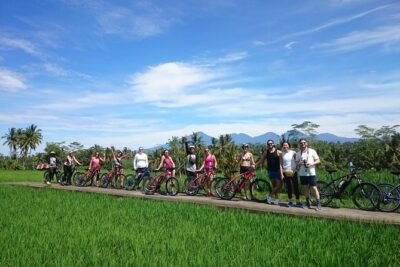
Electric Cycling Tour of Ubud with Free Hotel Transfer and Lunch
Read our review →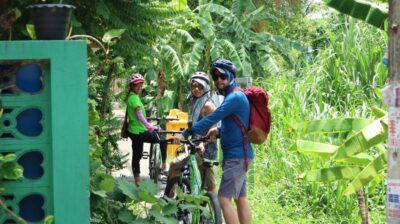
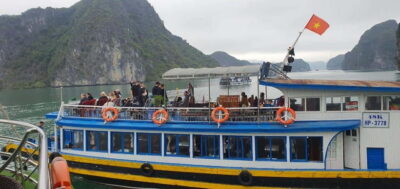
Cat Ba: Lan Ha, HaLong bay full day- biking, kayaking, lunch
Read our review →
Electric Bike Beach Adventure with Tequila Tasting and Lunch
Read our review →
Appian Way Aqueducts Bike Tour (Catacombs & Lunch Option)
Read our review →
Appian Way E-Bike Tour Catacombs, Aqueducts & Picnic
Read our review →Browse the lists this tour appears in