
Review · FOOD & MARKET BIKE TOURS
Eat, Drink & Cycle: Osaka Foodie Bike Tour
Osaka’s best food often comes in small, casual places, and this tour gives you a practical way to reach several of them. You pedal through Shinsekai, stop at Shitennoji Temple, explore Tsuruhashi Market, taste wagyu, and finish with sushi and kushikatsu. The ride breaks up the eating, so you can cover more ground than you would on foot.
I like the small group of up to seven, which gives guides such as Erik, Mako, Peter, Matt, and Maiko room to answer questions and adjust the pace. I also like the mix of local food and city sights, from street snacks to one of Japan’s oldest temples.
The main thing to consider is the price, about $99.49 per person. That is fair if you value the guide, bike, tastings, and time saved, but it may feel high if you expect a long market crawl or a large number of full meals. The exact food stops can vary, and one account described only two main eating locations.
Key points to know before you book
- Three and a half hours on two wheels: You cover South Osaka faster than on foot, with a relaxed route described as mostly flat.
- Food comes in stages: Expect three or four food stops or tastings, including regional snacks, wagyu, sushi, and kushikatsu.
- Tsuruhashi is a major stop: You spend about 40 to 60 minutes in the market, meeting stall holders and trying small bites.
- The group stays small: A maximum of seven people makes it easier to talk with your guide and ask for restaurant advice.
- E-bikes may be possible: Some older riders requested e-bikes and found the route easy, but you should ask in advance rather than assume one will be available.
- The route needs basic fitness: You must be at least 140 centimeters tall, and children aged 12 and under are not recommended.
Why a bike is useful for Osaka food touring
Osaka is a city where eating and getting around are closely linked. A noodle shop, market stall, temple, and neighborhood restaurant may all be a short train ride apart, but public transit does not always make those small hops convenient. A bicycle lets you connect them directly.
The route is described as mostly flat, and the ride is not meant to be a race. You cycle between stops, with food and short sightseeing breaks providing a natural rhythm. Several guides have been praised for keeping the day relaxed rather than turning it into hard exercise.
You still need to be comfortable riding in a city. The tour requires a moderate fitness level, and the route includes ordinary Osaka streets. Bikes and helmets are supplied, with several sizes available. Riders who are unsure about hills or stamina can ask about an e-bike before booking.
That question matters because the tour is best when you can focus on the food and surroundings, not on keeping up. One older couple requested e-bikes and found the outing easy. That is useful advice, but availability is not guaranteed in the details provided, so contact the provider early.
More Food Bike Tours in Japan:
- Tokyo: West-Side Cycling and Food Tour with Guide
★ 5.0 · 37 reviews - Versailles Palace Bike Tour with Market & Marie-Antoinette hamlet
★ 5.0 · 2,680 reviews - Madrid: 3 h. Guided Highlights Bike Tour with Optional Tapas
★ 4.9 · 1,623 reviews
Starting in Shinsekai with a first Osaka bite
The published details give two different meeting instructions: one describes meeting beneath Tsutenkaku Tower at 9:30 a.m., while the practical booking information lists 1-chōme-10-7 Tenma, Kita Ward, with a 10:30 a.m. start. You should confirm the exact meeting point and time after booking. Do not simply rely on the general description.
The tour then heads to the bike storage facility for a quick fitting. This is a useful first step. A poor saddle height can make even a flat ride uncomfortable, especially when you are stopping and starting through city streets.
The first food stop is in Shinsekai, one of South Osaka’s most recognizable old entertainment districts. Depending on the group’s tastes, the opening bite may be oden, tofu, or doteyaki. These choices give you a better start than jumping straight into a familiar dish such as sushi.
Oden is a Japanese comfort food of simmered ingredients served in broth. Doteyaki is associated with Osaka and uses beef tendon cooked in a miso-based sauce. Tofu offers a lighter option. Since the exact choice depends on the group, tell your guide about allergies, dislikes, or dietary limits at the beginning.
Shinsekai is also a good place to hear how food fits into Osaka life. The area is not presented as a polished restaurant district. It is a working neighborhood with casual eateries, old signs, and a local feel. The tour’s strength is that the guide provides the context while you are actually eating.
Shitennoji Temple adds a welcome pause
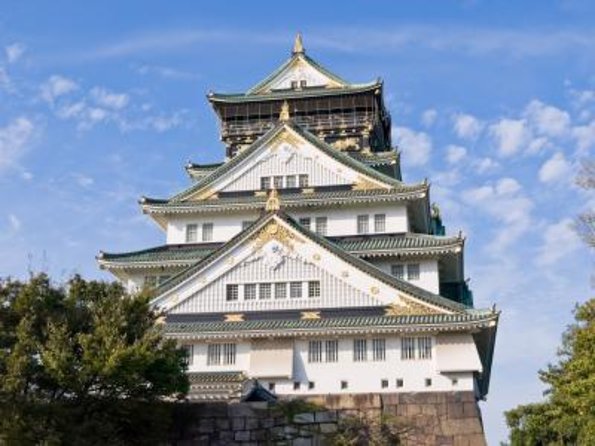
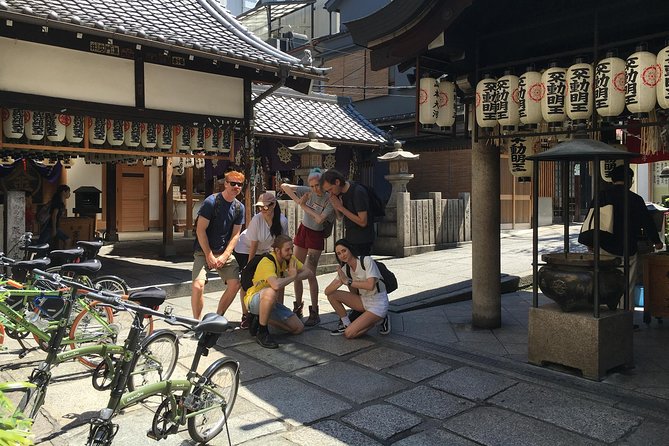
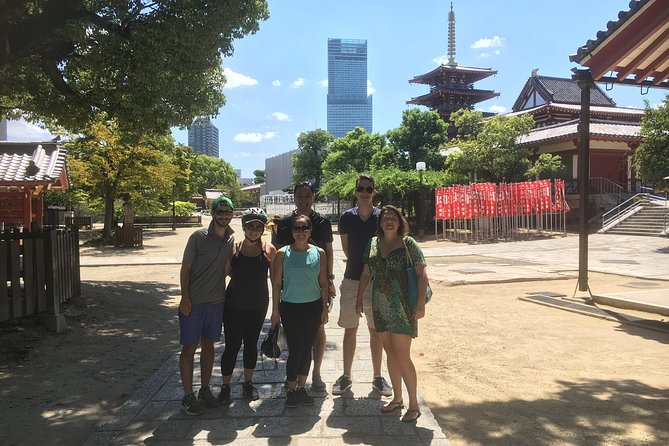
After Shinsekai, you ride toward Shitennoji, described as Japan’s oldest temple. The stop is short, with time for photos and an explanation of the area.
This is not a full temple tour, and that is worth understanding. You will not spend hours examining every building or detail. Instead, Shitennoji gives the food tour a cultural pause and helps you place Osaka’s neighborhoods in a longer story.
The ride down the slope afterward is one of the small pleasures of the route. You get a change of pace after the first tasting, and the temple stop keeps the outing from feeling like a meal crawl with bicycles attached.
Guides have been singled out for sharing bits of local culture and history in a natural way. Names attached to the experience include Erik, Mako, Peter, Matt, Maiko, Mayco, Akira, Yuki, and Danyk. The guide you receive will vary, but the strongest accounts describe friendly hosts who explain dishes, point out places to eat later, and take photos when appropriate.
Tsuruhashi Market is the tour’s main food window
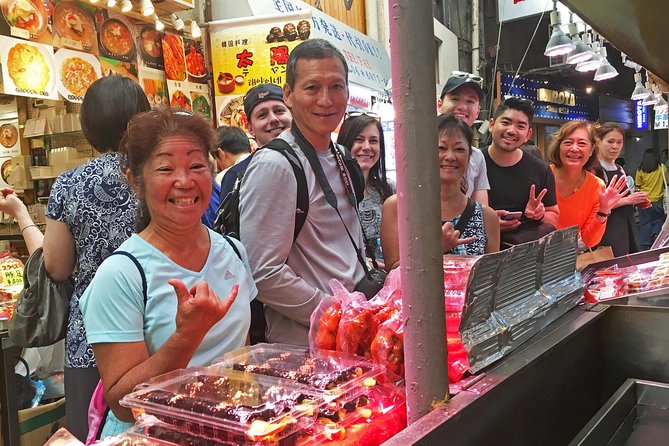
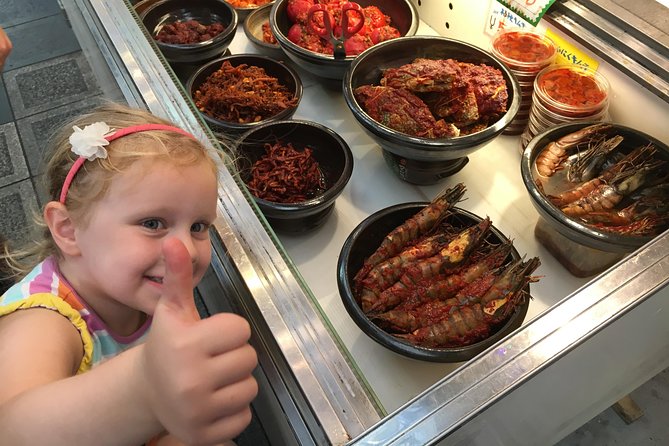
The route continues to Tsuruhashi Market, where the group spends about 40 to 60 minutes. This is the part I would value most if you want to see how Osaka’s food culture works at street level.
You meet local stall holders and sample a range of market snacks. Tsuruhashi is also linked with Osaka’s Korean community, and some versions of the experience include Korean dishes alongside Japanese specialties. That mix gives you a broader view of the city than a narrow list of famous Osaka foods.
The market stop is not a free-for-all period in which you independently buy whatever catches your eye. Your guide leads the group and organizes the tastings. That structure helps if you are new to Japan and do not know what to order, but it also means the experience will not feel like an unlimited market lunch.
Food portions are intended as tastings, not separate restaurant meals. Still, the stops add up. Some people finish pleasantly full, while others describe being completely stuffed. If you plan a large dinner soon afterward, keep that in mind.
This is also where expectations need managing. The tour description promises several stops, but one account found that the day centered on two main locations. The number and size of tastings can vary with the group, the shops open that day, and the guide’s route.
More bike tours in Japan:
- Hidden Kyoto E-Biking tour
★ 5.0 · 1,843 reviews - Tokyo Guided Small-Group Biking Tour
★ 5.0 · 1,250 reviews - Bike Tour Exploring North Kyoto plus Lunch
★ 5.0 · 1,087 reviews - Tokyo Great Cycling Tour
★ 5.0 · 811 reviews
Wagyu gives the middle of the tour a sit-down break
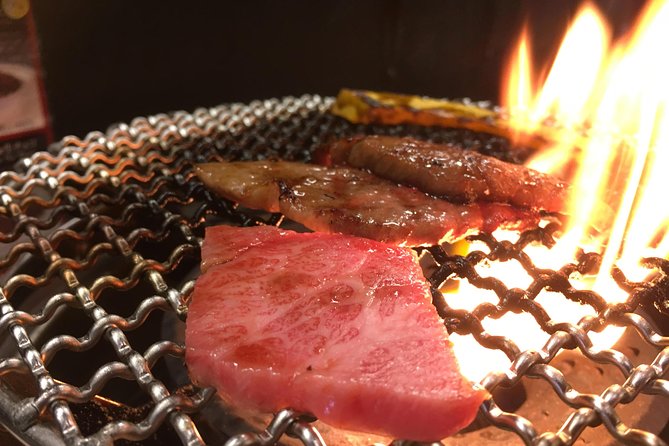
After the market, you stop for a wagyu beef tasting. This is a useful change from standing at stalls and eating small bites. You get to sit down, slow the pace, and try a more substantial Japanese specialty.
The supplied details do not specify the cut, portion size, or exact restaurant, so you should not book this expecting a full yakiniku meal. Some guides have made a point of choosing high-quality meat stops, and one guide was praised for selecting a particularly good yakiniku restaurant. Still, the experience is framed as a taster.
That distinction helps explain the price. You are paying for several guided tastings, but not necessarily for the same amount of food you would receive during a $99 restaurant dinner. Part of the value lies in the route, the introductions, and the time saved finding these places yourself.
Tower Knives puts a hands-on stop between meals
After wagyu, you ride to Tower Knives. Here you get to try your hand with knife skills, described as a chance to handle Osaka’s sharpest export.
This is a welcome change because a food tour can become repetitive when every stop involves sitting down and eating. The knife activity gives you something to do and connects the city’s culinary identity with one of its practical crafts.
The available information does not spell out how long the demonstration lasts or exactly what technique you practice. Think of it as a short hands-on interlude, not a full cooking class. If you have an interest in Japanese kitchen tools, this may be one of the more memorable stops.
Sushi and kushikatsu finish the route
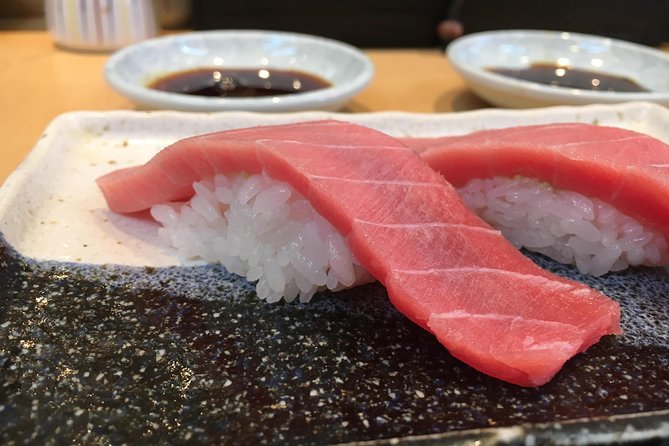
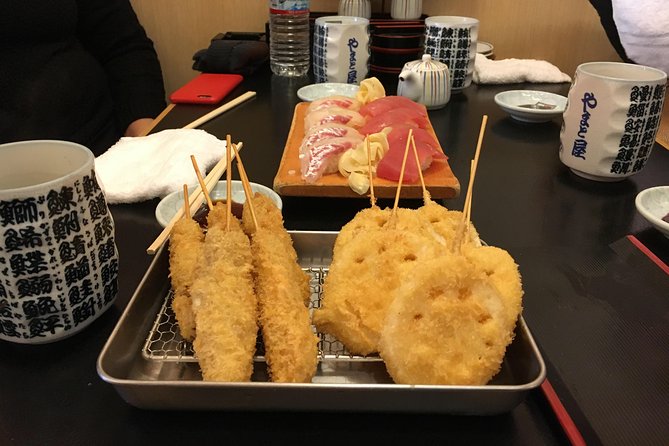
The final food stop is a locally run sushi shop. Your guide recommends a set of nigiri rolls, and assorted kushikatsu skewers are brought in from next door.
That pairing gives you two very different Osaka experiences. Nigiri is neat, simple, and focused on the fish and rice. Kushikatsu is more casual and indulgent, with skewered, breaded, fried foods. Ending with both makes sense for a tour that aims to show variety rather than one single style of cooking.
The route then takes only about two minutes to return to base. You drop off the bikes and are free for the afternoon. That timing is useful if you want to continue sightseeing, shop, or keep exploring Osaka’s food scene using the suggestions your guide has given you.
Several guides have been especially helpful with restaurant recommendations beyond the tour. I would treat this as a major benefit. A good food guide can save you from spending the rest of your trip in places chosen only because they are easy to find online.
What the $99.49 price really covers
At $99.49 per person, this is not the cheapest way to sample Osaka. You could spend less by eating at casual shops on your own. The question is what you want your money to do.
The fee includes the bicycle, helmet, English-speaking guide, bottled water, and food at three or four eateries. It also buys a planned route through several districts, a bike fitting, local explanations, and introductions to foods you might pass by without recognizing.
I see the strongest value in the first few days of an Osaka stay. You quickly learn what you like, gather restaurant ideas, and get a feel for several neighborhoods without spending time working out the route. It can also be useful if you have only a short visit and want sightseeing and lunch handled together.
The value is weaker if you are already an experienced Osaka food explorer, dislike organized group activities, or expect a full restaurant meal at every stop. The food portions are tastings, and the exact mix can change. One account found the experience too expensive for the number of locations visited, so keep your expectations focused on access and guidance rather than quantity alone.
Who will enjoy this Osaka bike tour
I would recommend it most strongly to adults and older teenagers who enjoy trying unfamiliar foods and can ride comfortably for several hours. It suits people who want a local introduction without committing to a full-day excursion.
It is also a good fit for couples and small groups. The maximum of seven keeps the experience more personal than a large bus-style food tour. Guides can answer questions, adjust the pace when possible, and offer suggestions for the rest of your stay.
Families need to read the age and height limits carefully. Children aged 12 and under are not recommended, and riders under 140 centimeters cannot take part. Everyone should have a moderate fitness level.
Weather matters too. The experience requires good weather and may be rescheduled or refunded if conditions are poor. Bring rain protection if the forecast is uncertain. One outing went ahead in rain with a poncho and still included food, views, and history, but cycling is plainly more comfortable in dry weather.
Cancellation is free up to 24 hours before the start for a full refund. Changes or cancellations inside that window are not accepted for a refund. The tour can also be canceled if it does not reach its minimum number, with a different date, another experience, or a full refund offered.
Should you book Eat, Drink & Cycle?
Book it if you want a guided first taste of Osaka, prefer moving between neighborhoods by bicycle, and value local food advice as much as the food itself. The combination of Shinsekai, Shitennoji, Tsuruhashi Market, wagyu, knife skills, sushi, and kushikatsu gives you a lively three-and-a-half-hour introduction.
Skip it if you want a long, unstructured market crawl, large portions, or the freedom to choose every dish yourself. At nearly $100, the tour earns its price through the guide, route, tastings, and time saved. It does not promise an unlimited feast.
Before booking, confirm the meeting address and start time, ask about e-bikes if needed, and tell the guide about food restrictions. If those details fit your plans, this is a smart way to get your bearings, eat broadly, and leave with a short list of places to try on your own.
FAQ
How long does the Osaka Foodie Bike Tour last?
The tour lasts approximately 3 hours and 30 minutes and ends back at the meeting point.
What food is included?
Included tastings may include oden, tofu, doteyaki, market snacks, wagyu beef, nigiri sushi, and kushikatsu skewers. The exact food selection can depend on the group and the day.
How many people can join the tour?
The maximum group size is seven travelers.
Are bicycles and helmets provided?
Yes. The tour includes use of a bicycle and safety helmet. Several bike sizes are available, and e-bikes may be requested.
Is the tour suitable for children?
Children aged 12 and under are not recommended, and riders under 140 centimeters cannot participate. Participants should have a moderate fitness level.
What happens if the weather is bad?
The tour requires good weather. If the provider cancels because of poor conditions, you will be offered another date or a full refund.
Latest bike tours added in Japan
- Private E-MTB guided cycling around Mt. Aso volcano & grasslands★ 5.0 · 16 reviews
- Tokyo: West-Side Cycling and Food Tour with Guide★ 5.0 · 37 reviews
- Tokyo: Private Cycling Tour with cute E-bike★ 5.0 · 11 reviews
- Tokyo Bay Area: Sunset Night View 3h E-bike Guided Bike Tour★ 5.0 · 11 reviews
- Tokyo: Hidden Gems Guided Bike Tour with Lunch★ 4.5 · 30 reviews
- Tokyo Bike Tour: Shibuya, Harajuku & Hidden Gems★ 5.0 · 20 reviews
- Tokyo: 3h Private E-bike Tours, Starting at Your Hotel★ 5.0 · 36 reviews
- Tokyo: 3-hour Guided E-Bike Tour of the City’s Hidden Gems★ 4.8 · 251 reviews
Food & Market Bike Tours, compared.

Versailles Palace Bike Tour with Market & Marie-Antoinette hamlet
Read our review →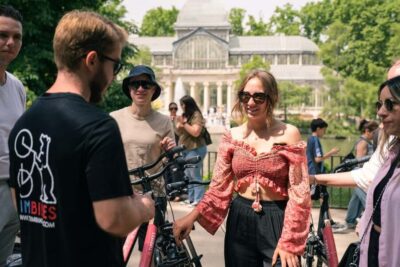
3 h. Guided Highlights Bike Tour with Optional Tapas
Read our review →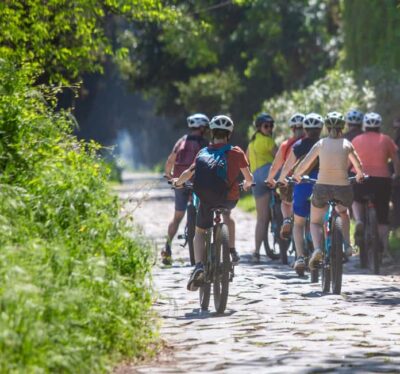
Appian Way & Aqueducts E-Bike Tour (Catacombs & Food)
Read our review →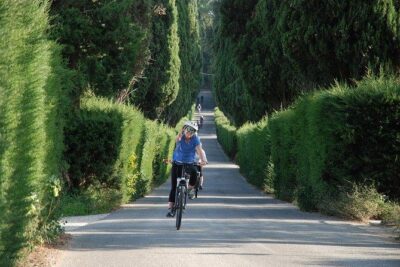
Tuscany Bike Tours Through the Chianti Hills with Wine Tasting
Read our review →
Rome by Night – Ebike Small Group Tour – Food and Wine (Option)
Read our review →
Rome by Night: E-bike Small Group Tour -Food & Wine (Option)
Read our review →
Electric Bike Beach Adventure with Tequila Tasting and Lunch
Read our review →
Versailles Bike Tour with Market, Gardens & Guided Palace Tour
Read our review →Browse the lists this tour appears in