
Review · E-BIKE TOURS
Appia Antica & Aqueducts e-Bike Tour – Official Provider
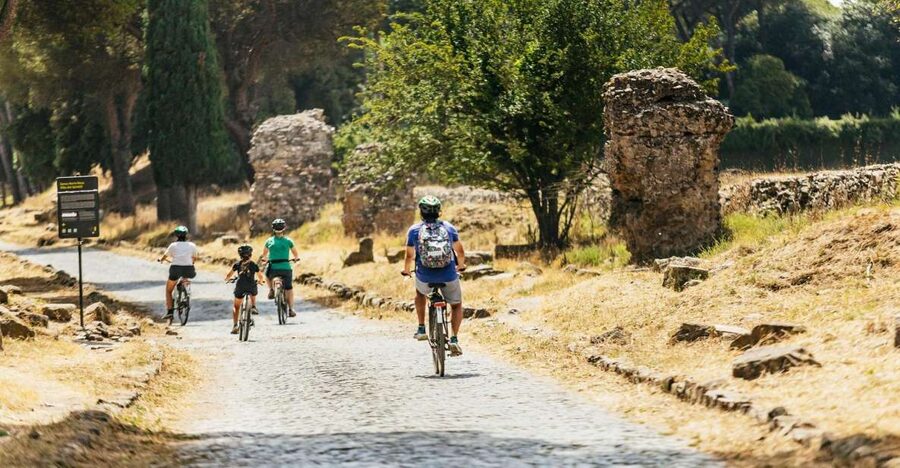
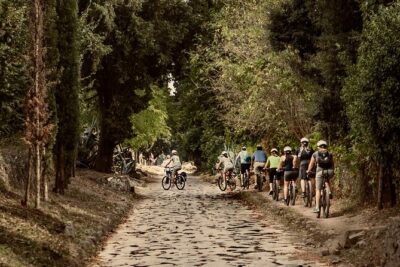
Rome’s ancient road country begins only about 2 kilometers from Circus Maximus, yet it feels far removed from the city center. On this 3.5-hour e-bike ride, you pedal over the Appian Way’s old paving stones, pass tombs and Roman ruins, and reach the giant arches of the Aqueducts Park.
I like two things here: the route gives you a broad look at Roman archaeology instead of stopping at one monument, and the electric bike makes the long distance far easier. Guides such as Federico, Sara, and Alex bring plenty of energy to the storytelling. The main catch is that some stretches share the road with traffic, and slower or inexperienced riders can affect the group’s pace.
Key points to know
- Touch the wagon-worn stones of the Appian Way, a road used by armies, merchants, pilgrims, and other travelers for centuries.
- Ride through three distinct settings: the Appian Way, Caffarella Valley, and Aqueducts Park.
- See the Circus of Maxentius for free, including the circus, villa, and mausoleum complex.
- Add a catacomb visit for €10, paid separately at Saint Sebastian or Saint Callixtus.
- Expect mostly off-road riding, with about 70 percent on unpaved or park paths and 30 percent on streets.
- Bring identification and prepare for all weather, since the tour operates rain or shine.
Why this e-bike route is worth your morning
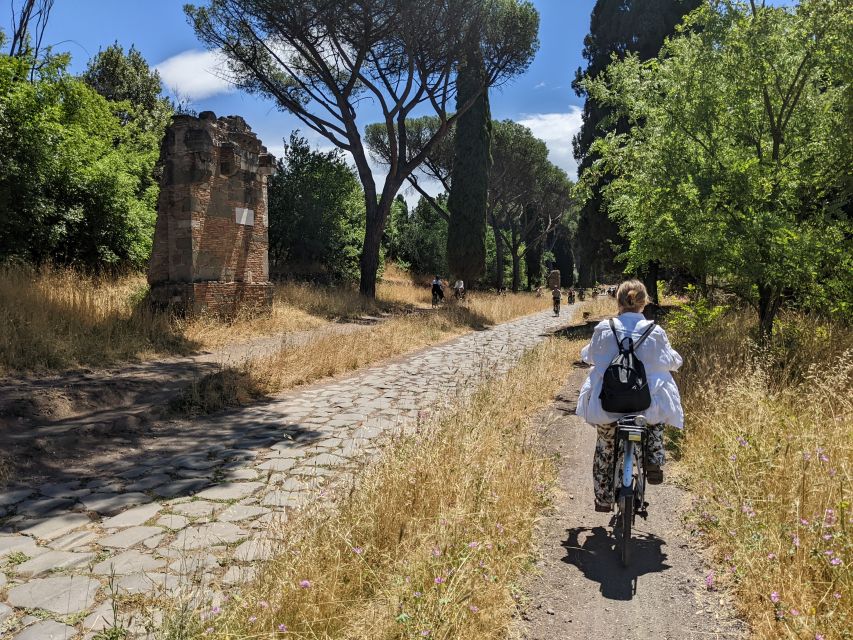
Rome rewards visitors who leave the tight cluster of famous city-center monuments. The Appian Way gives you open space, old stone, ruined tombs, churches, and Roman engineering in one outing.
The route starts at Centro Servizi Appia Antica, also called EcoBike, at Via Appia Antica 60. The guide first explains how the e-bike works and gives you an introduction to the area. That short briefing matters. You do not need to be a strong cyclist, but you do need to feel comfortable with the controls before setting off.
The electric assistance is especially useful because this is not a short spin around one attraction. You cover a long historic corridor and continue to the aqueducts before returning to the starting point. The bike also helps on the rougher sections, though it does not turn the ancient road into a smooth cycle path.
You receive a helmet, lock, map, and half a liter of mineral water. Child seats are available on request for children up to 20 kilograms. The tour is offered in English, and the guide stays with the group to explain what you are seeing and help at crossings.
More E-Bike Tours in Italy
- Rome EBike Tour: Appian Way, Catacombs & Roman Aqueducts
★ 5.0 · 1,766 reviews - Rome: Top Highlights & Hidden Gems Tour by Cannondale E-Bike
★ 4.9 · 1,760 reviews - Rome: Appian Way & Aqueducts E-Bike Tour (Catacombs & Food)
★ 4.9 · 1,498 reviews
From Domine Quo Vadis to the Queen of Roads
The first notable stop is the Church of Domine Quo Vadis, a small church tied to the story of Saint Peter. According to tradition, Peter was leaving Rome during Nero’s persecution of Christians when he met Jesus on the road. Jesus then disappeared, leaving footprints in the pavement.
You are not simply looking at a church in isolation. The stop helps explain why this road became such a powerful route through Roman history and Christian tradition. The Appian Way began as a military road and later carried traders, pilgrims, intellectuals, and other people moving across the Roman world.
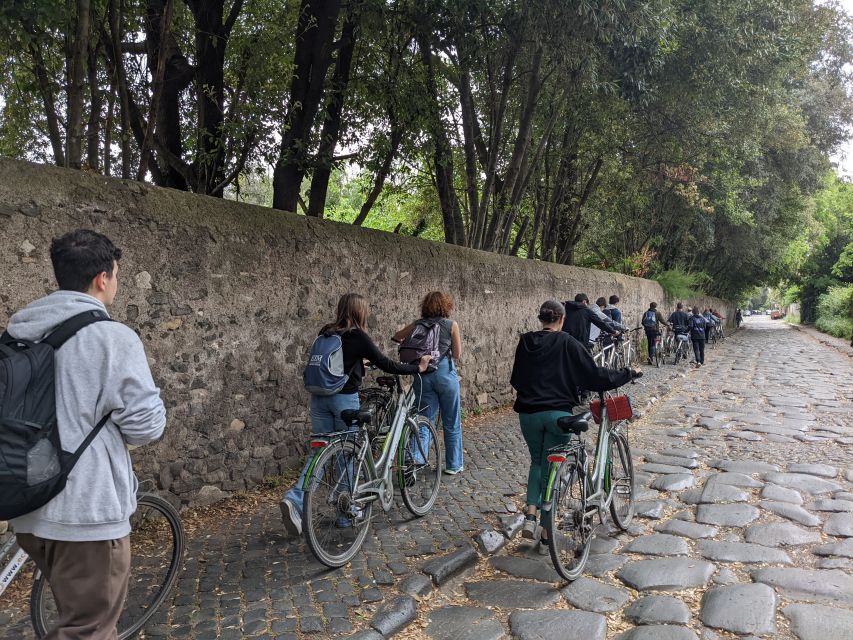
The road itself is the star. Its paving stones still show the marks made by wagon wheels and horses. You can see why the road earned the title Regina Viarum, or Queen of Roads. The stones are uneven, so keep both hands ready and let the electric motor do its work rather than trying to race.
This is also where the route feels most different from classic Rome sightseeing. Instead of moving from one crowded monument to another, you travel through a protected area with churches, tombs, catacombs, and Roman remains spread along a long green corridor.
The catacombs: an optional underground chapter
The tour can include a stop at either the Catacombs of Saint Sebastian or the Catacombs of Saint Callixtus. The visit is optional and costs €10 per person, paid on site. The basic ride does not include that entrance fee.
This choice gives you some control over the morning. If underground cemeteries are a priority, adding one gives the route a more complete view of early Christian Rome. If you prefer to stay above ground and focus on roads, villas, tombs, and aqueducts, you can skip it.
The practical point is to decide before the tour day if possible. The guide can explain how the stop fits into the outing, but your total time and cost will change if you add it. The tour description places the catacomb visit on the way back, so the main archaeological ride remains the central experience.
Circus of Maxentius and the story behind Ben-Hur
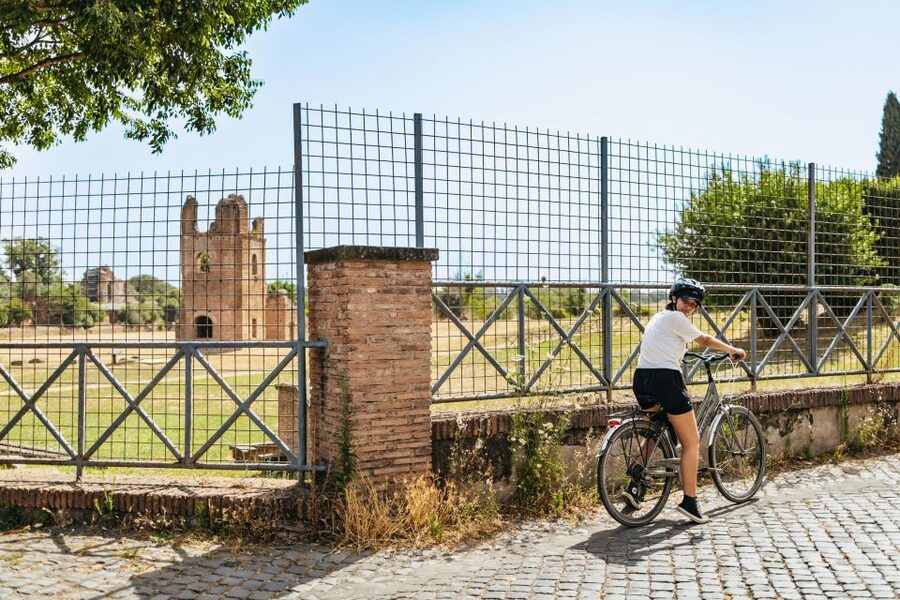
The Circus of Maxentius is one of the strongest stops on the route. This private imperial circus is described as the best-preserved Roman circus in the world, and the complex includes the circus, Maxentius’s villa, and the mausoleum of his son, Valerius Romulus.
You can enter this complex for free during the tour. That makes the stop especially good value, since you are not just passing a ruin from the roadside. You get a closer look at a full Roman building group and hear how the parts fit together.
The circus is also linked with the chariot-race scenes in the 1959 film Ben-Hur, directed by William Wyler and starring Charlton Heston. That detail gives the site a useful bit of modern context without taking away from the Roman remains.
I like this stop because it makes the scale of imperial power easier to picture. The road has tombs and fragments, but here you see a connected complex with a clear purpose. You can understand how entertainment, residence, and burial were tied to the power of one imperial family.
More E-Bike Tours in Rome
- Rome: Appian Way, Catacombs, & Roman Aqueducts E-bike Tour
★ 4.9 · 1,421 reviews - Rome City Small Group Bike Tour with quality Cannondale EBike
★ 5.0 · 1,380 reviews - Rome by Night – Ebike Small Group Tour – Food and Wine (Option)
★ 5.0 · 1,275 reviews - Rome by Night: E-bike Small Group Tour -Food & Wine (Option)
★ 4.9 · 1,233 reviews
Cecilia Metella and the medieval toll point
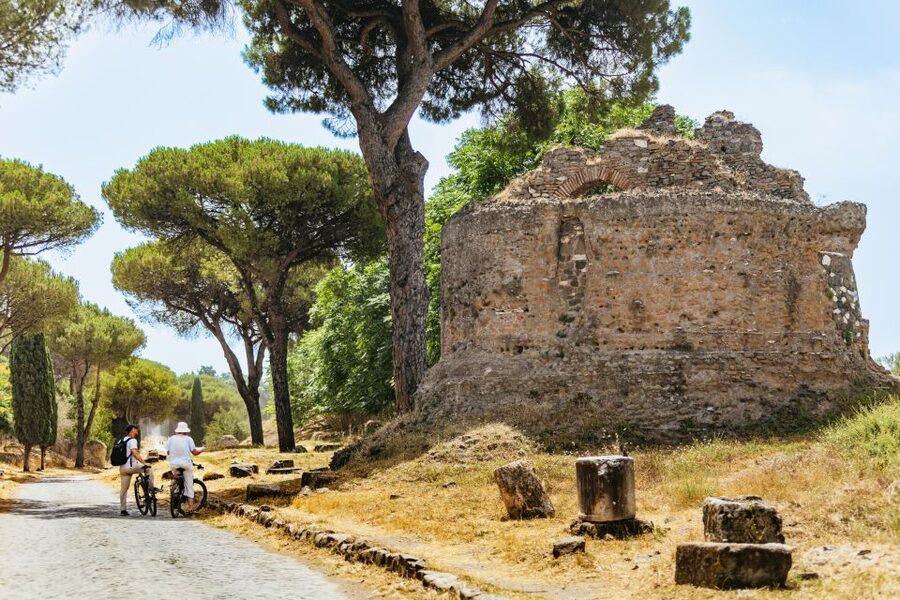
The Tomb of Cecilia Metella comes next, though the route passes by rather than offering a full interior visit. Its large cylindrical form rises above the Appian Way and is one of the road’s most recognizable monuments.
Little is known about Cecilia Metella beyond her noble family, but the location tells an important story. The tomb sits on a lava plateau dating back more than 260,000 years, giving it a strong position above the surrounding area.
In the Middle Ages, the site was used as a fortress. The Caetani family later took control of the area, using the tomb and its position to oversee the road. They built a fortified settlement with its own enclosure, and people passing through had to pay a toll.
That shift from Roman tomb to medieval stronghold is one of the best lessons along the route. Monuments do not simply disappear when an empire changes. Later families reuse them, control them, and give them new meaning.
Villa dei Quintili and the long archaeological corridor
The bike route passes the Villa dei Quintili, another reminder that the Appian Way was lined with more than military infrastructure. Roman aristocrats built villas, baths, tombs, and other substantial properties along this corridor.
You do not stop for a full visit to the villa on this tour, so you should not book the ride expecting detailed indoor exploration at every site. Instead, the guide uses the road itself as the connecting thread, showing how the monuments relate to one another.
That wider view is the strength of the experience. You see sepulchers, thermal baths, aristocratic residences, and road remains in a single outing. If you want to spend hours at one archaeological complex, a dedicated site visit may suit you better. If you want to understand the area as a whole, the bike route makes good sense.
Aqueducts Park: the Roman engineering finale
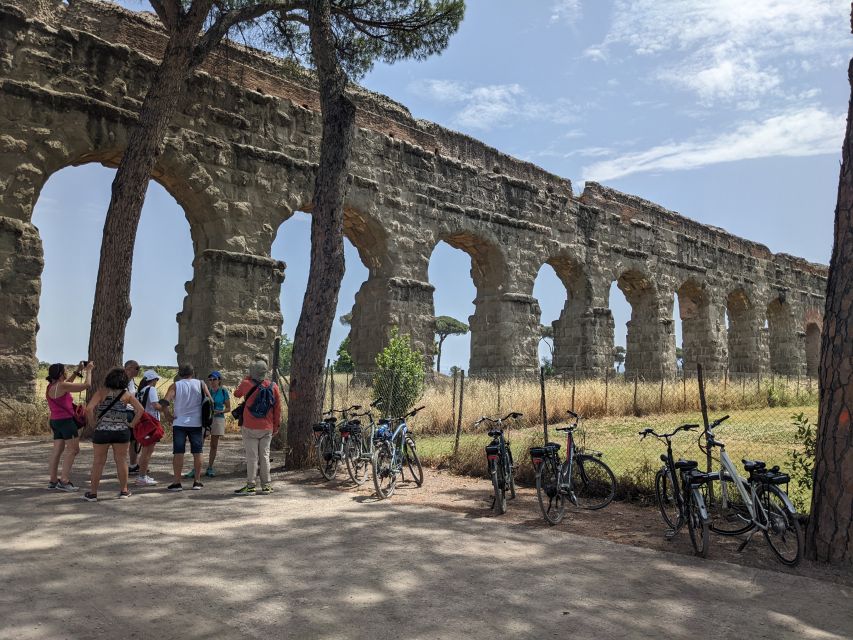
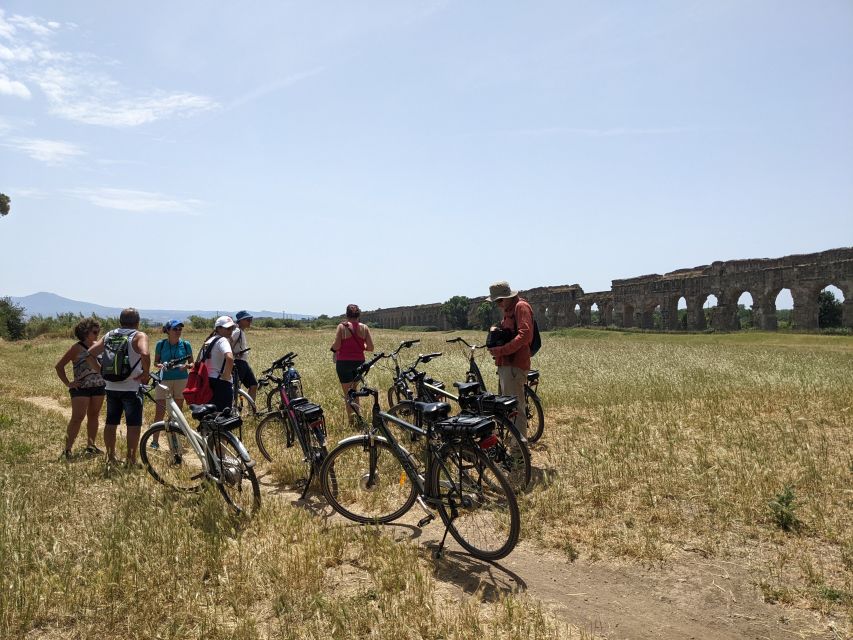
The tour continues to Parco degli Acquedotti, where the mood changes again. The Appian Way gives you ancient paving and tombs. The Aqueducts Park gives you long stretches of Roman engineering, with huge arches crossing the open park.
This is the visual high point for many people. The arches are easy to grasp from a bike because you can approach them across the open space and see how far the structures continue. The guide explains the aqueducts and their role in supplying Rome, connecting the remains to the wider workings of the ancient city.
The stop also gives your legs and eyes a change of pace. After rough stones and clustered ruins, you have broader views and a clearer sense of scale. The park is not merely a photo stop. It shows how Roman construction shaped the land around the city.
Bring your phone or camera, but do not forget to look away from the screen. The long perspective of the arches is what makes this stop work.
Caffarella Valley on the return ride
Parco della Caffarella adds a more natural section to the route. The tour passes through the valley as part of the wider Appian Way Regional Park, a protected area covering about 4,500 hectares.
Here, the main appeal is the contrast with central Rome. You are still close to the city, but the route gives you open ground, old paths, and archaeological remains without the usual traffic and crowds of the historic center.
The tour is not entirely off road. One rider described the balance as roughly 70 percent off-road and 30 percent on streets. That is a useful expectation to carry with you. You get the pleasure of park paths, but you also need to follow the guide carefully where roads and crossings are involved.
The guide’s role matters most here. Reviews of the experience repeatedly praise the route leaders, including Federico, Sara, and Alex, for clear explanations, good stories, and attention at crossings. Still, the pace is shared. Strong cyclists may need patience if someone in the group is new to e-bikes.
How much cycling is involved?
The tour lasts 3.5 hours, and the e-bike is not optional for this version of the route. The distance between the Appian Way and Aqueducts Park is one reason the electric assistance is useful.
You should be able to ride a bike and manage ordinary controls. The guide gives you an introduction before departure, and helmets are supplied. E-bikes are available from age 9 and a height of 135 centimeters, but the stated suitability rules say the tour is not suitable for children under 13. If you are booking for a child between those ages, confirm the rule before paying.
The bikes are homologated for adults up to 90 kilograms. The activity is also not recommended for pregnant women or people with back problems. Those limits matter because the route includes uneven historic surfaces and street sections.
Wear practical clothes and closed shoes. Bare feet are not allowed, and the tour runs rain or shine. A light rain layer is a sensible choice because there is no weather exception built into the schedule.
What the $59 price includes
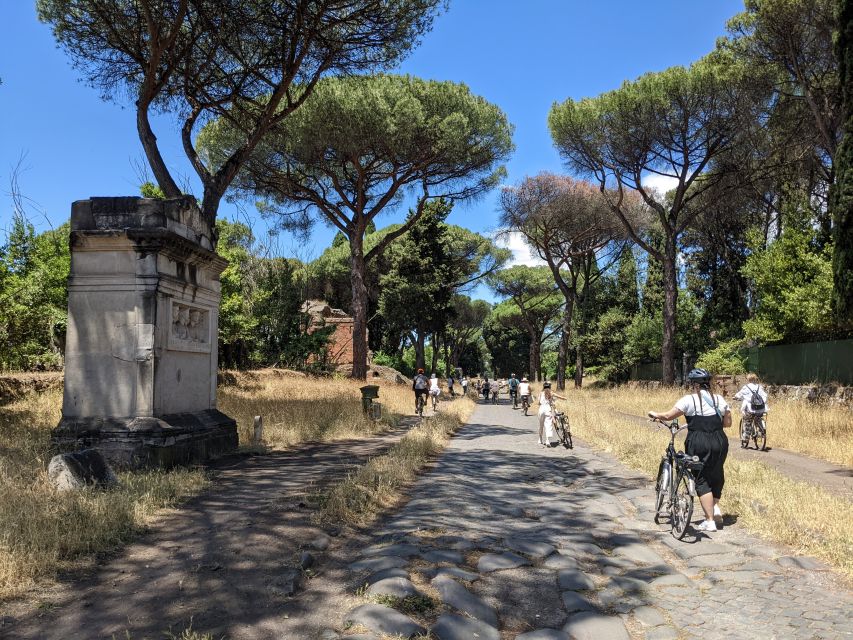
At $59 per person, the cost is reasonable for a guided half-day outing, especially because it includes the e-bike, professional English-speaking guide, helmet, lock, map, and water. You are paying not only for the bicycle but also for the route planning and interpretation across several widely spaced sites.
The free entry to the Circus of Maxentius adds value. The optional catacomb visit is separate at €10, so include that in your budget if underground Rome is part of your plan.
This is also a good choice for people who have already seen the Colosseum, Forum, and major fountains and want a different side of Rome. You cover more ground than you could comfortably manage on foot, yet the ride remains slower and more observant than a bus tour.
The main value limit is pace. You do not control every minute as you would on a self-guided rental. One rider specifically found that inexperienced cyclists slowed the group and would have preferred riding independently. If you are a confident cyclist who wants to stop whenever you like, a self-guided e-bike rental may suit you better.
Who should book this ride?
I would choose this tour if you want Roman archaeology with fresh air and movement. It suits adults, older children who meet the operator’s age and height rules, couples, families with suitable riders, and anyone who prefers ruins in an open setting to another indoor museum.
It is particularly useful for first-time visitors who have already covered the classic center, since the route reaches places that are not part of a standard Rome day. It also works well for repeat visitors who want a stronger sense of how Rome extended beyond its walls.
I would hesitate if you dislike cycling, have back trouble, are pregnant, or need a very controlled private itinerary. You should also think twice if uneven paths and some traffic would make you anxious.
Book it for the range of sights, the aqueduct arches, the old road stones, and the guide’s storytelling. Choose a self-guided rental instead if personal pace matters more than commentary and group structure.
FAQ
Where does the Appian Way e-bike tour start?
It starts at Centro Servizi Appia Antica, EcoBike Bike Rental, at Via Appia Antica 60.
How long does the tour last?
The guided e-bike tour lasts 3.5 hours.
What language is the tour offered in?
The live guide conducts the tour in English.
Is the e-bike included?
Yes. A high-quality e-bike is included, along with a helmet, lock, and map.
Is water included?
Yes. Each participant receives half a liter of mineral water.
Are the catacombs included in the price?
No. You may visit Saint Sebastian or Saint Callixtus independently by paying €10 on site for each catacomb visit.
Does the tour enter the Circus of Maxentius?
Yes. Entry to the Circus of Maxentius complex is free during the tour.
Can children join the tour?
E-bikes are available from age 9 and from a height of 135 centimeters, but the activity is listed as unsuitable for children under 13. Child seats for children up to 20 kilograms are available on request.
What happens if it rains?
The tour operates rain or shine. You should bring suitable clothing for the weather.
Latest bike tours added in Rome
- Rome: Guided eBike Evening Tour with italian Aperitif★ 5.0 · 16 reviews
- Rome: Villa Borghese E-Bike Tour (Small Group or Private)★ 4.9 · 92 reviews
- Rome: Appian Way, Aqueducts, & Catacombs E-Bike Guided Tour★ 4.9 · 54 reviews
- Rome: Top 10 Highlights Guided Tour by Bike or E-Bike★ 4.4 · 15 reviews
- Rome: Villa Borghese, Villa Ada, and Coppedè E-Bike Tour★ 4.8 · 78 reviews
- Rome: Piazza Venezia E-Bike Rental★ 4.4 · 10 reviews
- Sunrise in Rome: Small Group E-Bike Tour & Italian breakfast★ 4.9 · 177 reviews
- Rome: Taste of Rome by quality Cannondale E-Bike★ 5.0 · 12 reviews
E-Bike Tours, compared.
3-Hour Porto Highlights on a Electric Bike Guided Tour
Read our review →
Hills, Alfama, and Mouraria Tour by Electric Bike
Read our review →
Athens Scenic Electric Bike Tour with optional Acropolis visit
Read our review →
City Highlights 3-Hour Guided Electric Bike Tour
Read our review →
Rome EBike Tour: Appian Way, Catacombs & Roman Aqueducts
Read our review →
Top Highlights & Hidden Gems Tour by Cannondale E-Bike
Read our review →Browse the lists this tour appears in