
Review · E-BIKE TOURS
Cycle Angkor Backroad Bike Tour / E-Bike or Tuk Tuk
The best part of this $55 Angkor tour is not simply reaching the famous temples. It is getting between them on quiet forest tracks, away from the main vehicle flow. You see Angkor at a slower, more human pace, with shade, birds, village glimpses, and the occasional bump in the road.
I like the small groups of up to 12 and the way the guides adjust the day to the rider. I also like the practical extras: a proper Cambodian-style lunch, local fruit and snacks, bottled water, a helmet, and hotel pickup. The drawback is the distance. One outing covered about 45 kilometers, so this is not a gentle sightseeing ride for everyone.
Key points to know before you book
- Quiet backroads: Much of the route uses forest paths rather than the busiest temple approaches.
- Three major temple areas: You visit Angkor Thom and Bayon, Ta Prohm, and Angkor Wat, with time to walk around each site.
- Strong personal guiding: Guides including Voleak, Sotin, Steven, Mony, and Muniz have been praised for safety, clear English, local stories, and good photographs.
- A full eight-hour day: Expect morning pickup, several hours of riding and temple visits, lunch, rest, and a return to Siem Reap around 4 pm.
- Food is part of the experience: Lunch, tropical fruit, snacks, and bottled water are included.
- The Angkor pass costs extra: You must pay separately for entry to the Angkor Archaeological Park.
Why cycling gives Angkor a different feel
Angkor is vast. The temples are not arranged like rooms in one museum, where you walk from one doorway to the next. They sit across a large archaeological park, surrounded by trees, water, old roads, and modern traffic. A bicycle makes those gaps part of the experience instead of dead time in a vehicle.
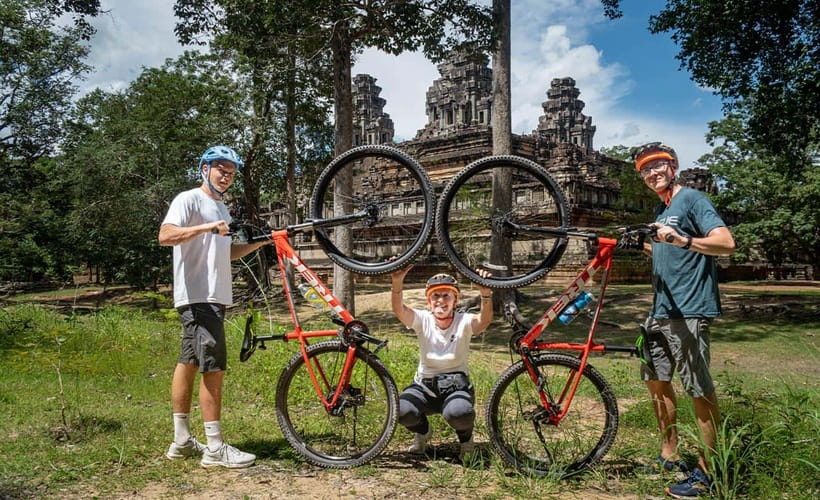
I like the way this tour uses the spaces between the monuments. You may ride beneath forest cover, leave the main road, and approach a temple from a quieter side. That does not mean you will have every path to yourself, but the route can feel far removed from the usual temple circuit.
The ride is generally described as flat and often shaded. That helps, but flat does not mean effortless. A full day in Cambodian heat, with stops at large temple compounds, is still a physical outing. One reported route reached about 45 kilometers. If you cycle often, that may feel manageable. If you rarely ride, ask about an e-bike or tuk tuk option before booking.
The tour title includes bicycle, e-bike, and tuk tuk choices, while the standard details focus on a bicycle and helmet. Confirm the exact vehicle and any price difference when you reserve. That simple check matters if you like the idea of the route but not the full cycling distance.
More E-Bike Tours in Siem Reap:
- Siem Reap Countryside Bike Tour / E-Bike or Tuk Tuk
★ 5.0 · 935 reviews - Angkor Sunrise Bike Tour / E-Bike or Tuk Tuk
★ 5.0 · 615 reviews - From Siem Reap: Angkor Wat Sunrise and Temples E-Bike Tour
★ 5.0 · 52 reviews
Starting in Siem Reap with a proper setup
Your morning begins with pickup in Krong Siem Reap, with the pickup described as optional. If you use it, wait in your hotel lobby 15 minutes before the scheduled time. You then go to the Siem Reaper shop, meet your guide, receive your bicycle and helmet, and go over the plan for the day.
This short briefing is more useful than it sounds. A good guide will check your bike, explain the route, and get a sense of your riding ability before the group sets off. Sotin is specifically praised for giving a full safety briefing, while Voleak is praised for checking riding skill and adapting the day.
You should wear comfortable cycling clothes, bring sunglasses, and carry a camera if you want temple photographs. Bottled water and snacks are supplied, but light clothing and sun protection still make sense. The activity runs rain or shine, so a wet-weather plan is part of the bargain.
The bicycles have received strong marks for being clean, well maintained, and suitable for the route. That is important here. A poor bike can turn a pleasant ride into a long negotiation with a loose chain or unhappy saddle. The included helmet is another welcome detail.
Entering Angkor Thom through the elephant gate
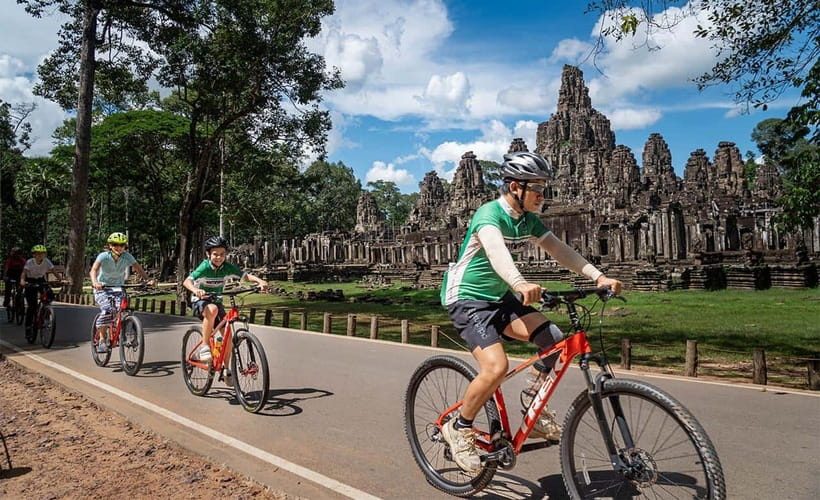
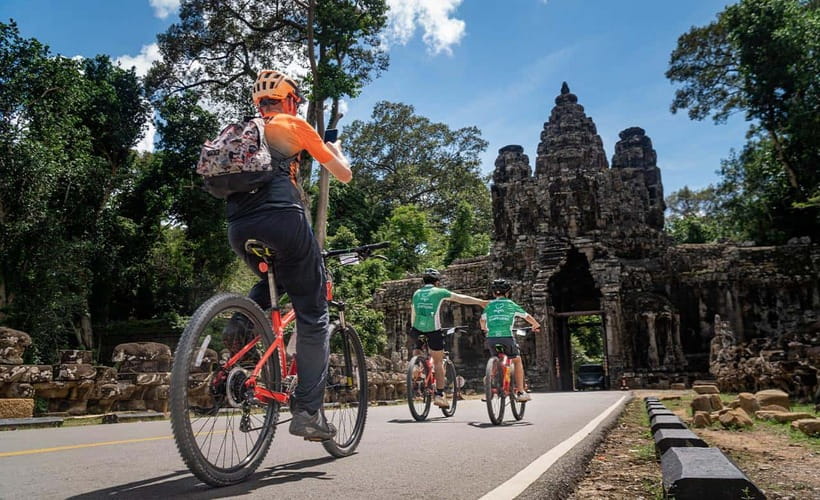
The route heads toward Angkor Archaeological Park and enters Angkor Thom through its famous gate. Look up as you approach. The entrance is decorated with elephants and topped by four giant faces, giving you an immediate sense that this was once a grand royal city, not just a collection of isolated ruins.
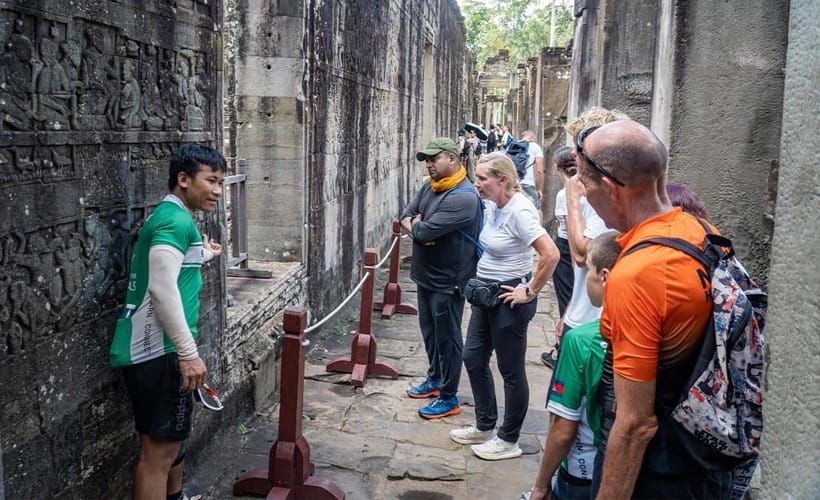
Angkor Thom was a major center of the Khmer Empire. You do not need to memorize dates to enjoy it, but the guide’s explanation helps you read the carvings and understand why the gates were built on such a large scale. This is one of the places where a live guide adds real value. Without context, the gate is impressive. With context, it becomes part of a much larger plan.
The bicycle also gives you a practical advantage. You can move between sites without waiting for a vehicle to park, load, and unload. That helps the day cover more ground in less time, though you will still need to lock or leave the bicycle as directed while exploring the temple interiors and terraces.
Bayon Temple and its many stone faces
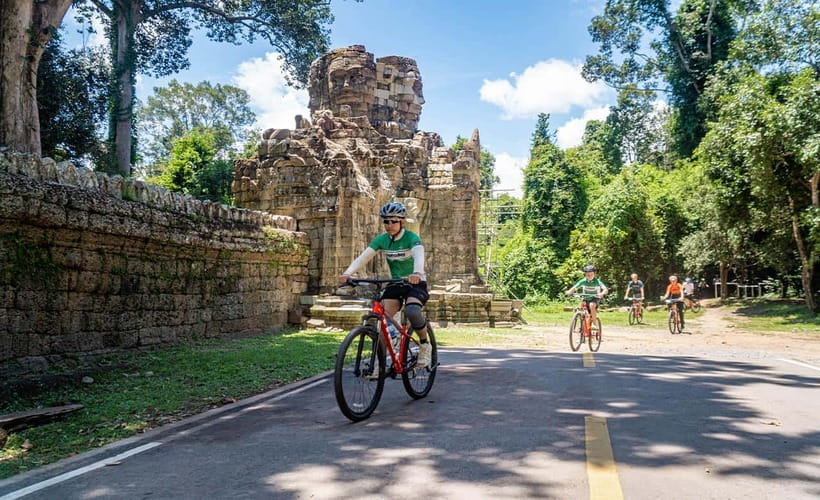
Bayon sits near the center of Angkor Thom and is usually the emotional high point of the morning. Its towers carry large carved faces with calm expressions. The tour description connects the faces with the 54 provinces of the Great Khmer Empire, giving the guide a useful opening to discuss power, religion, and the scale of the old kingdom.
Bayon is not a quick photo stop if you want to understand its layout. Passages, towers, and reliefs create a compressed, almost maze-like visit. The stones can feel crowded together, so listen closely as your guide points out details that are easy to miss.
The published timing gives Bayon and Angkor Thom a substantial block of the day, up to about two and a half hours in the itinerary. That allows time for photographs and a proper walk rather than a rushed view from outside. The exact balance depends on your group and the pace of the ride.
You will also see the Terrace of the Elephants and Baphuon Temple. The terrace is known for its carved animals and ceremonial scale. Baphuon offers a different look at Khmer building methods and religious design. These stops are useful because they prevent the morning from becoming only a parade of famous names. You get a broader view of Angkor’s public spaces and sculpture.
More tuk-tuk rides in Siem Reap:
- Siem Reap: Countryside Sunset Bike Tour / E-Bike or Tuk Tuk
★ 4.7 · 13 reviews - Phnom Penh Silk Island Bike Tour/ E-Bike or Tuk Tuk
★ 5.0 · 495 reviews
Forest paths on the way to Ta Prohm
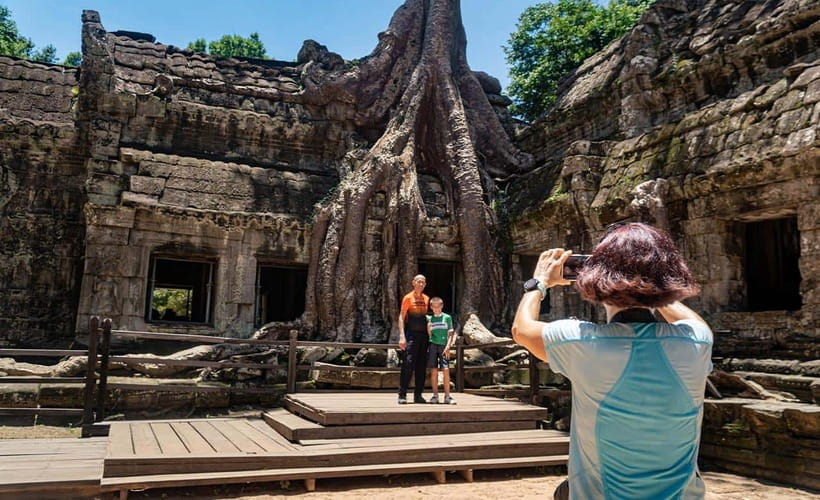
After Angkor Thom, the ride continues through forest tracks toward Ta Prohm. This is where the cycling format earns its keep. Instead of treating the road as a transfer, you get a shaded stretch that links the monuments and gives your legs a break from temple steps.
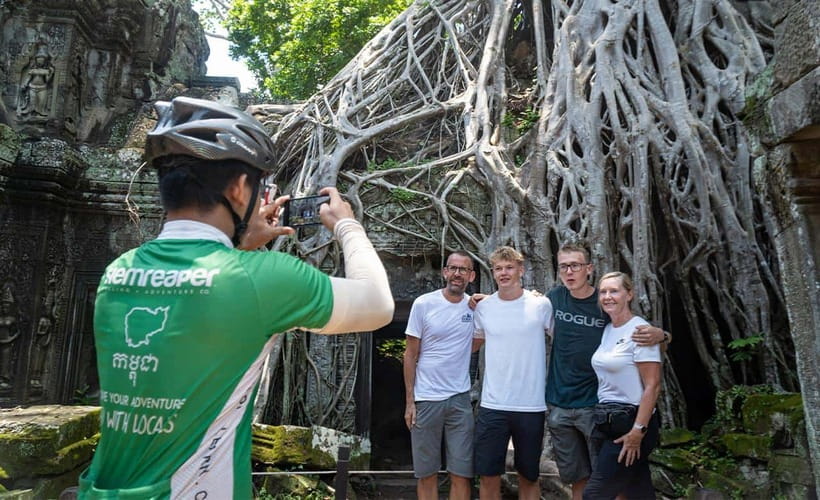
Ta Prohm is the temple most closely tied to popular movie images. It was featured in Tomb Raider, and its trees growing over stone walls have become one of Angkor’s signature sights. The roots and fallen blocks create dramatic photographs, but the site is more than a film set. It shows how nature and architecture have been interacting across centuries.
You should expect uneven surfaces and plenty of walking once you leave the bicycle. The temple’s appeal comes from its tangled, weathered form, not from a polished restoration. Watch your footing and give yourself time to look at the carved doorways and galleries rather than rushing straight to the best-known tree scenes.
The tour description allows about two hours for Ta Prohm. That is enough for a meaningful visit if the group keeps moving between the main points. It is not an unlimited exploration of every corner. If Ta Prohm is your top priority, tell the guide early so the timing can reflect that.
Lunch beside a tropical garden
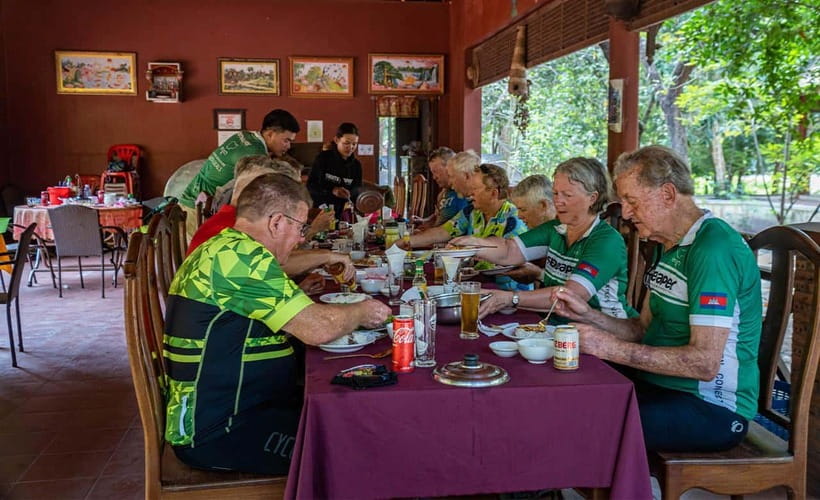
Lunch comes at a local restaurant by a tropical garden with a view over a pond. This pause breaks the day into sensible halves. By this point, you have ridden, climbed temple steps, and spent time in the sun, so sitting down matters as much as the meal itself.
A Cambodian-style lunch is included, along with local snacks and fruit. The food has been a strong part of the experience, with fresh fruit receiving repeated praise and one guide introducing a rider to street food and helping collect cashews along the way. Those small touches can turn a standard temple outing into a closer look at everyday food in Cambodia.
Do not treat lunch as a brief fuel stop. The schedule gives it about an hour, followed by a rest period. Use that time. The final temple is the largest and most famous of the day, and arriving tired can make it harder to appreciate.
The menu is not specified, so you should not book this expecting a particular dish. What you can count on from the tour details is a local meal, snacks, fruit, and water. If you have dietary needs, ask before departure.
Angkor Wat in the quieter late afternoon
The final major stop is Angkor Wat, the enormous temple complex that gives the wider park its name. The late afternoon timing is a smart choice. It places the visit after the morning rush and lets you see the monument when the light begins to soften.
Angkor Wat is the largest religious monument in the world and one of the finest examples of Khmer architecture. Its scale can be hard to take in at first. Give yourself time to look beyond the famous front view. The towers, galleries, courtyards, pools, and long approaches were designed as one connected statement.
The guide can explain the temple’s symbolism and the stories shown in its carvings. That background helps you understand why the layout matters, rather than leaving you with a collection of grand walls and towers. A peaceful spot for the talk is especially welcome after the busy morning.
The itinerary information lists Angkor Wat for about two and a half hours, though the narrative places it later in the day after lunch. The exact order may shift with park conditions, group pace, or the guide’s plan. Either way, the day is designed to give Angkor Wat a substantial visit, not merely a drive-by photograph.
You should also expect a fair amount of walking here. Cycling gets you to the temple, but it does not replace the time needed to cross courtyards and explore the galleries. Comfortable footwear matters just as much as cycling clothes.
What the guides add to the day
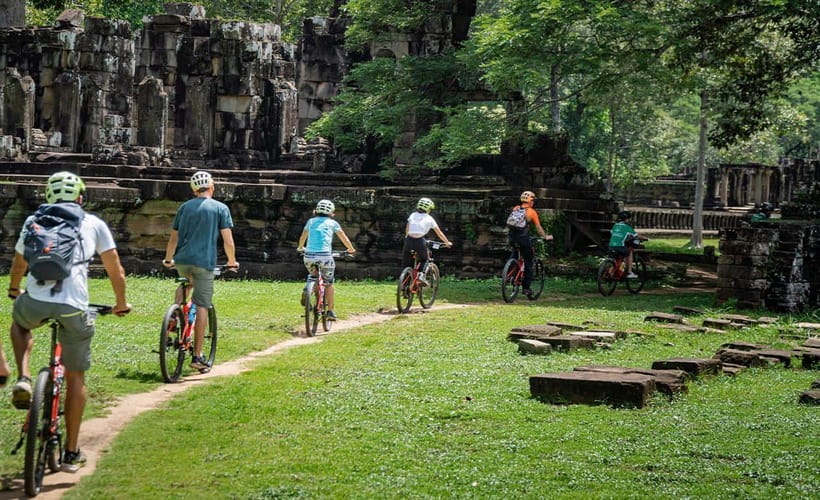
The strongest part of this experience is the guide-to-rider relationship. Guides named in the feedback include Muniz, Voleak, Sotin, Mony, and Steven. Their reported strengths are practical: clear English, safety awareness, strong temple explanations, good photography, and a willingness to adjust the pace.
Voleak, for example, is described as quickly judging a rider’s skill and interests, then changing the focus of the tour to match. Steven is praised for using quieter routes and explaining both Angkor and daily life in Cambodia. Sotin is noted for the safety briefing, while Muniz is singled out for making the day fun and challenging without pushing beyond a rider’s control.
That flexibility matters in a small group. Some people want dates and architecture. Others care more about local food, forest paths, or photographs. You can get more from the day if you tell your guide what interests you during the opening briefing.
The group limit is 12, but some departures may be much smaller. One person ended up with a private-style outing when no other participants joined, and the tour continued rather than being cancelled. You should not assume that every booking becomes private, but a small group gives the guide room to make sensible adjustments.
Is $55 good value?
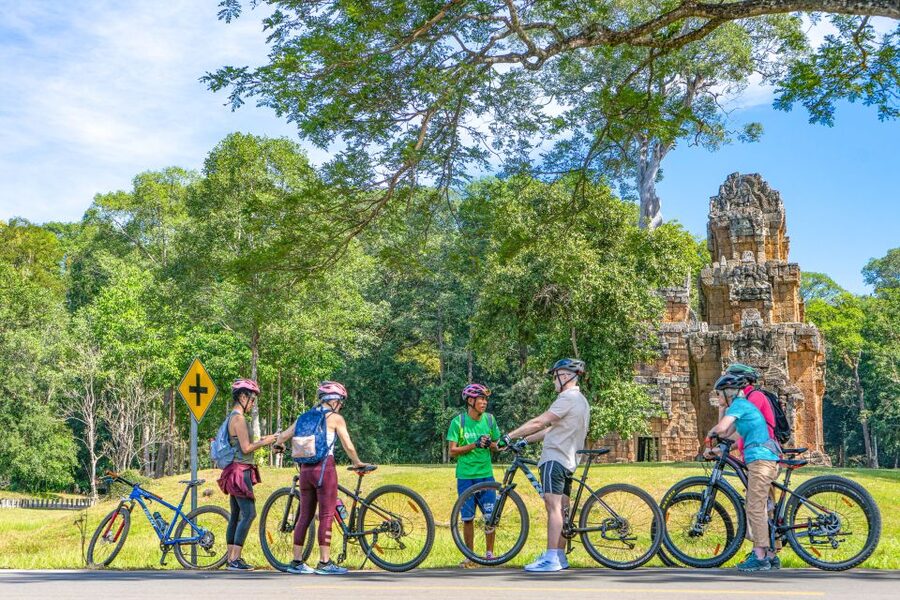
At $55 per person, the tour offers a lot for a full day. The price includes hotel pickup and drop-off, an English-speaking guide, bicycle, helmet, lunch, bottled water, and snacks. It also includes the planning needed to connect several major temple areas by backroads.
The Angkor Archaeological Park entrance pass is not included. Add that cost to your budget before comparing this with a tuk tuk or self-guided visit. The tour’s value is strongest if you want a guide, food, bike, and route planning in one package.
A tuk tuk may be easier on a very hot day, and a self-guided bicycle can cost less if you already know the park and have transport. But you would then need to arrange the bike, decide on a route, carry water, find food, and handle the park’s large distances yourself.
For me, the included lunch and water are useful, but the main value is access to a quieter route with someone who knows how to connect the temples. You pay for time saved, local explanation, and less transport fuss.
Who should book this ride?
This tour suits you if you enjoy active sightseeing and want more than a sequence of temple entrances. It is a good fit for confident cyclists, couples, friends, and small groups who like a full day outdoors.
It is less suitable if you dislike heat, have limited cycling experience, or want a relaxed vehicle-based tour. Pregnancy is specifically listed as a reason not to join. If the distance concerns you, ask about the e-bike or tuk tuk option tied to the experience before paying.
The tour takes place rain or shine, so weather is another consideration. Bring sunglasses, a camera, and cycling clothing, and be ready for a long day rather than a short morning excursion.
You can cancel up to 24 hours in advance for a full refund, and reserve now while paying later. Starting times depend on availability, so check the departure window that fits your hotel and temple plans.
Should you book the Cycle Angkor Backroad tour?
Book it if you want Angkor with movement, shade, and a stronger sense of place between the monuments. The combination of quiet paths, good bikes, small groups, local food, and attentive guiding gives the day more character than a standard drive-and-stop circuit.
Skip it if you want minimal exertion or if 45 kilometers sounds unreasonable. For everyone else, this is a smart way to see Angkor Thom, Bayon, Ta Prohm, and Angkor Wat in one well-planned day. Ask about the vehicle option, budget separately for the park pass, and tell your guide what you want from the experience. That will help turn a long ride into the right kind of long ride.
FAQ
How long does the Cycle Angkor Backroad tour last?
The activity lasts eight hours. Pickup is in the morning, and the expected return to Siem Reap is around 4 pm.
What temples are included?
The tour includes Angkor Thom, Bayon Temple, Ta Prohm, and Angkor Wat. It also includes the Terrace of the Elephants and Baphuon Temple during the Angkor Thom section.
Is lunch included?
Yes. A local Cambodian-style lunch is included, along with bottled water and snacks. Fresh fruit may also be served during the day.
Is the Angkor Archaeological Park entrance fee included?
No. Entry to the Angkor Archaeological Park is not included in the $55 tour price.
What should I bring?
Bring sunglasses, a camera, and suitable cycling clothing. The tour supplies a bicycle, helmet, bottled water, lunch, and snacks.
Can I cancel the booking?
Yes. You can cancel up to 24 hours in advance for a full refund. The activity also offers a reserve-now, pay-later option.
Latest bike tours added in Siem Reap
- Siem Reap: Countryside Sunset Bike Tour / E-Bike or Tuk Tuk★ 4.7 · 13 reviews
- Kampong Phluk: Floating Village Sunset Bike Tour or E-Bike★ 5.0 · 11 reviews
- Siem Reap: Angkor Sunset Bike & Boat Tour /E-Bike Available★ 4.9 · 23 reviews
- Siem Reap: Bike the Angkor Temples – Full-Day 30km Tour★ 4.9 · 159 reviews
- Siem Reap: Bike Rental★ 4.7 · 12 reviews
- Siem Reap: Countryside Cycle and Local Village Life Tour★ 4.7 · 32 reviews
- From Siem Reap: Angkor Wat Sunrise and Temples E-Bike Tour★ 5.0 · 52 reviews
- Angkor Wat: Guided Sunrise Bike Tour w/ Breakfast and Lunch★ 4.8 · 48 reviews
E-Bike Tours, compared.
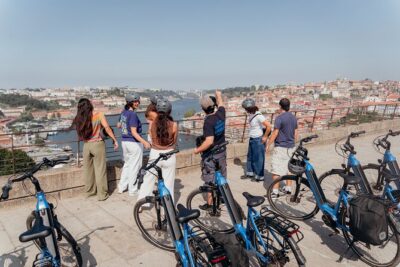
3-Hour Porto Highlights on a Electric Bike Guided Tour
Read our review →
Hills, Alfama, and Mouraria Tour by Electric Bike
Read our review →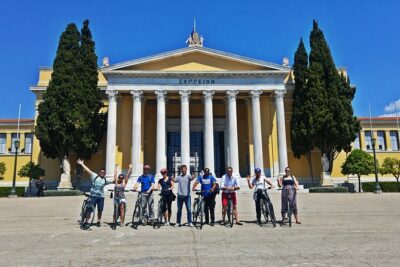
Athens Scenic Electric Bike Tour with optional Acropolis visit
Read our review →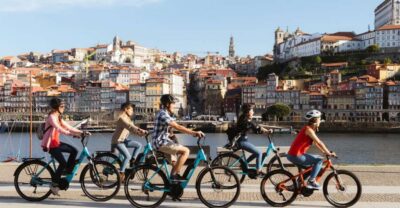
City Highlights 3-Hour Guided Electric Bike Tour
Read our review →
Rome EBike Tour: Appian Way, Catacombs & Roman Aqueducts
Read our review →
Top Highlights & Hidden Gems Tour by Cannondale E-Bike
Read our review →Browse the lists this tour appears in