
Review · POLAND BIKE TOURS
Secrets of Warsaw 4-hour Bike Tour
Warsaw’s best surprises are spread across the city, and this four-hour bike ride links them in a way that walking tours cannot. You move from prewar streets and wartime memory to communist buildings, quiet parks, wooden cottages, river beaches, and Praga’s old streets. I like the route’s variety, and I like that it reaches places many first-time visitors would miss.
The English-speaking guides give the ride a human voice. Marcin, named in several recent bookings, has handled history with humor and adjusted the route for a meaningful August 1 siren ceremony. The main drawback is simple: you need to be comfortable on a bicycle, and bad weather can make 210 minutes in the saddle less pleasant.
Key points to know before you ride
- A city-spanning route: Cover central Warsaw, the Vistula riverbanks, and Praga without arranging several separate trips.
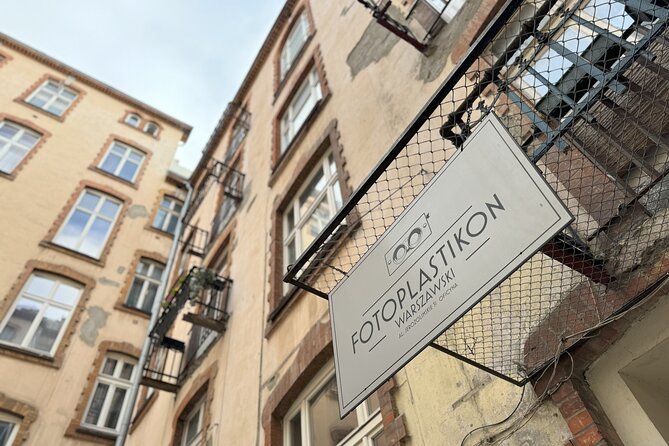
- Prewar Warsaw in the Fotoplastikon: The included ticket gives you a rare visual look at the city before World War II.
- Quiet corners near the center: Otwarty Jazdów’s Finnish cottages feel far removed from nearby government buildings.
- Parks and wildlife: Łazienki and Skaryszewski parks add shade, water, and a break from traffic.
- A useful local guide: Marcin has been praised for clear explanations, humor, and sensitivity when discussing Polish history.
- Practical limits: The tour is in English, children under 10 are not accepted, and you must be fit to cycle.
Why this route gives Warsaw a wider frame
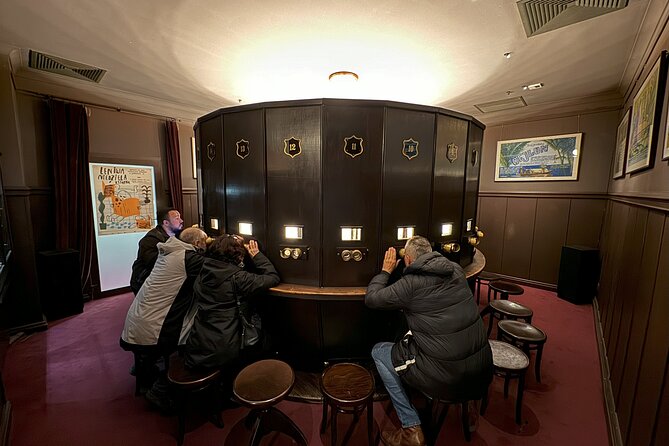
Warsaw can be hard to read at street level. Much of the city was destroyed during World War II, then rebuilt under communism, and later reshaped by modern offices and towers. A bike lets you see those layers in quick succession.
You begin at Station Warsaw Tours, at 16/18 Koźla Street. This is about one kilometer from Sigismund’s Column in Castle Square, so allow extra time if you are coming from the Old Town. The nearest metro stop is Ratusz Arsenał, about 1.2 kilometers away.
The price is $57 per person. That is not the cheapest way to move around Warsaw, but it includes the bicycle, an expert local guide, and admission to the Fotoplastikon. The value improves if you want history, parks, both sides of the Vistula, and Praga in one outing. A standard city tour would usually cover only part of this ground.
More bike tours in Poland:
- Complete Cracow Bike Tour (small group of maximum 15 people!)
★ 5.0 · 1,322 reviews - Krakow: Bike Tour of Old Town, Jewish Quarter and the Ghetto
★ 4.9 · 1,155 reviews - Highlights of Krakow Bike Tour – Small group
★ 5.0 · 662 reviews
From Krasiński Park to the lost Jewish district
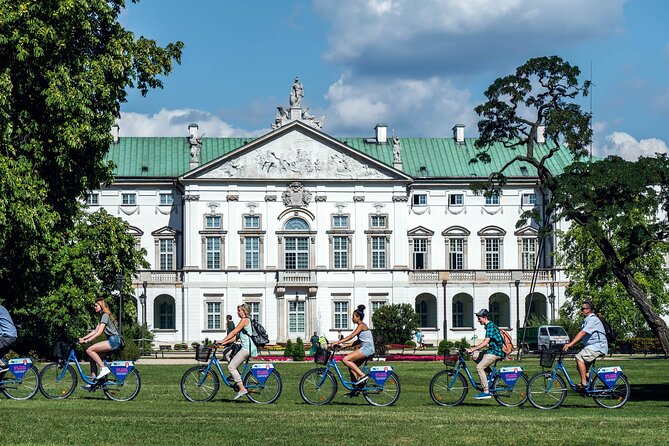
The ride begins near Krasiński Park, a pleasant green starting point before the city’s heavier stories come forward. You soon reach Stare Nalewki, once part of the Jewish district. Today, the area cannot show you the prewar neighborhood in full, but the route helps explain what was here and what was lost.
The ten-minute ride to Bank Square takes you into a more formal part of central Warsaw. Bank Square and nearby Lubomirski Palace show the city’s grander architecture, while the changing streets make clear how thoroughly Warsaw was rebuilt.
This early section is not about stopping at every building. It is about orientation. You begin to see the city as a place of broken continuity, where a palace, a modern road, and a rebuilt block can sit close together.
Fotoplastikon and Warsaw before 1939
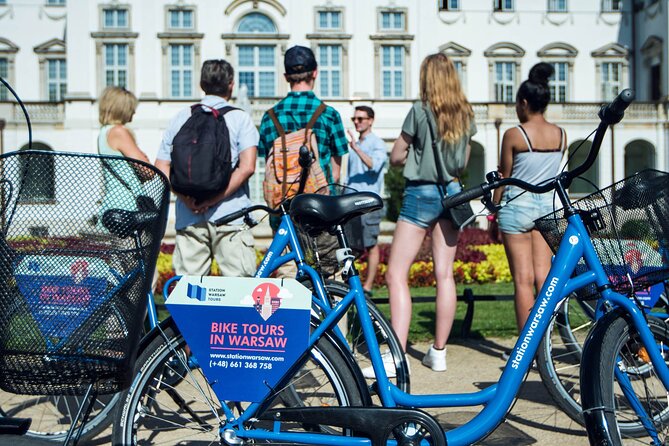
The most distinctive indoor stop is the Warsaw Fotoplastikon. You receive the admission ticket as part of the tour, and spend about 30 minutes between cycling stretches.
The Fotoplastikon is a historic stereoscopic viewing machine. It presents old three-dimensional photographs, including views that bring prewar Warsaw into focus. This matters because so much of the former city survives mainly through photographs, memory, and fragments.
I would pay close attention here, even if you are not usually drawn to small museums. The stop gives you a visual reference for later parts of the ride. After seeing the older streets and people, modern Warsaw feels less like a replacement city and more like one chapter in a long story.
The visit also gives your legs a useful rest. Four hours is a long city ride, and a pause indoors helps break up the pace.
Communist landmarks and the modern center
From the Fotoplastikon, the route heads toward the Centrum Bankowo Finansowe area and then the former Communist Party headquarters. Warsaw’s central skyline is a study in contrast. Glass towers rise near solid buildings from the communist period, while older monuments and reconstructed facades fill in the gaps.
You then pass the Polish Parliament, the Sejm. It is not a long formal visit, but the stop helps connect the city’s streets with modern Polish government. The route also includes Congress Hall, another reminder of the communist era and its large public architecture.
Your guide’s role matters most here. These buildings can look like ordinary city scenery if you do not know why they were built or what they represented. A good explanation turns a ten-minute cycling stretch into useful context without requiring a lecture.
Another way to spend a morning on two wheels:
- 3-Hour Guided Cycling Tour of Warsaw
★ 4.9 · 624 reviews - Full Bike Tour – the Old Town, Jewish Qtr & the Ghetto NEW BIKES
★ 5.0 · 437 reviews - Krakow: Highlights of Krakow Bike Tour – Small Group
★ 4.9 · 421 reviews - Hidden Krakow Bike Tour
★ 5.0 · 275 reviews
Otwarty Jazdów and the Finnish cottages
One of the route’s most unusual stops is Otwarty Jazdów, a small cluster of Finnish wooden houses near the center. These cottages have a fairytale quality, but their importance is practical as well. They show how a modest residential pocket can survive close to major government buildings and busy roads.
The contrast is sharp. You have just passed formal institutions and city offices, then suddenly reach a tiny village of timber homes. This is the kind of stop that makes a bike tour worthwhile. You can cross a large part of Warsaw quickly, but you still get close enough to notice its small-scale corners.
The route then passes the monument to John III Sobieski before reaching Royal Łazienki Park. The park is one of Warsaw’s grandest green spaces, with broad paths, historic buildings, and water. You are riding through rather than taking a full park tour, so do not expect to see every major feature. Still, the change from traffic to trees is welcome.
Across the Vistula to the National Stadium
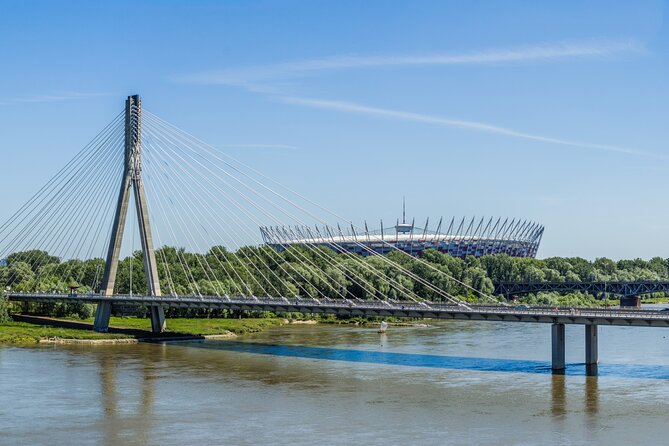
The ride continues to Świętokrzyski Bridge, one of Warsaw’s best points for seeing the river and the city skyline together. Crossing the Vistula gives you a clear sense of Warsaw’s geography. The river is not just a scenic feature. It divides two parts of the city with different moods and histories.
On the far side, the route reaches Poniatówka, a city beach and riverside recreation area. Conditions and activity can vary, but the stop gives you a look at how Warsaw uses its riverbanks. It is a more relaxed view of the capital than the formal center.
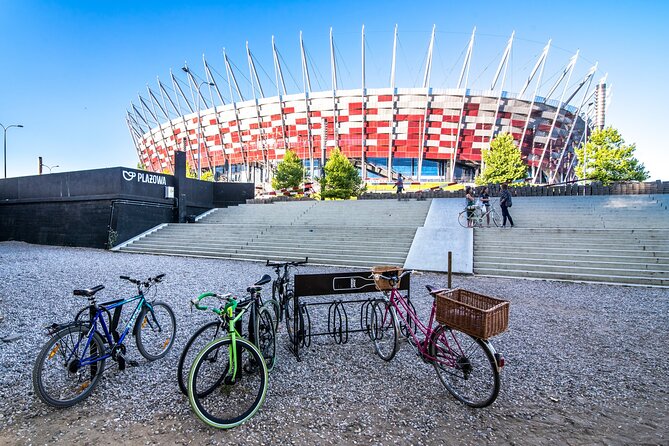
You then head toward PGE Narodowy, the National Stadium. Its scale is hard to miss, and the approach offers a change from historic buildings and parks. The stadium is not a separate ticketed visit on this tour. You see it as part of the ride and continue onward.
Skaryszewski Park and the lake
Skaryszewski Park is Warsaw’s second-largest park and one of the route’s more peaceful sections. It brings another kind of nature into the day, with open paths, trees, and a lake. You may also notice local wildlife, though the precise sightings depend on the season and timing.
I like this part because it prevents the tour from becoming a string of monuments. You get a sense of how residents use Warsaw’s green spaces, and you have room to slow down after the city-center streets.
The tour schedule allows about ten minutes for most cycling sections, but the overall pace is guided rather than rigidly stop-and-go. Ask questions when something catches your eye. The route is long enough that the guide must keep moving, but the strongest parts come when a site’s story connects with what you have just seen.
Wedel chocolate and a useful mid-tour pause
The stop at E. Wedel lasts about 30 minutes. Wedel is Poland’s oldest chocolate factory, and this break adds a lighter note after the war and political history earlier in the day.
Refreshments are not included, so budget for your own purchase. The listing specifically excludes drinks and snacks along the way. You can also rent a basket for 5 PLN or a rain poncho for 5 PLN, while the bicycle itself is included.
This is a good point to check your comfort level. If your legs, seat, or hands are already complaining, the remaining ride still includes Praga and the final bridge views. The route is not described as a technical cycling outing, but it is long enough that basic fitness and confidence matter.
Praga, Brzeska, and the city’s rougher edges
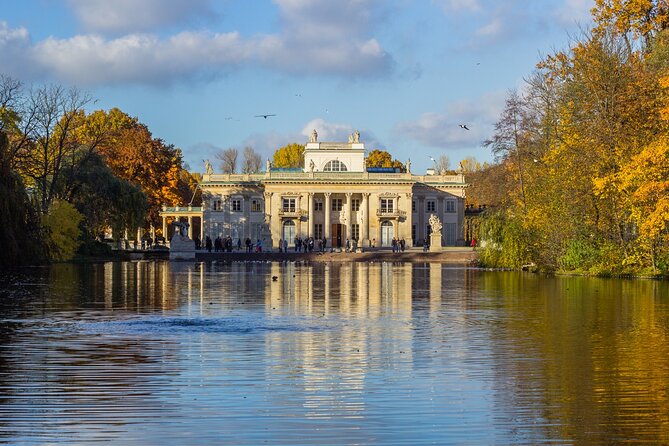
After Wedel, you continue through Brzeska and into Praga. This district has a different feel from the rebuilt center. It is known for old streets, local character, creative activity, and stories that are harder to read at a glance.
The tour passes Port Praski and the Metropolitan Cathedral of Saint Mary Magdalene. These stops help show Praga as more than a fashionable district. Its identity includes religious buildings, river infrastructure, older housing, and ongoing change.
Do not expect a museum-style examination of every street. You are cycling through, so the guide’s commentary will shape what you take from the area. This is also one reason to ask questions. Praga is best understood through small details and local context, not just a quick photograph.
The route’s promise of mysteries should not be taken to mean staged entertainment. The interest comes from the district’s unusual mix of old and new, and from seeing a side of Warsaw that is not always included in a first city visit.
Finishing on the newest bridge
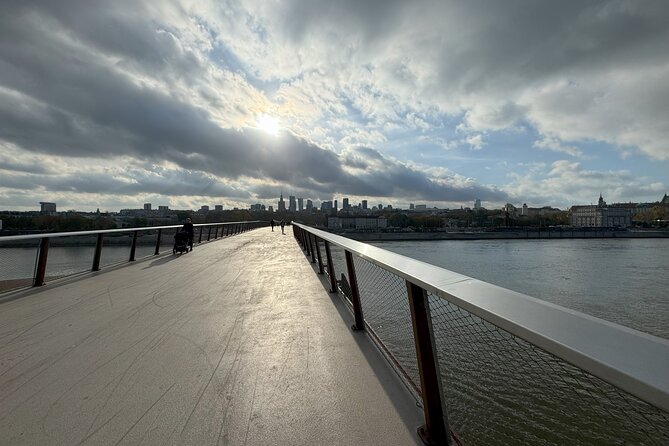
The final section reaches Most Na Pragę, the new bridge crossing. This is the payoff in visual terms. From the bridge, you can bring together the river, Warsaw’s skyscrapers, the Old Town side, and the Praga side in one view.
After several hours of separate pieces, the skyline begins to make sense. You have seen the city from parks, streets, beaches, and both banks. The final panorama connects those places and gives the ride a clean ending before returning to Station Warsaw Tours.
The bridge is also a good reminder of Warsaw’s current direction. The city is not preserved in one period. It keeps adding new structures while older districts, parks, and historic traces remain close by.
What the guides add to the ride
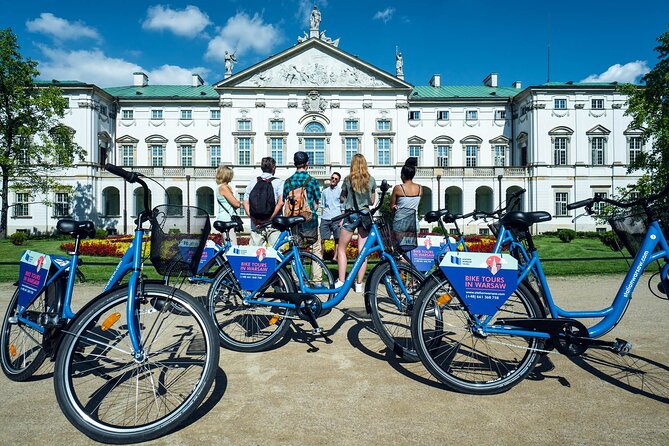
The guide is the difference between a long bicycle transfer and a real city tour. The experience is in English, and the strongest recent comments point to Marcin’s clear explanations, humor, and ability to connect individual sites with Polish history.
One particularly meaningful ride took place on August 1, the anniversary of the 1944 Warsaw Uprising. Marcin adjusted the route so the group could experience the city’s sirens at the remembrance hour. That example shows why a local guide can add value beyond a fixed route. Dates and public events can change how Warsaw feels.
The tour also has room for ordinary human moments. One ride continued through steady rain and a flat tire, with the guide working to keep the group moving and the historical commentary going. You should not count on perfect conditions, but it is reassuring to know the route is not built only for postcard weather.
Who should book, and who should skip it
I would choose this tour if you have at least one full day in Warsaw and want more than the Old Town and major museums. It suits adults, older children, and anyone who likes to combine city history with parks and everyday neighborhoods.
It is also a good choice for families who want a shared overview before exploring individual areas on their own. The route covers enough ground to help you decide where to return later.
I would skip it if you dislike cycling in a city, have trouble riding for several hours, or want long visits inside monuments. This is a moving tour with short site stops, not a series of extended museum entries. Children under 10 cannot participate, and every rider must confirm that they can bicycle and understand Polish road rules.
Alcohol and drugs are forbidden before and during the ride. If the guide decides someone is not fit to cycle, that person can be refused for safety reasons, without a refund. Plan carefully, wear practical clothing, and check the weather before you leave. A rain poncho costs 5 PLN if needed, but it is wiser to avoid relying on last-minute supplies.
You can cancel up to 24 hours ahead for a full refund, and the reserve-now-pay-later option keeps the booking flexible. Availability and starting times should be checked before booking.
Should you book the Secrets of Warsaw bike tour?
Book it if you want Warsaw in broad strokes and small details at the same time. For $57, you get a bicycle, an English-speaking guide, the Fotoplastikon ticket, two major parks, the Vistula, the National Stadium, Praga, and a final skyline view.
The best reason to go is the route itself. It reaches wooden Finnish cottages, a chocolate tradition, a river beach, a prewar photo machine, and districts shaped by war and political change. You will work harder than on a bus tour, but you will also feel the city’s distances and contrasts.
If you are a confident cyclist and want a well-rounded first look at Warsaw, I would book it. If you need a slow pace, indoor comfort, or detailed visits to individual monuments, choose shorter walking tours instead.
FAQ
Where does the bike tour start?
It starts at Station Warsaw Tours, 16/18 Koźla Street. The meeting point is about one kilometer from Sigismund’s Column in Castle Square. The nearest metro station is Metro Ratusz Arsenał, about 1.2 kilometers away.
How long does the tour last?
The tour lasts 210 minutes, or three and a half hours. The experience is commonly described as a four-hour bike tour, so check the available starting time and schedule when booking.
Is bicycle rental included?
Yes. Bike rental is included in the price, along with an English-speaking local guide and a ticket to the Warsaw Fotoplastikon.
Is the tour offered in English?
Yes. The live tour guide language is English.
Can children join?
Children under 10 are not suitable for this activity. Every participant must also confirm that they can ride a bicycle.
Are food and drinks included?
No. Refreshments along the route are not included. The tour includes a 30-minute break at E. Wedel, but you should plan to pay for any snacks or drinks yourself.
What happens if it rains?
A rain poncho is available for 5 PLN. The tour can take place in rainy conditions, but you should dress for the weather and be prepared for several hours of outdoor cycling.
Latest bike tours added in Poland
- Krakow: Old Town Bike Tour with a Guide★ 4.5 · 54 reviews
- Krakow: Complete Bike tour with all the highlights★ 4.9 · 90 reviews
- Krakow: 3-Hour Small Group Tour on E-Bike★ 4.8 · 135 reviews
- Gdansk Private Bike Tour★ 5.0 · 21 reviews
- Gdańsk: Highlights Bike Tour★ 4.9 · 173 reviews
- Hidden Krakow Bike Tour★ 5.0 · 275 reviews
- Krakow: Highlights of Krakow Bike Tour – Small Group★ 4.9 · 421 reviews
- Full Bike Tour – the Old Town, Jewish Qtr & the Ghetto NEW BIKES★ 5.0 · 437 reviews
Poland Bike Tours, compared.
Complete Cracow Bike Tour (small group of maximum 15 people!)
Read our review →
Krakow: Bike Tour of Old Town, Jewish Quarter and the Ghetto
Read our review →
Full Bike Tour – the Old Town, Jewish Qtr & the Ghetto NEW BIKES
Read our review →
Krakow: Highlights of Krakow Bike Tour – Small Group
Read our review →
Browse the lists this tour appears in