
Review · PARIS BIKE TOURS
Paris Bike Tour Hidden Secrets in the Latin Quarter & Le Marais neighborhoods
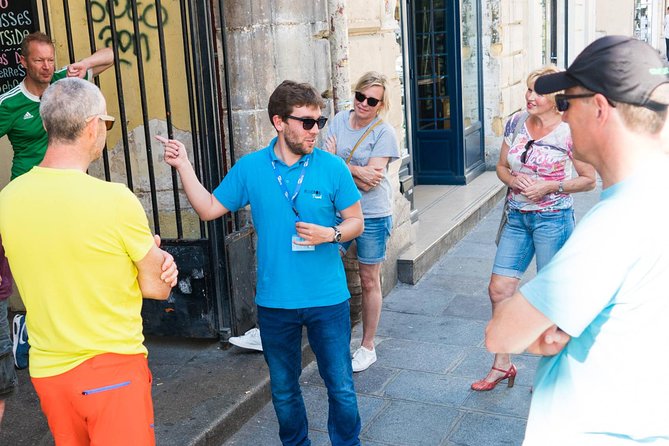
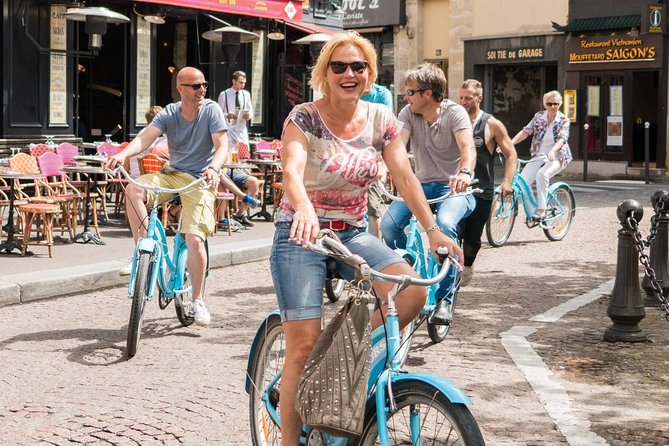
Paris reveals itself differently from a bicycle. This tour links the Latin Quarter and Le Marais, two central neighborhoods packed with old streets, religious landmarks, Jewish history, Roman remains, and good places to stop for lunch. You cover far more ground than you would on foot, yet still pause often enough to hear the stories.
I like the small maximum of 12 people, which makes it easier to stay with the guide, and I like the mix of famous sights and easy-to-miss corners, from the Arenes de Lutece to the cannonball lodged in the Hotel de Sens. The catch is city riding: you must be comfortable beside cars, buses, scooters, pedestrians, and other bicycles.
Key points at a glance
- Two historic neighborhoods in four hours: Move from university streets and Roman ruins in the Latin Quarter to Jewish heritage sites and grand squares in Le Marais.
- A real lunch break: You get 30 minutes near rue Mouffetard to buy crepes, bakery food, or a café meal at your own cost.
- Small-group attention: The tour has a maximum of 12 people, and guides such as Arnaud, Aaron, Lena, Joris, and Cece are praised for warmth and strong local knowledge.
- Bikes and helmets are included: The bikes are reported to be new and comfortable, but they have no baskets, so bring a small backpack.
- City traffic is part of the deal: Some riders feel perfectly comfortable, while others find close cars, crossings, and crowded lanes stressful.
- Good value for active sightseers: At $54.42 per person, you get four hours, equipment, a guide, and many stops, but food and gratuity cost extra.
Why this route gives you more Paris in less time
The route begins at the Fontaine Saint-Michel at 10 a.m. and returns there after roughly four hours. That central meeting point is near public transport, though construction or market tents can sometimes hide the fountain, so allow time to find the exact spot.
This is not a nonstop cycling workout. The ride is broken into short stretches, photo stops, brief walks, explanations, and a lunch pause. You will still pedal through central Paris, but the day has a sightseeing rhythm rather than a race.
The main gain is distance. On foot, you could spend a full day covering only part of this route. By bicycle, you connect places that sit a few streets apart but feel like separate worlds. You also get the pleasure of seeing ordinary Parisian streets between the headline sights.
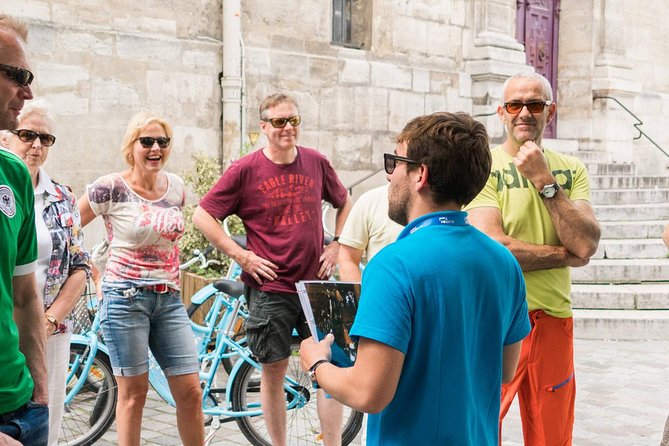
The tour is offered in English and includes a local guide, bicycle, and helmet. The small-group limit matters here. Paris is not always easy to navigate as a group, and a guide who can see and respond to each rider makes the experience more relaxed.
More bike tours in Paris:
- Versailles Palace Bike Tour with Market & Marie-Antoinette hamlet
★ 5.0 · 2,680 reviews - Paris: Charming Nooks and Crannies Bike Tour
★ 4.8 · 2,585 reviews - From Paris: Versailles Bike Tour w/ Palace, Gardens, & Picnic
★ 5.0 · 2,150 reviews
Shakespeare and Company begins the Latin Quarter
The first part takes place in the Latin Quarter, one of the oldest parts of Paris. Its name comes from the Latin once used by students and teachers at the Sorbonne, when Paris was becoming one of Europe’s early international university centers.
The first stop is Shakespeare and Company, the famous bookstore near Notre-Dame. The shop occupies a medieval building with timber beams and plaster walls. Inside, shelves are packed tightly with literature, and the atmosphere feels more like an old reading room than a modern shop.
You get a short explanation of the store’s past, followed by free time to look around. The bookstore has long been linked with visiting writers, and some authors have slept there as part of its tradition. This is a quick stop, but it gives the tour an inviting start.
Le Procope and the café life of old Paris
Next comes Le Procope, founded in 1686 and often described as Paris’s oldest café. The stop is brief, mainly for stories and photographs, but its famous former customers give the place weight.
Benjamin Franklin, Voltaire, Napoleon Bonaparte, and Victor Hugo are all linked with the café. Your guide can turn the building into a small lesson about the political and literary life that grew around Parisian cafés.
You do not need to dine here, and food is not included. Think of it as a look at an important Paris address, not a restaurant visit.
Saint-Sulpice, unusual towers and church grandeur
Saint-Sulpice is one of the largest churches in Paris, almost edging out Notre-Dame in height. Its two towers do not match, which gives the facade an unusual appearance and makes it easy to recognize.
The guide explains the church’s complicated past and its link with Dan Brown’s The Da Vinci Code. You also go inside to see the broad interior. Admission is not included in the tour price, so be prepared for that possible extra cost.
This stop suits visitors who like architecture but do not want to spend a long time in every church. Fifteen minutes is enough to grasp the main story and take in the scale, though you may wish you had more time if religious art is a major interest.
Another way to spend a morning on two wheels:
- Paris: City Highlights Bike Tour
★ 4.7 · 1,835 reviews - Electric Bike Tour of Paris’ Hidden Gems
★ 4.9 · 1,377 reviews - Paris Local Districts and Stories Off the Beaten Track Guided Bike Tour
★ 5.0 · 1,264 reviews - Best of Paris Electric Bike Tour
★ 5.0 · 1,179 reviews
The Pantheon, France’s memorial hall
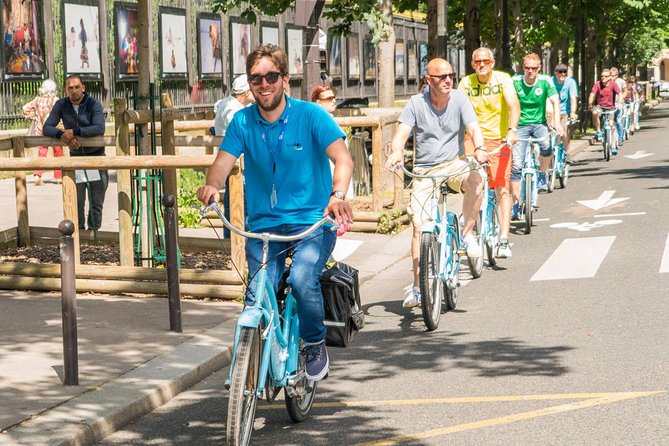
The Pantheon is one of the route’s biggest sights, yet it often receives less attention from international visitors than the Eiffel Tower or Notre-Dame. It began as a church and now serves as the final resting place of some of France’s most honored figures.
The guide points out names such as Pierre and Marie Curie, Alexandre Dumas, Victor Hugo, and Josephine Baker. That list alone shows how the building connects science, literature, politics, and social change.
The stop is listed as free, but the schedule allows only about 15 minutes. You get the story and a look at the building, not a long interior visit. If you want to study the crypt or architecture at length, return another day.
Lunch near rue Mouffetard
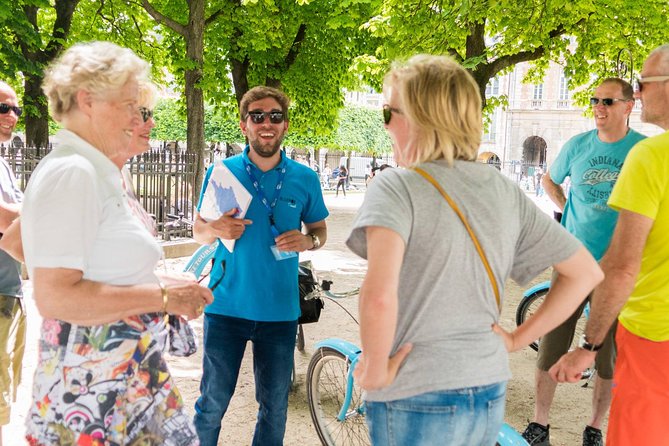
The lunch break comes around Marche Monge and rue Mouffetard, an area known for local cafés and food shops. You have 30 minutes to choose and pay for your own meal.
Savory crepes are a natural choice here, though you can also use the break for a bakery or café. The guide can point you toward lunch and ice cream options, as Joris did for one family group.
This pause is useful for more than food. It gives your legs a rest and lets you experience the neighborhood at street level. Bring a small backpack rather than expecting to carry a shopping bag on the bicycle. The bikes do not have baskets.
Roman Paris at the Arenes de Lutece
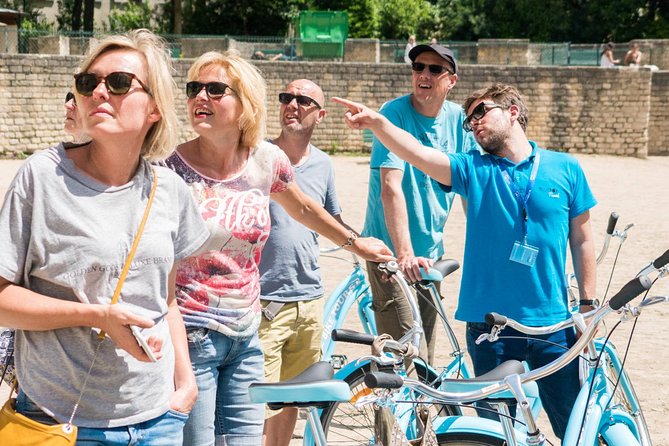
The Arenes de Lutece is one of the tour’s most surprising stops. Paris was once the Roman city of Lutetia, and this ancient arena is a reminder that the city’s story reaches far beyond medieval churches and grand boulevards.
You cycle into the arena and hear about the role Rome played in shaping Paris, along with the public spectacles held here. The site is tucked away enough that many people pass through the Latin Quarter without realizing it exists.
This is exactly the kind of stop that makes a bike tour useful. You arrive quickly, hear the explanation, and see a part of Paris that is easy to miss when your route is limited to major monuments.
Entering Le Marais and its Jewish heritage
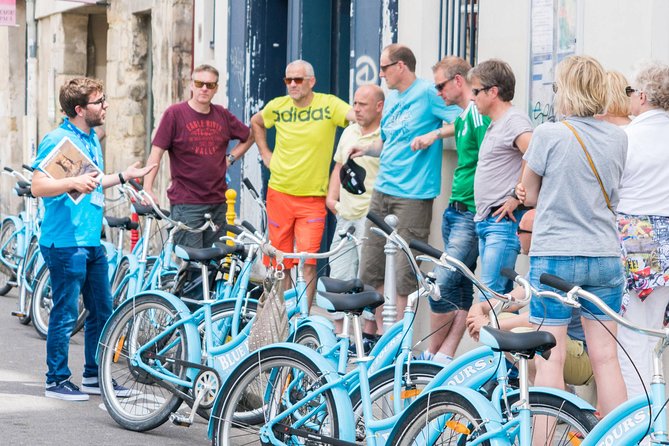
The second half moves into Le Marais, a district with a strong Jewish identity and a long record of urban change. The neighborhood began as marshland, then was built up over the centuries.
Today Le Marais is known for shops, cafés, galleries, food, and handsome old buildings. It is especially active on Sundays, when many businesses are open. In France, shops must close for at least one day each week, and many Le Marais businesses close on Saturday instead.
The route does not treat the neighborhood as just a pretty shopping district. It gives proper attention to the Jewish community and to the painful wartime history that shaped this part of Paris.
The Shoah Memorial and the cost of remembrance
The Memorial de la Shoah is a quiet, serious stop. A wall records the names of more than 3,900 non-Jewish French people who risked, and in some cases lost, their lives while helping Jewish people during World War II.
This is not a light sightseeing moment. The guide presents it as part of the cultural story of Le Marais, where Jewish life has long been central. You should expect the tone to change here, and you should give the stop the attention it deserves.
The visit is short, around 15 minutes, but it adds moral and historical depth to the route. Without it, Le Marais could seem like little more than attractive streets and restaurants.
Rue des Rosiers, the heart of Jewish Le Marais
At Rue des Rosiers, you get off and walk the bicycle through the pedestrian street. This is a good arrangement because the lane can be busy with people, shops, and restaurant traffic.
The street is known for small boutiques, kosher restaurants, and the smells coming from its food counters. It is a natural place to notice how the neighborhood’s past remains part of daily life.
Do not expect a long meal here. The route gives you time to look, smell, and absorb the setting before moving on. If you return independently, this is one of the places where a slower visit makes sense.
Place des Vosges and the old royal city
Place des Vosges is one of Paris’s most beautiful squares, framed by red-brick buildings dating from the 1500s. Its design feels unusually complete and orderly compared with the winding streets around it.
The square brings together several sides of Paris. Elegant buildings house art shops and a high-end hotel, while the grassy center belongs to picnickers, families, and children playing near the fountains.
This is a pleasant stop for photographs and a breather. It also shows how Le Marais shifted between aristocratic, residential, commercial, and local uses over the centuries.
The medieval wall of Philippe II Augustus
The Wall of Philip II Augustus gives you a physical trace of medieval Paris. Philippe, king of France in the 1100s, ordered a substantial stone wall around the city as protection against attack.
The guide connects Philippe with Richard the Lionheart, who ruled England at the time, and explains the political reasons behind the fortification. You stop at the largest and best-preserved section on the route.
This is not a grand monument, and that is the point. A remaining stretch of stone can tell you how small Paris once was compared with the city you see today.
Hotel de Sens and its memorable cannonball
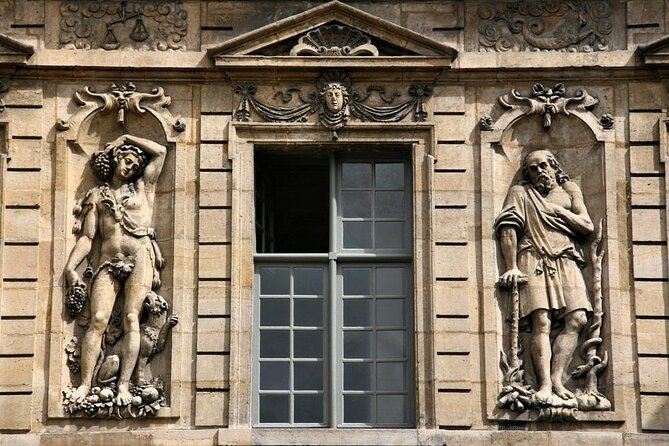
The Hotel de Sens looks almost like a small fortress, with turrets and gargoyles. It is tucked away from the main tourist paths, making it a fine example of the route’s preference for unusual corners.
The guide explains why the mansion was built and points out a cannonball stuck in the facade. That odd detail gives the building a story you are likely to remember long after the architectural facts have faded.
The stop is brief, but it is also one of the tour’s most charming moments. You see an elegant old structure, then get a surprising piece of Parisian history attached to it.
How hard is the cycling?
You do not need to be a serious cyclist, but you do need to know how to ride confidently in a city. Anyone aged 10 or older must cycle independently. Children aged 1 to 4 can use a reserved child seat, while children aged 5 to 9 may ride alone if able or use a reserved tandem attachment.
The bikes are one-speed models with low gearing. That makes them simple to use, but one rider found that hills and some intersections required heavy stand-up pedaling. Another rider in their late sixties found the tour physically demanding even though the pace was not rushed.
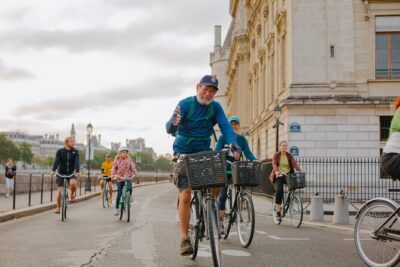
Several guides, including Aaron, Lena, Lucien, and Ryan, are praised for setting a manageable pace and keeping an eye on less confident riders. Still, no guide can remove every challenge from central Paris.
Traffic, crossings, and practical comfort
Some stretches use bike lanes, but this is not a car-free ride. You may share the road with cars, buses, scooters, pedestrians, and other cyclists. Main-road crossings can split a group if the light changes, and a few riders felt uneasy when vehicles passed close by.
Pay close attention to the guide and follow the group’s signals. If you are nervous on a bicycle, or if city traffic scares you, choose a walking tour instead. The tour is not recommended for adults who lack confidence on a bike.
Wear shoes that stay secure on your feet. Flip-flops are specifically discouraged. The tour runs in all weather, so check the forecast and pack a raincoat. One guide had ponchos available, but you should not count on that.
Price, group size, and guide quality
At $54.42 per person, the tour offers four hours of guiding, bicycle use, helmet use, and a route through two central neighborhoods. You also get a planned lunch break and repeated chances to stop rather than simply cycling past the sights.
The price is fair if you value orientation and local stories. You would pay separately for lunch, drinks, possible admission at Saint-Sulpice, and a tip if the guide serves you well.
Guide quality is a major part of the value. Arnaud is praised for mixing history trivia with a playful tone. Aaron is singled out for making less confident riders feel safe. Lena is described as attentive and informative, while Joris helped with meeting-point details and food suggestions.
Cece received especially warm praise after giving a small private-feeling group extra time for a birthday celebration. That kind of personal attention cannot be guaranteed, but it shows how much the guide shapes the day.
Should you book this Paris bike tour?
Book it if you want to see a lot of central Paris in one morning and enjoy learning the stories behind ordinary streets. It is especially good for first-time visitors, repeat visitors who have already seen the major monuments, families with confident older children, and anyone who likes history mixed with food and neighborhood life.
Skip it if you want quiet cycling, a car-free route, or long visits inside each monument. You should also think twice if you are not comfortable starting, stopping, crossing roads, and riding near traffic.
For the best experience, bring a small backpack, a rain layer, secure shoes, and enough energy for four active hours. Arrive early at the Fontaine Saint-Michel, stay close to the guide, and treat the lunch stop as part of the experience rather than a rushed interruption.
FAQ
Where does the Paris bike tour start and finish?
The tour starts at Fontaine Saint-Michel, Place Saint-Michel, 75005 Paris, at 10 a.m. It ends back at the same meeting point.
How long does the tour last?
The experience lasts approximately four hours, including sightseeing stops and a 30-minute lunch break.
What is included in the price?
A local English-speaking guide, bicycle rental, and helmet rental are included. Food, drinks, and tips are not included.
How many people can join the tour?
The small-group tour has a maximum of 12 participants.
Do I need to be an experienced cyclist?
You do not need advanced cycling skills, but you must be able to ride independently if you are aged 10 or older. The route includes city traffic, road crossings, and some sections that may require effort on the one-speed bikes.
What happens if the weather is bad?
The tour runs in all weather. Dress according to the forecast, bring rain protection if needed, and avoid wearing flip-flops.
Latest bike tours added in Paris
- The Best of Paris by Bike with a Local★ 4.8 · 15 reviews
- The Best of Paris: Small Group Bike Tour like a Local★ 4.7 · 12 reviews
- Paris: Afternoon E-Bike Guided Small Group Tour★ 4.8 · 152 reviews
- Private Highlights of Paris Bike Tour★ 4.9 · 12 reviews
- Paris: Guided Private E-bike Sightseeing Tour★ 4.4 · 19 reviews
- Paris: Versailles Palace and Queen Hamlet E-Bike Tour★ 5.0 · 126 reviews
- Paris: Street Art Open-Air Museum Bike Tour★ 4.8 · 51 reviews
- Paris : Private guided tour Rickshaw bike – Saint-Germain★ 4.7 · 15 reviews
Paris Bike Tours, compared.
Versailles Palace Bike Tour with Market & Marie-Antoinette hamlet
Read our review →
Versailles Bike Tour w/ Palace, Gardens, & Picnic
Read our review →
Paris Local Districts and Stories Off the Beaten Track Guided Bike Tour
Read our review →
Highlights of Paris Bike Tour w/ a Local Guide (English or Dutch)
Read our review →Browse the lists this tour appears in