Review · TOURS
Fatima Neighborhood and Church Unit Bike Tour
Brasília makes the most sense from a bicycle. This tour connects the city’s grand plans with everyday life in the superquadras, the residential blocks designed by Lúcio Costa. You’ll pedal from the TV Tower through parks, schools, shops, a cinema, and two striking churches, ending at the blue-lit Sanctuary of St. John Bosco.
I like the sensible route and the mix of open parks with lived-in neighborhoods. I also like the focus on SQS 308, the model residential block, since it shows how Brasília was meant to function rather than simply presenting monuments for photographs. The main consideration is weather: the ride needs good conditions, and Brasília’s broad outdoor spaces offer little shelter from strong sun or rain.
Key points to know before you ride
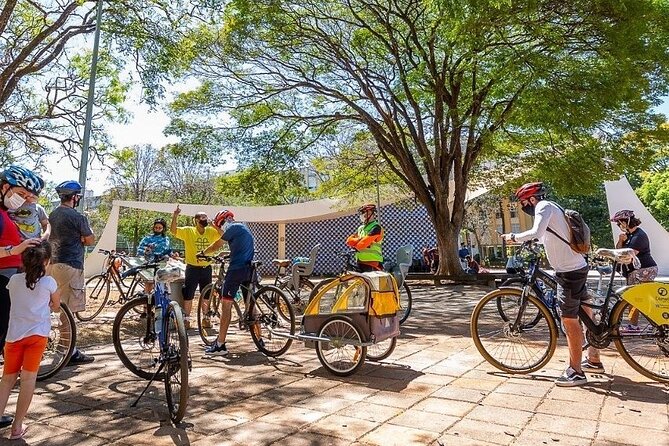
- SQS 308 is the heart of the tour: See the model superquadra planned by Lúcio Costa and landscaped by Roberto Burle Marx.
- The route connects design with daily life: Shops, a school, cinema, residential buildings, and cultural venues help explain Brasília beyond its famous government buildings.
- Two churches provide memorable finishes: Igrejinha Nossa Senhora de Fátima has Athos Bulcão tiles, while Dom Bosco Sanctuary is known for its dramatic interior light.
- You get about three hours on the bike: Planned stops total roughly two hours, with the remaining time used for cycling between sites.
- The group is capped at 15 people: That is small enough for a guide to keep the ride organized and answer questions.
- Families can request extra support: An articulated tandem passenger trailer or bike is available for children from about 4 to 10 or 12 years old.
Why a bicycle is the right way to read Brasília
Brasília can feel spread out when you move between sights by car. Its wide avenues and carefully separated districts were designed for a new capital, not for wandering from one landmark to the next on foot. A bicycle gives you a useful middle ground: you cover more distance than walking, yet you still notice the rhythm of the residential blocks.
The tour begins at Camelo Bike Tour’s office in the Brasil 21 business center on SHS Quadra 06, in Asa Sul. From there, the route enters the central parts of Brasília’s residential plan. You are not just ticking off buildings. You are seeing how the city’s ideas were applied to housing, green space, culture, and public gathering places.
The route is also a good fit if you want a guide to explain the city’s design in plain terms. Duda, one of the guides associated with this experience, has been praised for connecting the buildings and public spaces with ordinary life in Brasília. That matters here, because the architecture can seem abstract until someone points out the nearby shops, school, cinema, and shared open areas.
The ride lasts about three hours. The listed stops account for around 120 minutes, so expect the rest of the time to cover cycling, transitions, and explanations along the way. The pace is designed around frequent stops rather than a long-distance workout.
More bike tours in the world:
- Lion City Bike Tour of Singapore
★ 5.0 · 6,211 reviews - Big Bike tour Amsterdam – See all in 3 unforgettable hours
★ 4.7 · 4,929 reviews - 3-Hour Porto Highlights on a Electric Bike Guided Tour
★ 5.0 · 4,392 reviews
TV Tower: a quick orientation to the capital
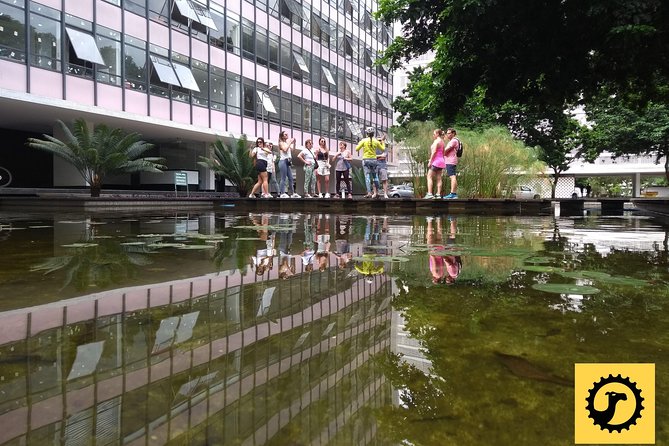
The TV Tower is the first stop, with about 10 minutes set aside for an explanation and photographs. Admission is free. This is a short opening visit, but it gives you a useful point of reference before the ride heads into the residential districts.
Do not expect a long stay here. The value is in getting your bearings and seeing one of Brasília’s recognizable public structures before moving on. If you want extensive time for photographs, you may need to be efficient, since the tour keeps moving.
The route also passes a cultural space inspired by the idealism of Reco do Bandolim and shaped by Oscar Niemeyer’s design work. It includes the concert hall of Brasília’s Choro Club. Choro, a Brazilian instrumental music tradition, adds a cultural layer to a tour that might otherwise seem focused only on architecture and urban planning.
This stop helps explain that Brasília was planned as a center for Brazilian culture as well as government. You see modern design serving music, public life, and national identity.
Parque da Cidade and the Eduardo e Mônica square
Next comes Parque da Cidade Sarah Kubitschek, one of the world’s largest urban parks. The tour spends about 25 minutes here, with free admission. The park was created by Roberto Burle Marx, one of Brazil’s best-known designers of public gardens and open spaces.
The important thing for you is scale. Brasília’s parks are not small decorative patches between buildings. They are major pieces of the city plan. Cycling through one gives you a clearer sense of how much space was reserved for recreation and public use.
Inside the park, the route visits Praça Eduardo e Mônica, created in honor of the song by the Brazilian band Legião Urbana. This is a specific and appealing detail for anyone interested in Brazilian popular music. It also keeps the tour from becoming a lesson only in famous architects. You get a reminder that Brasília has its own music, memories, and local cultural references.
The park stop should feel relaxed, though the open setting means sun protection is sensible. The tour information does not specify bike equipment or shade, so bring what you normally need for a sunny ride. The short stop works well as part of a morning route, but it is not designed as a long park visit.
Burle Marx Garden and the art of open space
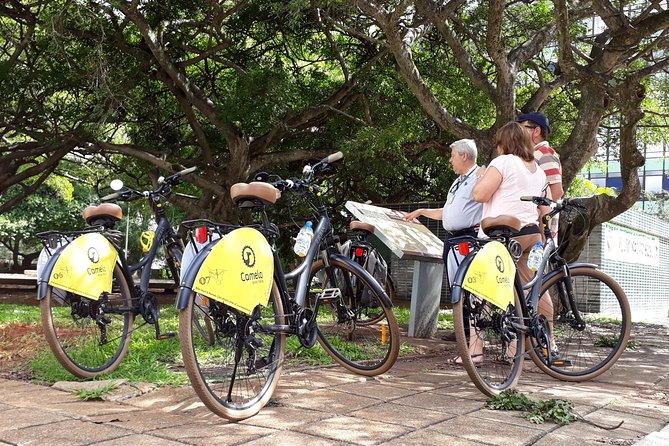
The 10-minute stop at Jardim Burle Marx is brief, but it reinforces one of the tour’s central ideas: Brasília was planned through the relationship between buildings, paths, trees, and open ground.
Burle Marx was not simply adding plants around completed structures. His work helped shape how people experience the city from the street and from the bicycle. On a route that includes large residential blocks and wide public spaces, this is useful context. You begin to notice that the greenery is part of the design rather than leftover space.
Because the visit is short, treat it as an explanation and photo pause, not a full garden tour. The advantage is that the route keeps moving and gives you several different examples of Brasília’s urban planning in one morning.
Another way to spend a morning on two wheels:
- Ninh Binh Full-Day Tour from Hanoi to Hoa Lu, Tam Coc & Mua Cave Via Boat & Bike
★ 5.0 · 4,384 reviews - Small Group Guided Bike Tour of Amsterdam’s Hidden Gems
★ 5.0 · 3,936 reviews - 3-hour Complete Prague Bike Tour
★ 5.0 · 3,674 reviews - Bangkok: Temples, Canals & Local Life Bike Tour
★ 4.9 · 3,511 reviews
SQS 308: Brasília’s model residential block
The most valuable part of the ride is the 45-minute visit to SQS 308, also called Superquadra Sul 308. This was chosen as the city’s model residential block. Lúcio Costa designed the block, Burle Marx handled the urban planning and gardens, and Banco do Brasil built it. It opened on February 19, 1962.
Here you see the residential idea at a human scale. The superquadra was meant to combine housing with shared green areas and nearby services. Instead of treating the apartment blocks as isolated towers, the plan placed daily needs around the homes.
The tour includes the nearby shopping area, school, and cinema. That makes SQS 308 more useful than a quick pass by a modernist building. You can examine how the planned residential unit was intended to work, with ordinary services close to where people live.
I especially like this section because it answers a question many people have about Brasília: was the city built only for monumental government buildings, or was there a plan for daily life too? SQS 308 gives you the answer. It shows the residential scale that Lúcio Costa imagined for the city.
The block is also a strong place to discuss the limits of planned cities. A model design can look elegant on paper, but it still has to support real families, students, workers, and local businesses. The tour’s attention to shops, school, and cinema helps you see the block as a functioning neighborhood rather than a museum piece.
Cine Brasília and Renato Russo Hall
The route continues through two cultural landmarks: Cine Brasília and Renato Russo Hall. Cine Brasília hosts the Brasília Film Festival, national film releases, foreign programs, themed weeks, debates, book launches, and exhibitions of paintings, photographs, and posters.
That range gives the cinema a broader role than a standard movie theater. It is part of the city’s cultural network, with links to embassies, public schools, and universities. For you, the stop adds useful local context: Brasília’s cultural life is not limited to monumental architecture or official ceremonies.
Renato Russo Hall connects the route to Brazilian music and the legacy of Legião Urbana’s frontman. Since the tour already includes the Eduardo e Mônica square, these cultural references form a thread through the day. You see how Brasília’s identity has been shaped by music, film, and public gathering places as well as by architects.
The available schedule does not assign separate times to Cine Brasília or Renato Russo Hall, so think of them as passing points or explanatory stops within the wider route. Their value comes from the story they add, not from a long interior visit.
Igrejinha Nossa Senhora de Fátima
The small Church of Our Lady of Fátima receives about 20 minutes. Known locally as Igrejinha, it opened in June 1958 and was the first church in Brasília’s residential sector.
The church was built at the request of Dona Sarah Kubitschek after her daughter recovered from an illness. That personal origin gives the building a different feel from Brasília’s large official structures. It connects the new capital to family faith and neighborhood life.
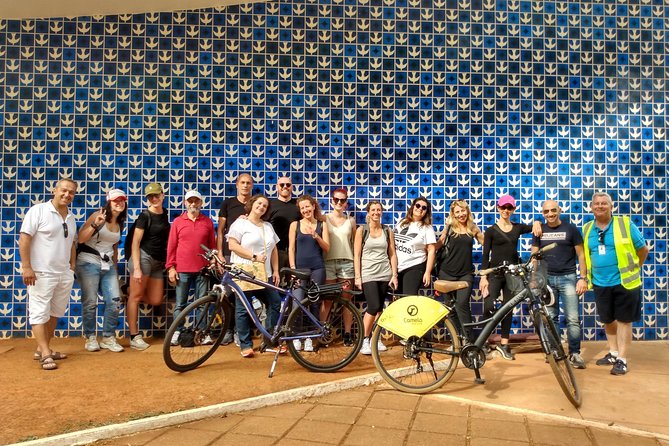
The exterior tiles are by Athos Bulcão. They show stylized figures of the Divine Dove and the Star of the Nativity. These tiles make the church easy to recognize and show how art was built into Brasília’s public spaces from the beginning.
This is one of the tour’s best photo stops, but it is worth looking beyond the surface. The church brings together architecture, religious devotion, Brazilian art, and the early years of the capital in a compact building. The 20-minute visit gives you enough time to hear the story and take in the tilework without slowing the entire route.
Dom Bosco Sanctuary and the blue end to the ride
The final stop is the Sanctuary of St. John Bosco, with about 10 minutes scheduled. It honors Brasília’s patron saint, St. John Bosco, and offers a dramatic final contrast to the smaller Igrejinha.
The sanctuary is particularly memorable for its interior atmosphere, created by blue stained glass. The tour’s short stop is enough to see the main effect, though you should not expect a long religious or architectural visit. It works as a compact finish after the neighborhood-focused middle section.
Ending here is smart. You have spent much of the ride looking at the practical side of Brasília’s plan: housing, parks, services, and cultural spaces. The sanctuary brings the tour back to a grand, symbolic interior. It gives the route a strong visual close before you cycle back to the starting point.
The activity ends at the same Camelo Bike Tour meeting point. Since the ride returns to Asa Sul, you do not need to arrange a separate pickup at the end.
Price, group size, and who gets the most value
At $62.73 per person, this is not the cheapest way to move around Brasília, but the price is reasonable if you want transportation, a bicycle, and a guide’s explanation in one package. You are paying for a focused route through several districts, not for admission tickets, since every listed stop is free.
The value is strongest for first-time visitors who find Brasília hard to read on their own. A map can show you the superquadras, but it does not explain why SQS 308 matters or how the residential plan was supposed to function. The guide supplies that link.
The maximum group size is 15 people. That keeps the ride from becoming a huge procession and should make it easier to hear explanations at stops. It is still large enough that you may not get a private tour feel, so anyone wanting a completely personal pace should keep that in mind.
The experience is recommended by 100 percent of the 58 ratings shown, with an overall score of 4.9 out of 5. The strongest praise focuses on the guides’ clear explanations, the balance between parks and residential areas, and the chance to see how people live in the superquadras. Those are exactly the areas where this tour offers more than a standard city sightseeing loop.
The route is also suitable for many ability levels, since most participants can take part. Families should ask in advance about the articulated tandem passenger trailer or bike for children from 4 to 10 or 12 years old. The exact age fit depends on the child and available equipment, so do not wait until arrival to request it.
Practical details before you book
The tour is often reserved about 41 days ahead, so an early booking makes sense if your dates are fixed. Confirmation normally arrives at booking, though reservations made within two days of departure may take up to 48 hours and remain subject to availability.
The meeting point is Camelo Bike Tour Brasília, SHS Quadra 06 Conjunto A, Bloco A, Loja 17, Centro Empresarial Brasil 21, Asa Sul, Brasília. The location is near public transportation, which helps if you are staying elsewhere in the city.
Plan around the weather. A full refund is available when you cancel at least 24 hours before the start time. Cancellations or changes made inside that window are not refunded or accepted. If poor weather forces the operator to cancel, you can choose another date or receive a full refund.
Should you book the Fatima Neighborhood and Church Unit Bike Tour?
Book it if you want Brasília explained through its residential design, not just its famous monuments. The long SQS 308 visit, the Burle Marx spaces, local music references, and the two churches create a well-balanced three-hour route.
I would choose this tour for a first or second day in Brasília, when the city’s scale and layout still feel unfamiliar. It is also a good pick for anyone interested in urban planning, Brazilian art, architecture, or how a planned capital supports daily life.
Skip it if you want a fast tour of Brasília’s major government buildings, or if cycling outdoors in strong sun is not appealing. For most people who want a practical, thoughtful introduction to Asa Sul and the superquadras, the route offers good value and a more grounded view of the capital.
FAQ
How long does the Fatima Neighborhood and Church Unit Bike Tour last?
The tour lasts approximately three hours, including cycling between stops and time for explanations and photographs.
Where does the tour start and finish?
It starts at Camelo Bike Tour Brasília, located at SHS Quadra 06 Conjunto A, Bloco A, Loja 17, Centro Empresarial Brasil 21, Asa Sul, Brasília. It ends back at the same meeting point.
How much does the tour cost?
The listed price is $62.73 per person.
What places are included?
The route includes the TV Tower, a cultural space connected with Brasília’s Choro Club, Parque da Cidade Sarah Kubitschek, Praça Eduardo e Mônica, Jardim Burle Marx, SQS 308, Cine Brasília, Renato Russo Hall, Igrejinha Nossa Senhora de Fátima, and the Sanctuary of St. John Bosco.
Are admission tickets included?
All listed stops have free admission, so there are no stated entry fees for the itinerary.
Can children join the bike tour?
Children can use an articulated tandem passenger trailer or bike from about 4 to 10 or 12 years old. You need to ask for this equipment in advance.
What happens if the weather is bad?
The activity requires good weather. If the operator cancels because of poor conditions, you can select another date or receive a full refund.
Latest bike tours added in the world
- Brooklyn Neighborhoods Small-Group Bike Tour★ 5.0 · 137 reviews
- Hudson Valley Craft Brewery Bike Tour★ 5.0 · 23 reviews
- The Best of Bristol Bike Tour★ 5.0 · 39 reviews
- A Day in Brooklyn Bike Tour★ 5.0 · 59 reviews
- 2 Hour Private Brisbane Mountain Bike Coaching Session and Ride★ 5.0 · 24 reviews
- Brisbane Kayak, Bike★ 4.5 · 23 reviews
- Brisbane Electric Mountain Bike Experience Tour★ 5.0 · 48 reviews
- Private Bike Tour with Olive Oil Tasting★ 4.5 · 15 reviews
Tours, compared.
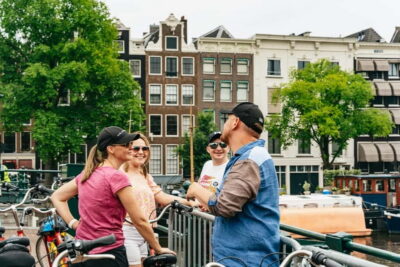
Big Bike tour Amsterdam – See all in 3 unforgettable hours
Read our review →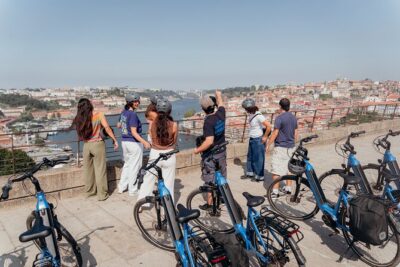
3-Hour Porto Highlights on a Electric Bike Guided Tour
Read our review →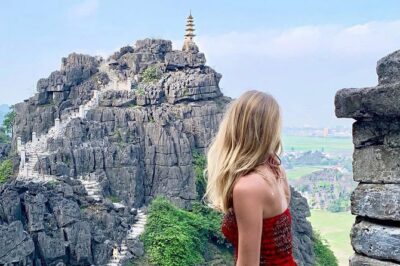
Ninh Binh Full-Day Tour from Hanoi to Hoa Lu, Tam Coc & Mua Cave Via Boat & Bike
Read our review →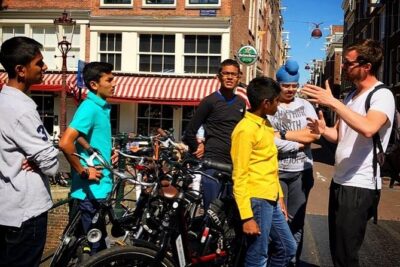
Small Group Guided Bike Tour of Amsterdam’s Hidden Gems
Read our review →