
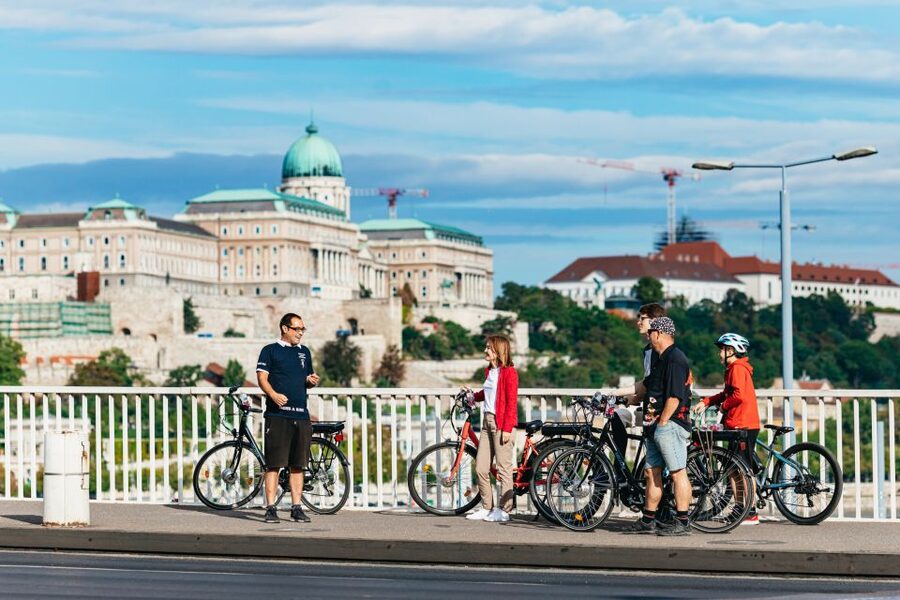
Review · CITY HIGHLIGHTS BIKE TOURS
Budapest: Grand Sightseeing Bike Tour
Budapest is made for a bike tour, and this route gives you a fast, useful introduction to both sides of the city. You ride the Danube, climb to Castle Hill, pause at Fishermen’s Bastion, then sweep through Pest to Parliament, St. Stephen’s Basilica, and Heroes’ Square. I especially like the mix of landmark views and local stories, plus the chance to cover ground that would take much longer on foot.
I also like that guides such as Carson, Thomas, Zsolti, and Andy adjust the pace and route when they can. You get a bottle of water, a helmet, and a well-maintained bike, with guides often taking photos along the way. The main drawback is the steep climb into Buda. It is manageable for a reasonably fit cyclist, but an e-bike is worth considering if you are out of practice or dislike hills.
Key points to know
- Castle Hill is the tour’s hardest section: The uphill ride is short but demanding, and an e-bike upgrade may make sense.
- You see both Buda and Pest: The route links the riverfront, Parliament, the Castle District, Andrássy Avenue, and City Park.
- The pace favors sightseeing: You ride between stops, then pause for photos, stories, and views.
- Margaret Island adds a welcome break: The leafy island gives you time away from city traffic.
- Guides make a real difference: Carson, Thomas, Zsolti, Andy, and others are praised for humor, local insight, and flexible routing.
- It is best for first-time visitors: Three hours gives you a broad sense of Budapest before you return to explore favorite sights on foot.
A three-hour introduction to both Buda and Pest

Budapest is split by the Danube, with hilly Buda on the west bank and mostly flat Pest on the east. That geography makes a bike useful. You can move between major sights quickly, see how the districts fit together, and stop at places that are too far apart for a casual walking tour.
The tour begins at the activity provider’s office at Stasher, a luggage storage location in central Budapest. Bring comfortable shoes and clothing suited to the weather. The bikes, helmets, and mineral water are provided, but large bags and luggage are not allowed.
The guide speaks English, and the group may be small. Some departures have been private when only one or two people booked. That can lead to a more personal route and extra time for questions, though you should not count on having a private guide every time.
The rating of 4.8 from 984 reviews points to a consistently strong experience. The praise centers on friendly guides, clear explanations, good bikes, and the amount of ground covered in three hours. That combination matters here. Budapest’s major sights are spread out, so a tour that stays in one neighborhood would leave too much out.
More City Bike Tours in Budapest:
- Budapest Highlights Bike Tour
★ 5.0 · 770 reviews - Budapest: Guided Downtown Electric Bike Tour
★ 4.9 · 595 reviews - Budapest: Monster Bike Roller Guided City Tour
★ 5.0 · 538 reviews
Along the Danube to Elizabeth Bridge
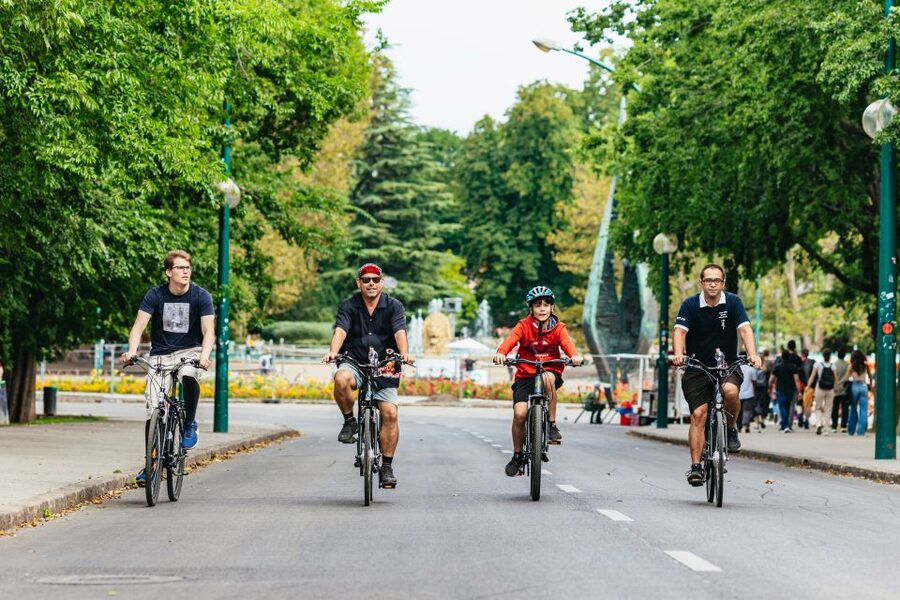
The first part of the ride follows the Danube toward Duna Corso, Budapest’s riverside promenade. This is a pleasant way to begin because the river gives you an immediate sense of the city’s scale. Across the water, the Castle District rises above Buda. On the Pest side, grand buildings line the waterfront and the bridges link the two halves of the capital.
You pass Elizabeth Bridge and stop for a guided look and photographs. The bridge is a useful orientation point, connecting the inner city with the Buda hills. From here, the route continues toward the Chain Bridge, perhaps Budapest’s most famous river crossing.
The Chain Bridge offers one of the tour’s best moving views. As you approach, you can see the Castle District above you and the Danube opening out in both directions. The stop is relatively brief, so I would not expect a long architectural lecture. Instead, you get a clear explanation of the bridge’s place in Budapest and a chance to see it from street level.
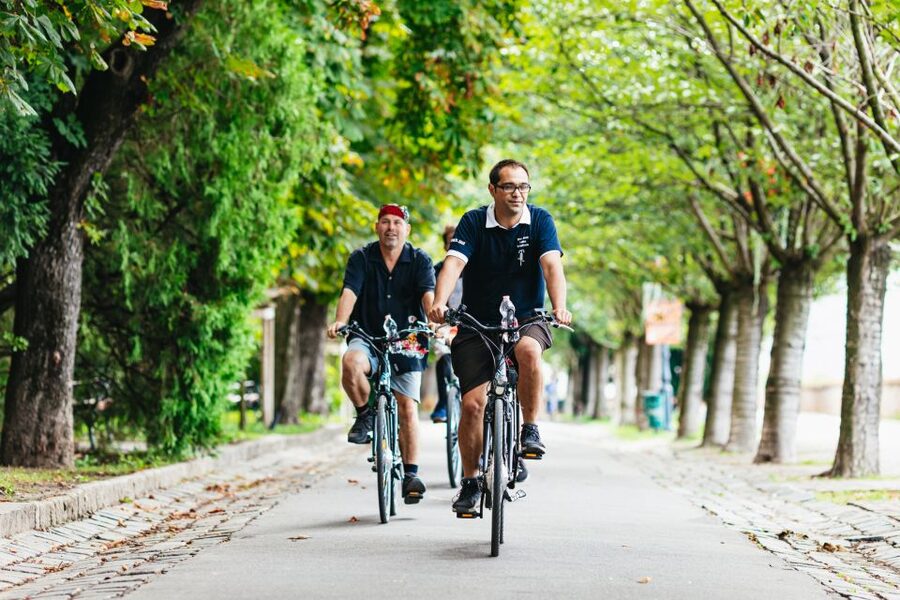
Cycling beside the river is one of the strongest parts of the experience. You avoid the slower rhythm of a walking tour, but you still travel slowly enough to notice the bridges, riverfront buildings, and changing views.
The uphill test on Castle Hill
The route then turns toward Buda and climbs Castle Hill. This is the point to take seriously. Several people who enjoyed the tour still singled out the hill as the one physically demanding section. If you ride regularly, you may find it fine. If you have not been on a bike for years, ask about an e-bike before setting off.
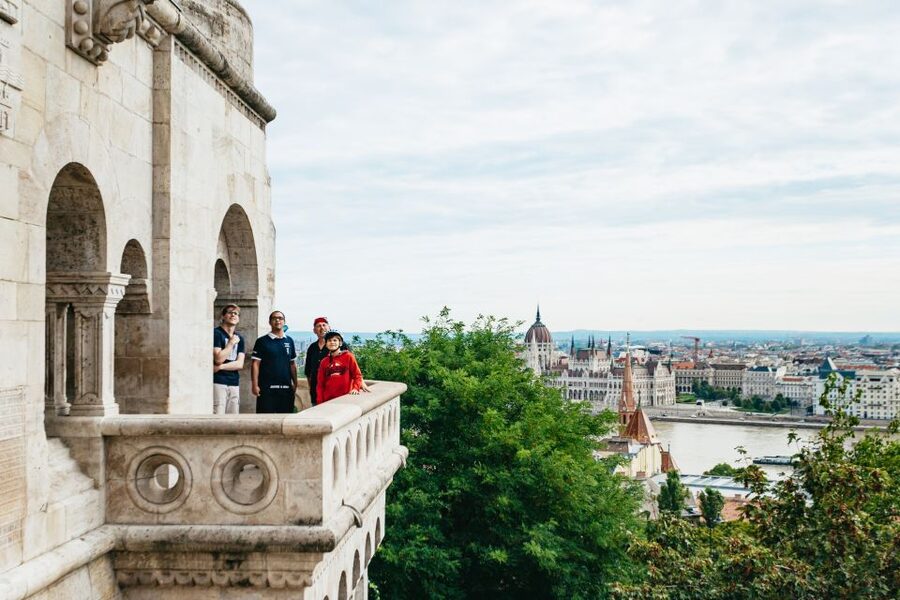
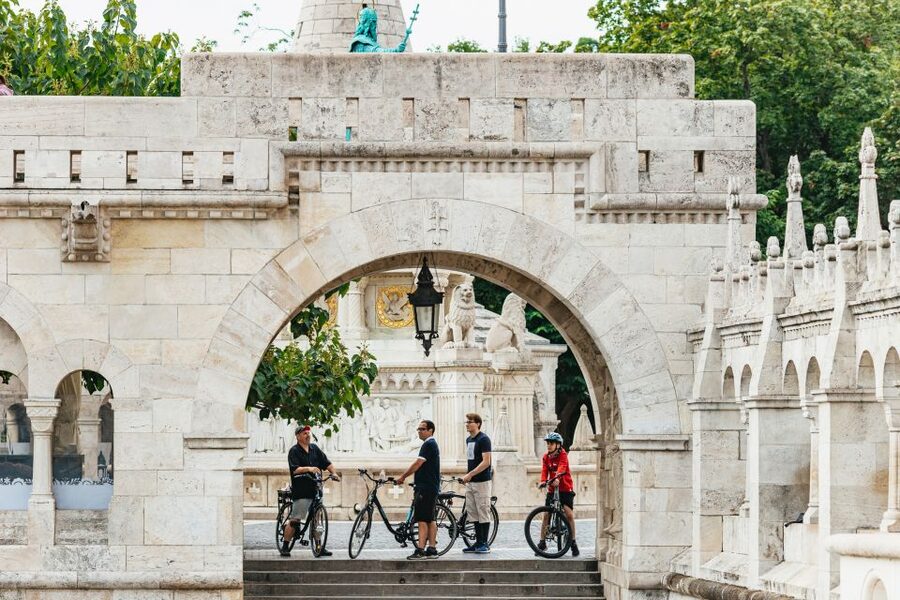
The reward is a wide view over Pest. From the Castle District, the Danube cuts through the city below, with Parliament facing the river and the bridges stretching toward the east bank. Fishermen’s Bastion provides one of the most photogenic viewpoints in Budapest, with its pale stone towers and open terraces.
You have time for a break, photos, and a walk or ride through the Castle District’s streets. This is more than a lookout. The old streets, historic buildings, and elevated position give you a feel for Buda that a fast river cruise cannot provide.
The stop is also a reminder that a bike tour is not a nonstop race. You will spend much of the three hours riding, but the route includes pauses where you can catch your breath and listen. The guide may tell stories about the Castle, the city’s past, and the contrast between Buda and Pest.
Margaret Bridge and a breather on the island
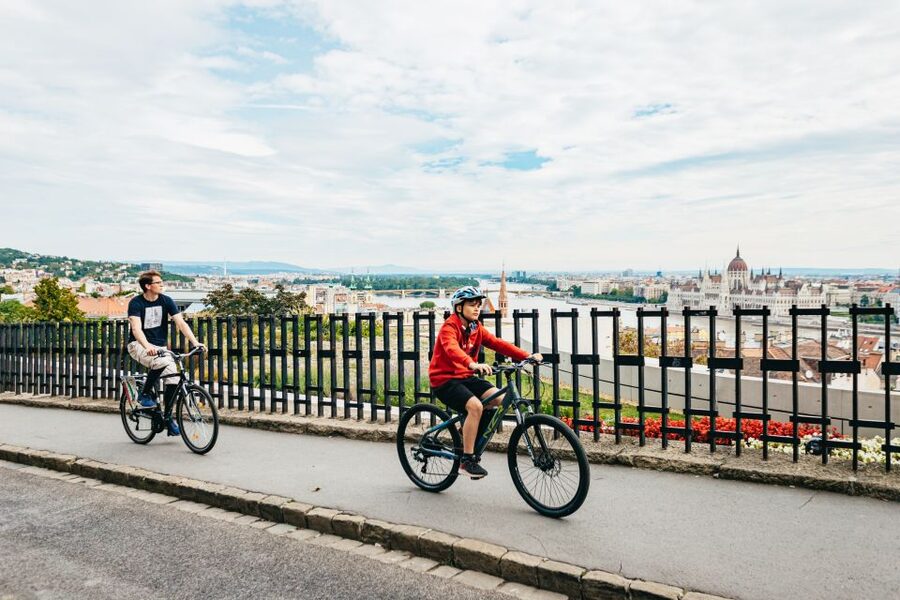
After descending from Castle Hill, you cross or pass Margaret Bridge and head toward Margaret Island. This section offers a welcome change from the hill. Margaret Bridge has a central branch leading to the island, and it is one of the city’s useful links across the river.
Margaret Island is a large green retreat in the middle of the Danube. The tour includes time for a break, photos, and a guided ride through the island. It is a good place to slow down, stretch your legs, and enjoy a quieter side of Budapest.
I like this stop because it prevents the experience from becoming a string of monuments. You get a glimpse of where local residents go for open space and recreation. The island also breaks up the riding before the route returns to the formal city center.
Do not expect a long independent visit. The island stop is part of a three-hour sightseeing route, not a full afternoon there. Still, it adds balance and gives you a chance to recover before the next run of landmarks.
More bike tours in Budapest:
- Budapest: Guided City Discovery Bike Tour
★ 4.7 · 702 reviews - Budapest Bike Tour
★ 5.0 · 365 reviews - Budapest: E-Bike Guided Tour and Castle Hill
★ 4.9 · 241 reviews - Budapest: Guided Bike & E-bike Tour with a Goulash
★ 4.8 · 220 reviews
Parliament, Freedom Square, and St. Stephen’s Basilica
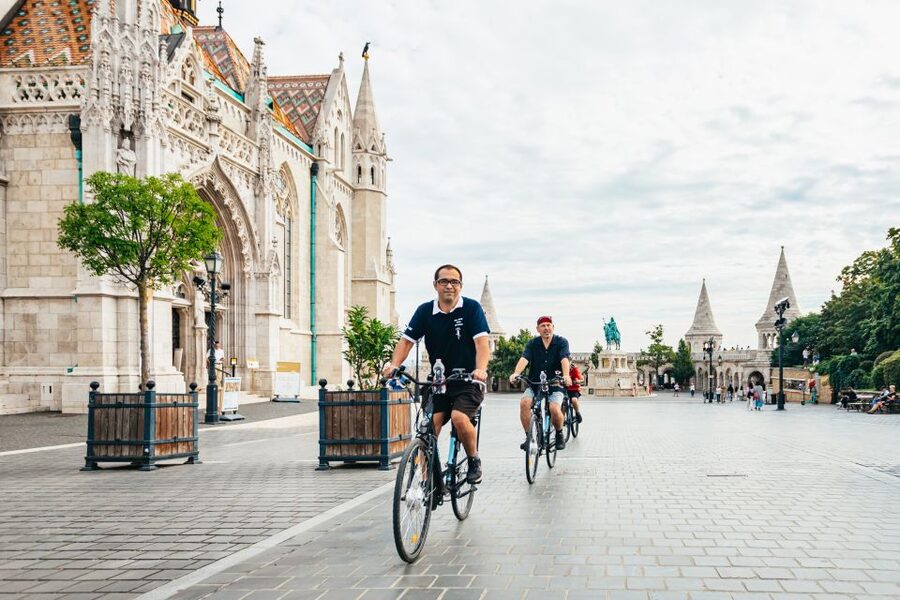
Back in Pest, the tour heads to the Hungarian Parliament Building. This is one of Budapest’s essential sights, with its grand riverside façade and prominent dome. You stop for photos and hear the guide explain the building and its role in the city.
Seeing Parliament from the outside is especially effective by bike because the route lets you approach it from the surrounding streets and river area. You can take in the full scale without committing several hours to an indoor visit. If you want to tour the interior, you will need to arrange that separately.
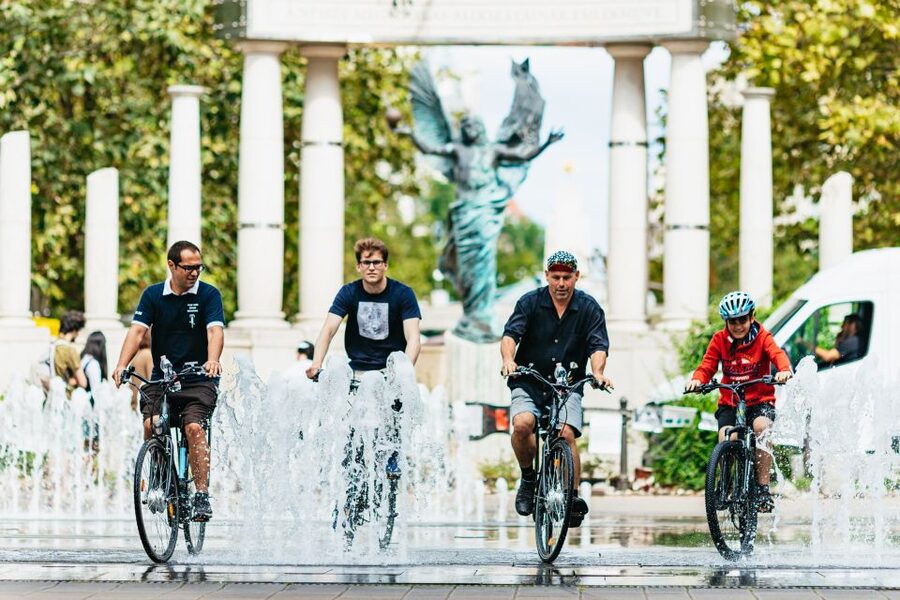
The next stop is Szabadság Square, or Freedom Square. It is close to Parliament but feels different, with open space, monuments, and important political associations. The guide’s stories help connect the buildings and memorials to Hungary’s modern past.
From there, you ride to St. Stephen’s Basilica. The basilica is one of Pest’s major landmarks, and its dome gives the surrounding streets a strong focal point. The tour stops for an explanation and photographs, but it does not include an interior visit as part of the listed route.
This part of the tour is useful for building a mental map. Parliament, Freedom Square, the basilica, and the inner Pest streets are close enough to revisit later on foot. Your guide may also suggest places to eat or sights to return to, which makes the tour a practical first morning activity.
Andrássy Avenue and Budapest’s grand city center
If time permits, the route continues along Andrássy Avenue. This UNESCO-listed boulevard is one of Budapest’s most elegant streets, lined with Neo-Renaissance buildings and cultural landmarks. Riding it gives you a sense of the city’s formal, late-19th-century design.
You pass the Hungarian State Opera House, where the guide stops for photos and explains the building. Even from the street, the Opera adds a dose of ceremony to the route. The pace is quick enough to keep the tour moving, but you can note where to return for a closer look.
The House of Terror follows. This museum examines the periods when Hungary was ruled by fascist and communist dictatorships. The tour does not include admission, and you should not expect a full museum visit during the bike ride. Still, the guide’s short explanation gives you useful context and may help you decide if the museum belongs on your own itinerary.
This is one reason I recommend taking the tour early in your stay. You get a list of places to revisit, rather than trying to absorb every sight in one hurried stop. The guides are especially good at turning a quick pass by a building into a reason to return later.
Heroes’ Square and City Park
The final major section takes you to Heroes’ Square and Városliget, or City Park. Heroes’ Square is marked by a sweeping colonnade and statues of important figures from Hungarian history. It is spacious, highly visual, and easy to photograph.
City Park gives the route a more open finish. You ride through the park and pass some of its notable sights before returning to the starting office. The park is a good place to continue exploring after the tour if your schedule allows, though the bike experience itself ends back at the provider’s office.
The route may not always include every final stop if traffic, weather, road closures, or group pace affect the timing. One guide adjusted a route during a national holiday when roads were closed, and another changed course so the group could see Liberty Bridge. That flexibility is useful, but it also means you should view the listed route as a strong plan rather than a strict guarantee of equal time at every stop.
Guides, bikes, and the feel of the ride

The guide is the heart of this experience. Carson is often praised for humor, patience, and clear explanations. Thomas is noted for setting a comfortable pace and helping people feel safe. Zsolti brings a friendly style and local stories, while Andy is praised for making the city easy to understand.
These names do not mean you can request a particular guide or that one person will lead every departure. They do show the kind of guiding style you can expect: informal, attentive, and focused on giving you a useful introduction rather than delivering a stiff lecture.
The standard bikes are reported to be in good condition, and a helmet and water are included. Most of the riding uses cycle paths or calmer streets, although you will still encounter regular traffic. The guide keeps an eye on the group and checks that everyone is comfortable, an important detail if you have not cycled in a busy capital recently.
The tour operates in all weather. That makes clothing your responsibility. Wear shoes you can pedal in, dress for the forecast, and remember that wind beside the Danube can make a mild day feel cooler. Pregnant women and children under 12 are not suitable for this activity.
Is $44 a fair price?
At $44 per person, the tour is good value if you want an active overview of Budapest. You receive a bike, helmet, water, and an English-speaking guide, while the route covers Buda, Pest, the river, Margaret Island, the Castle District, and the major central sights.
A self-guided bike rental might cost less, but it would not give you the route planning, local stories, traffic guidance, or historical context. You would also need to work out how to connect distant sights efficiently. For a first visit, those practical benefits help justify the price.
The value is strongest if you have only two or three days in the city. Several people used the tour to get oriented at the start of a short visit, then returned to places that caught their attention. It is less useful if you prefer slow museum visits or already know Budapest well.
The e-bike may cost extra, but it can be money well spent for the Castle Hill climb. You do not need to be an athlete, yet the hill can change the tone of the ride if you are not comfortable cycling uphill.
Who should book this bike tour?
I would choose this tour if you want to see a broad spread of Budapest in one morning or afternoon and you enjoy learning while moving. It suits couples, friends, solo visitors, and active families with children aged 12 or older.
It is also a strong choice for first-time visitors. The route gives you landmarks, neighborhoods, bridges, parks, and viewpoints in one pass, making it easier to plan the rest of your stay.
I would think twice if you are uncomfortable on a bicycle, dislike riding near traffic, or need a slow and highly detailed visit at each sight. The tour includes breaks, but it still asks you to pedal for three hours and handle the Castle Hill climb.
Free cancellation up to 24 hours before the start and the option to reserve now and pay later make planning less risky. Just remember that luggage and large bags are not allowed, and the tour runs in all weather.
Should you book the Grand Sightseeing Bike Tour?
Book it if you want a lively introduction to Budapest rather than a long, stationary tour. The combination of Danube views, Castle Hill, Margaret Island, Parliament, and Andrássy Avenue gives you a lot for three hours, and the guides add the local detail that turns a route into a useful city lesson.
Choose an e-bike if the Buda climb worries you. Otherwise, bring comfortable clothes, leave your luggage behind, and take the tour early in your visit. You will return with a better sense of the city, a list of places worth revisiting, and a pleasant bit of exercise along the way.
FAQ
How long is the Budapest Grand Sightseeing Bike Tour?
The tour lasts three hours.
What language is the tour offered in?
The live guided tour is offered in English.
What equipment is included?
A bike, helmet, and bottle of mineral water are included.
Does the tour visit both Buda and Pest?
Yes. The route includes Pest, the Danube, Castle Hill in Buda, Margaret Island, Parliament, central Pest, Andrássy Avenue, Heroes’ Square, and City Park.
Is the Castle Hill climb difficult?
The route includes an uphill climb to the Castle District. It is manageable for many cyclists but can be demanding, so an e-bike upgrade may be useful if you are not comfortable riding hills.
Who cannot join the tour?
The activity is not suitable for children under 12 or pregnant women. Large bags and luggage are also not allowed.
Latest bike tours added in Budapest
- Szentendre by Bike: Self Guided Bike Rental Package!★ 4.7 · 26 reviews
- Budapest to Szentendre e-Bike Tour with a local guide★ 5.0 · 10 reviews
- Budapest: Self-Guided Bike Tour to scenic Szentendre★ 4.6 · 24 reviews
- Budapest ❤️Winter Bike Tour with Coffee Stop❤️★ 4.8 · 20 reviews
- Budapest Highlights Bike Tour with a local guide★ 4.9 · 66 reviews
- Budapest: Guided Bike Tour Plus★ 4.7 · 62 reviews
- Budapest: E-Bike Guided Tour and Castle Hill★ 4.9 · 241 reviews
- Budapest: Guided Bike & E-bike Tour with a Goulash★ 4.8 · 220 reviews
City Highlights Bike Tours, compared.
3-Hour Porto Highlights on a Electric Bike Guided Tour
Read our review →
City Highlights 3-Hour Guided Electric Bike Tour
Read our review →
Highlights & Hidden Spots of Barcelona Bike Tour w/ Local Guide
Read our review →
Sights and Highlights Bike Tour with a Local Guide
Read our review →

Highlights 3 Hour Bike Tour with a Local Guide
Read our review →
Browse the lists this tour appears in