
Review · CITY HIGHLIGHTS BIKE TOURS
Vienna by Bike 3-Hour All-In-One City Bike Tour in English
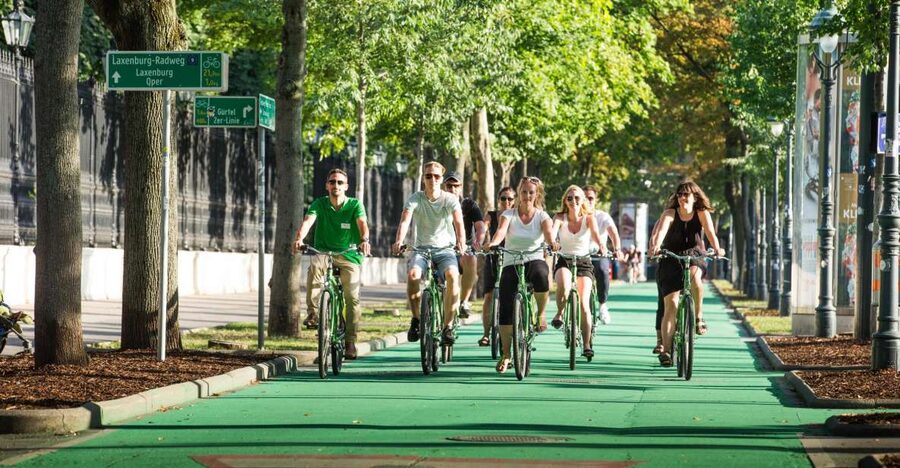
Vienna’s grand center makes more sense from a bicycle. In three hours, you can connect the Ringstrasse, imperial buildings, the Danube Canal, Hundertwasserhaus, and Prater without spending the day on foot or underground. The route is mostly flat, and the stops give you time to look up, take photos, and hear why these places matter.
I like the balance between riding and short talks, plus the easy-to-ride bikes and good cycle paths. Guides such as Lisa, Marco, Jan, Horst, and Robert have been praised for mixing history with humor and practical local advice. The main consideration is that this is a city overview, not a tour of Vienna’s medieval lanes or museum interiors, and a group of around 14 can feel a little large.
Key points
- A three-hour overview on two wheels: Cover far more ground than you would on foot, with regular stops at major sights.
- Ringstrasse at the center: See the Opera House, Rathaus, Parliament, Vienna University, Imperial Palace, and Heroes’ Square.
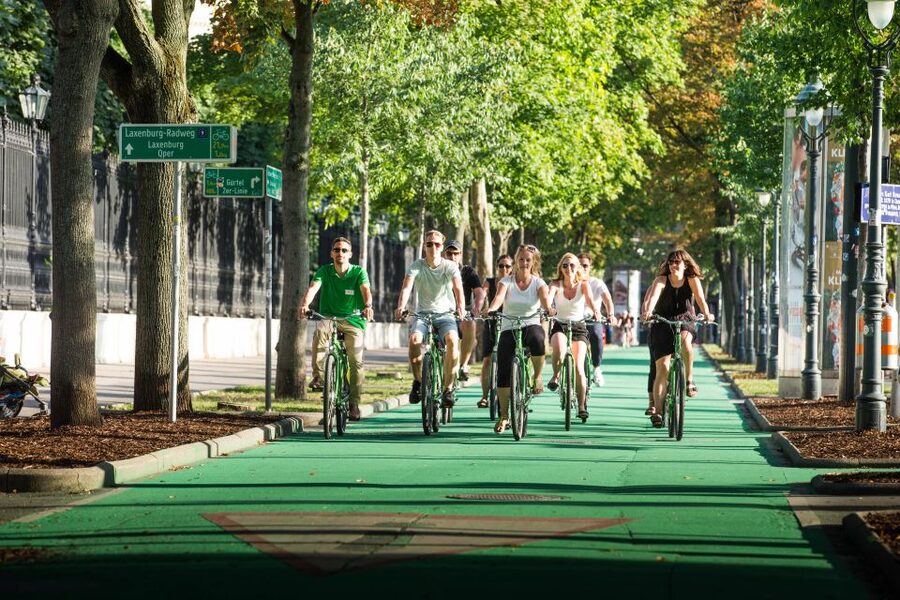
- Mostly easy cycling: The route uses safe, well-surfaced paths and is largely flat.
- More than imperial Vienna: The ride includes the Danube Canal, Hundertwasserhaus, Karlskirche, and Prater.
- Strong guiding is part of the appeal: Guides including Lisa, Marco, Jan, Horst, and Robert are praised for clear history, humor, and care at crossings.
- Useful in uncertain weather: The tour runs in rain, with ponchos provided.
Why a bicycle works so well in Vienna
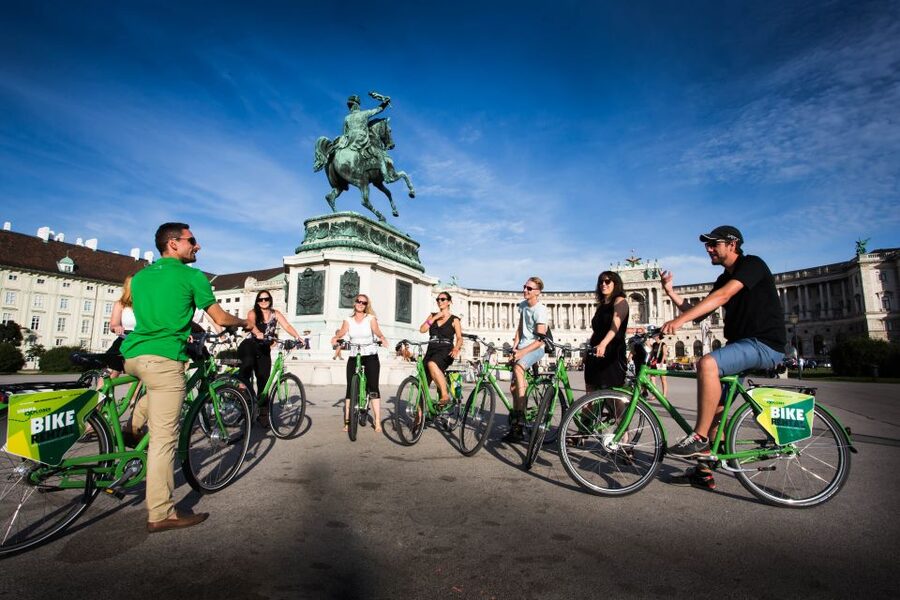
Vienna is a city of grand distances disguised by its tidy center. The Opera House, Hofburg, Rathaus, Parliament, Karlskirche, Hundertwasserhaus, and Prater are all part of one larger story, but they are not all next door to one another. On foot, you can spend much of a day connecting them. By bicycle, you get a broader picture in one outing.
I like that this tour is not simply a fast ride past famous façades. The guide leads you along safe, well-surfaced routes and stops at important points for explanations and photos. You get a moving view of the city, then enough time to listen without trying to pedal and take notes at once.
The pace is generally described as leisurely and safe. That matters if your group includes mixed ages or cycling confidence. Families have used the tour successfully, and one guide patiently managed a lively 12-year-old. Some riders have also chosen e-bikes when they wanted a little extra help, though the route itself is largely flat.
The tradeoff is focus. This outing is built around the grand central boulevards and a few outlying sights. You will not spend the tour wandering through the oldest pedestrian lanes, entering a string of museums, or lingering inside every church. Think of it as an orientation ride with history, not a replacement for your indoor sightseeing.
More City Bike Tours in the world:
- Lion City Bike Tour of Singapore
★ 5.0 · 6,211 reviews - 3-Hour Porto Highlights on a Electric Bike Guided Tour
★ 5.0 · 4,392 reviews - Porto: City Highlights 3-Hour Guided Electric Bike Tour
★ 4.8 · 3,092 reviews
Starting at Franz Josefs Kai
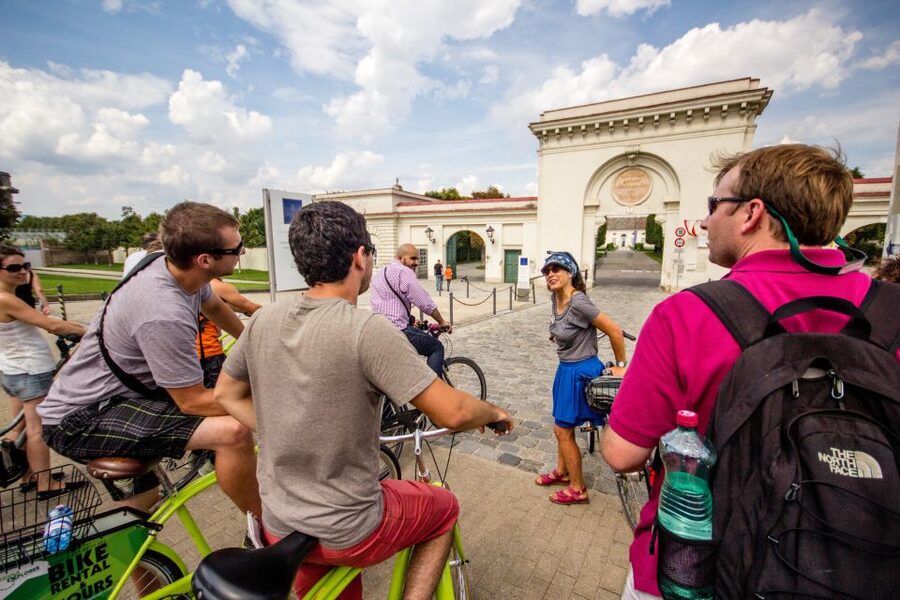
The meeting point is at Franz Josefs Kai, 45, in Vienna’s 1010 district. Schottenring station, served by the U4 and U2 subway lines, is the nearest underground stop. Arrive ready to ride in comfortable clothing, since the tour begins with fitting and getting settled on the bikes.
The supplied bikes are modern city bicycles described as comfortable and easy to handle. Helmets are available, and several outings have been praised for bikes in good condition and seats that remain comfortable over the three-hour route. If you have a particular bike preference, it is sensible to ask about the available choices when you arrive.
The tour is offered in English, with English and German-speaking staff listed for the activity. The guiding style varies by person, but the strongest names in the feedback include Marco, Lisa, Jan, Horst, Robert, Karl, and Clemens. Their common strength is turning historical facts into a conversation rather than a long speech delivered while the group waits in the sun.
You should expect a group setting, not a private ride. One outing had 14 people, a size that still worked well with a strong guide but could make questions harder if several people are competing for attention. The guide’s position at intersections and the group’s ability to stay together matter more in a larger group.
Following the Ringstrasse past imperial Vienna
The Ringstrasse is the natural backbone of the tour. This broad boulevard replaced Vienna’s old defensive walls in the 19th century and became a showcase for the power and ambition of the Austro-Hungarian Empire. Cycling it lets you see how the city used architecture to announce its importance.
The route passes the Vienna Opera House, with its Neo-Renaissance design and long connection to the city’s musical life. You stop rather than simply roll past, so you can frame a photograph and hear the guide explain the building’s place along the imperial boulevard.
Rathaus, or City Hall, brings a different mood. Its Gothic façade, towers, and pointed details can look like a medieval palace, even though the building belongs to the 19th-century rebuilding of the Ringstrasse. It is an excellent example of Vienna using historic styles for modern civic purposes.
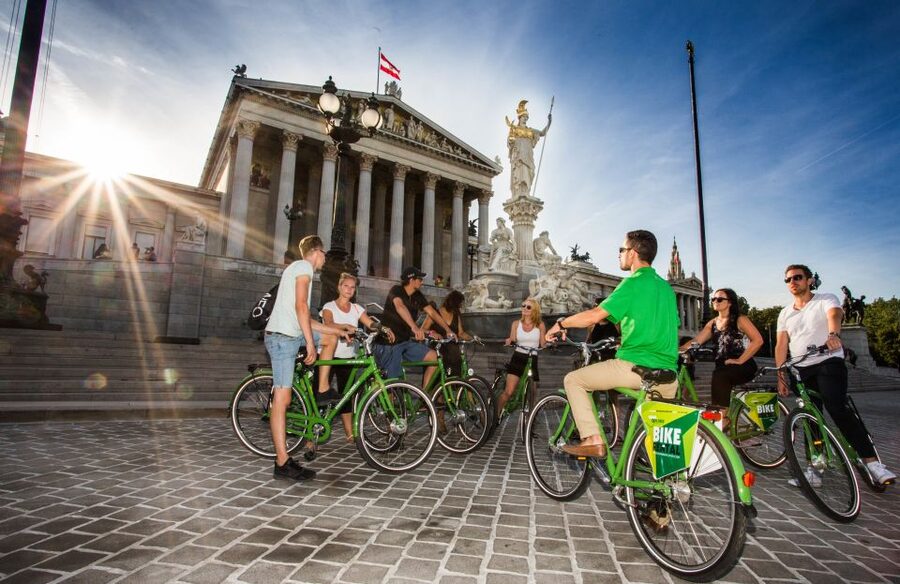
The Parliament buildings show the same habit in another form. Their classical columns and formal design reflect the political ambitions of the Austro-Hungarian era. You also pass Vienna University, the Imperial Palace, and other major public buildings, giving you a useful visual map of the old imperial center.
This section is especially helpful on your first day. You see where the principal sights sit in relation to one another, then you can return later to the places that deserve an indoor visit. I would not try to make every stop a full architectural study. The value is in the connections: the Ringstrasse was not just a road, but a grand civic project.
Heroes’ Square and the darker side of Vienna’s past
Heroes’ Square, or Heldenplatz, brings political history into the ride. It is closely linked with the Hofburg complex and the imperial story, but it also carries the memory of Adolf Hitler’s 1938 Anschluss speech, delivered after Nazi Germany annexed Austria.
A good city tour should not treat Vienna as a collection of pretty façades, and the guides are praised for handling political and wartime history with care. Some explain not only the public events but also personal and family connections to the war years. That can give the stop more weight than a quick date and name.
You will be outdoors, likely standing with the bicycles while the guide talks. The subject is serious, and the stop may feel different from the lighter stories shared elsewhere. That contrast is useful. Vienna’s imperial image is only part of its story, and this section helps you see how public spaces can carry several layers of memory.
More three-hour rides in the world:
- 3-hour Complete Prague Bike Tour
★ 5.0 · 3,674 reviews - Copenhagen: Highlights 3 Hour Bike Tour with a Local Guide
★ 4.8 · 2,312 reviews - Classic Vienna: 3-Hour Guided Bike Tour
★ 4.7 · 2,146 reviews - Munich 3-Hour Guided Bike Tour
★ 4.5 · 1,731 reviews
Karlskirche and the city’s grand religious architecture
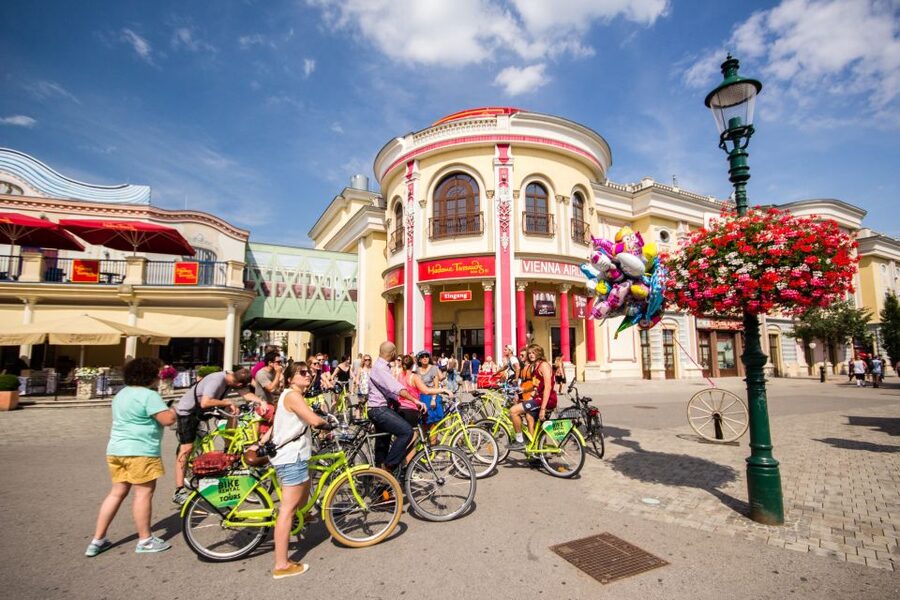
At Karlsplatz, you see the columns and dome of Karlskirche. The church is one of Vienna’s most recognizable pieces of Baroque architecture, and its broad setting makes it especially effective from outside. The tour allows time for photographs and a short explanation before moving on.
This stop also breaks up the long succession of Ringstrasse civic buildings. After seeing government offices, palaces, and cultural institutions, Karlskirche shows how religious architecture used scale and decoration to make a different kind of statement.
Do not expect a long interior visit to be the focus here. The experience is designed to keep moving, and the main benefit is seeing Karlskirche within the wider city route. If its interior or art interests you, mark it for another visit after the bike tour.
Along the Danube Canal
The ride later reaches the banks of a sidearm of the Danube, usually described as the Danube Canal. This section offers a change from formal boulevards and monumental stone. You are still close to central Vienna, but the pace and views feel less ceremonial.
Cycling beside the water is one of the practical pleasures of the route. It gives you a stretch where you can ride rather than stop every few minutes for another building. The canal also helps explain Vienna’s relationship with its waterways and gives the tour some variety.
One important point: this is not a long excursion to the main Danube far outside the center. You are riding along the canal within the city. That makes it easy to fit into a three-hour route, but you should not book this expecting a countryside ride or a full riverfront tour.
Hundertwasserhaus, Vienna’s colorful rule breaker
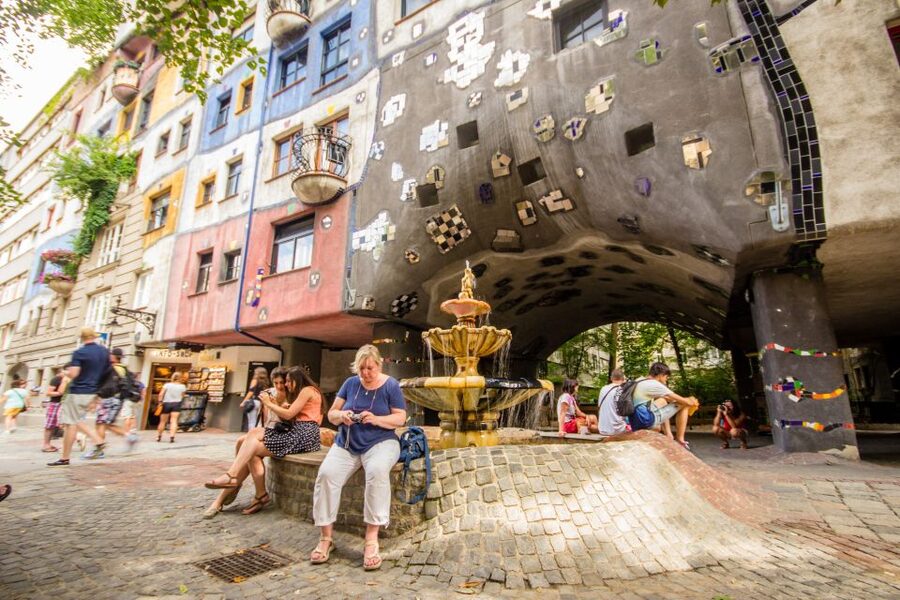
Hundertwasserhaus is the visual shock of the day. After the orderly symmetry of the Ringstrasse, this apartment building looks playful, uneven, and deliberately unconventional. Its bright colors, irregular surfaces, and plant-covered elements reflect the ideas of artist Friedensreich Hundertwasser.
The stop works because it gives you a clear contrast. Imperial Vienna often presents itself through straight lines, repeated columns, and carefully controlled façades. Hundertwasserhaus rejects much of that order. You get a quick lesson in how modern Vienna can be just as expressive as its imperial core.
The tour visits the building from outside, with time to take pictures. It is a popular photo stop, so patience helps if other people are also looking for the best angle. I would also listen for the guide’s explanation rather than treating it as a quick colorful backdrop. The building makes more sense when you understand why its irregular design was intentional.
Prater Park and the giant Ferris wheel
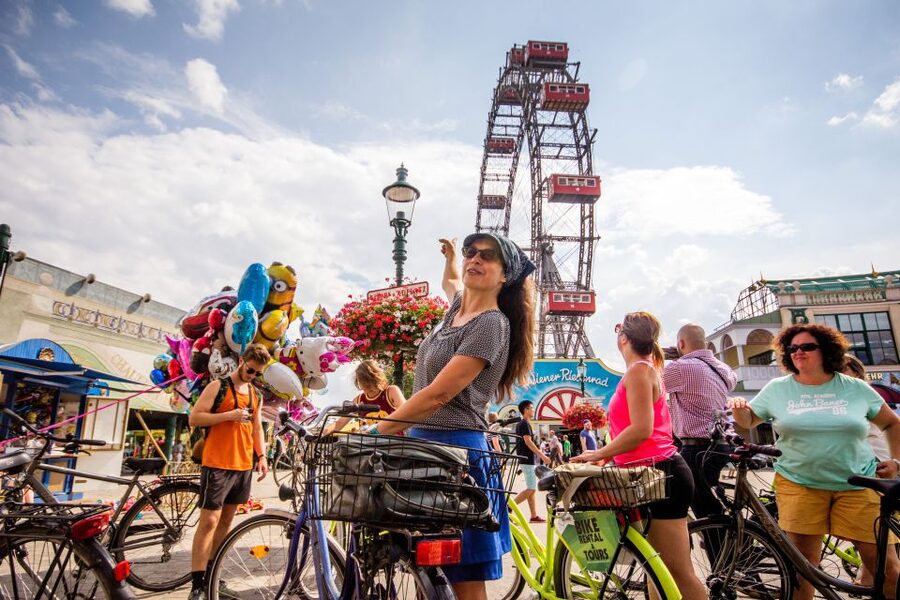
The route continues toward Prater Park, one of Vienna’s best-known recreational areas. The giant Ferris wheel is the landmark here, with its large red carriages and long connection to the city’s public life.
Arriving by bicycle makes the Prater feel like part of Vienna rather than an isolated amusement stop. You have already crossed formal boulevards and urban waterways, and now the route opens into a park setting. The Ferris wheel provides another strong photograph and a memorable final sight before the ride back.
The guides also add small local details here. One example concerns why Prater has trees but no bushes in certain areas, a detail that is easy to miss if you only come for the wheel. These observations are part of what makes a guided ride more useful than following a standard sightseeing map.
The tour does not include a Ferris wheel ride. You see and photograph it as part of the cycling route, then continue back along the canal. If you want the wheel itself, plan that separately and allow additional time.
The pace, stops, and comfort level
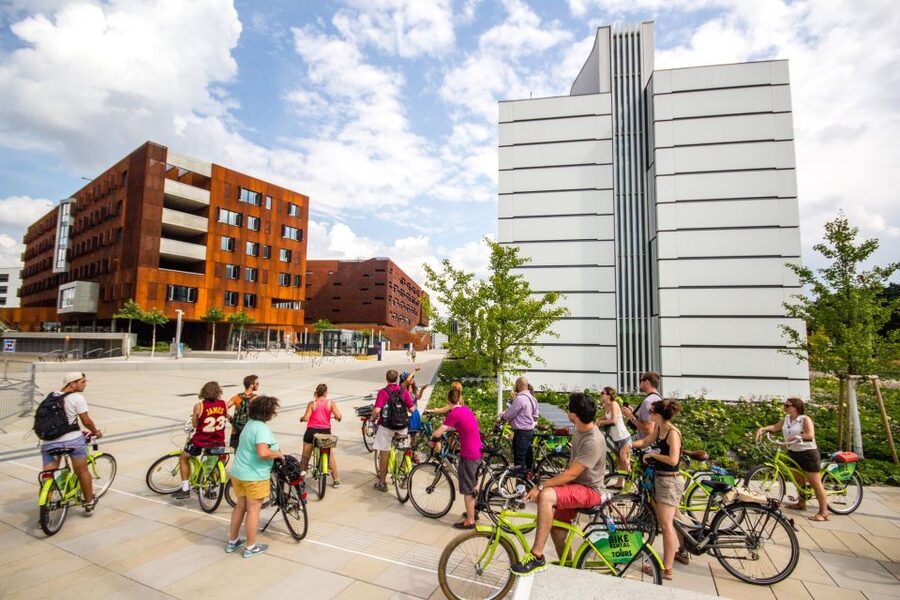
Three hours is a good length for this route. It gives you enough time to cover a wide area without turning the ride into an endurance test. Several riders describe the balance as just right: plenty of cycling, but also regular stops for history, questions, and photographs.
One practical complaint is the lack of another comfort stop during the three-hour outing. There is no stated scheduled bathroom or refreshment break, so plan ahead before departure. The route includes many pauses, but a photo stop is not the same as a proper rest stop.
The route is described as mostly bike paths and easy cycling. Still, this is an urban ride, so you will encounter crossings, traffic points, and the need to stay with the group. Guides have been praised for watching the oldest and youngest riders and helping everyone through intersections.
The tour operates in all weather. Rain ponchos are provided when conditions are wet, which is useful but not the same as having dry, warm clothing. In good weather, comfortable clothes and ordinary walking or cycling shoes should be enough. On a hot day, the afternoon route may offer more shade in places, but conditions can vary.
What $55 gets you
At $55 per person, the tour is not the cheapest way to see Vienna. You can walk around the Ringstrasse for free, use public transport between sights, and read about the buildings yourself. The price makes more sense if you value the bike, the route planning, and a live guide who can connect architecture, politics, and local details.
I see the strongest value in the amount of ground covered. A three-hour walk would need to move quickly or skip several of these stops. A bus tour may cover similar distances, but a bicycle lets you pause close to the buildings and travel along paths that feel more connected to the city.
The cost also buys flexibility. You can reserve now and pay later, and cancellation is free up to 24 hours before the tour for a full refund. Those terms help if your Vienna plans depend on weather or changing arrival times.
The value is weaker if you dislike cycling, want long indoor visits, or already know the Ringstrasse well. It is also less attractive for someone seeking a small private experience. For a first visit, though, the combination of exercise, transport, and guiding makes the price reasonable.
Who should book this Vienna bike tour?
I would choose this outing early in a Vienna stay. It gives you a useful map of the center and points you toward places worth revisiting. Several people used the tour to plan the following days, which is exactly how I would use it.
It suits couples, families with cycling-capable children, and adults who want a little exercise between museums and cafés. The relaxed pace helps, and the route is largely flat. If one person in your group is less confident on a standard bicycle, ask about an e-bike option before setting out, since some groups have used them.
History fans will get the most from the stops at the Ringstrasse, Heroes’ Square, and the imperial buildings. Architecture fans will enjoy the sharp contrast between Neo-Renaissance, Gothic, classical, Baroque, and Hundertwasser’s irregular modern design.
I would skip it if rain would spoil your day, even though ponchos are supplied, or if you want to spend most of your time inside the old town. The route is broad and varied, but it is not built around Vienna’s smallest lanes, museum collections, or extended church visits.
Should you book it?
Book this tour if you want a lively first look at Vienna, prefer seeing a city while moving, and like history delivered in manageable pieces. The strongest reasons are the comfortable bikes, mostly easy route, wide selection of sights, and guides who bring personality to the ride.
Choose another format if you need a private tour, cannot comfortably cycle for three hours, or want detailed time inside each attraction. For most first-time visitors who can ride a bicycle, $55 is a fair price for the ground covered and the orientation it provides.
FAQ
How long is the Vienna bike tour?
The tour lasts three hours.
What language is the tour conducted in?
The live tour guide speaks English. English and German-speaking staff are also listed for the activity.
Where does the tour meet?
Meet at Franz Josefs Kai, 45, 1010 Vienna.
Which subway station is closest to the meeting point?
Schottenring is the nearest subway station. It is served by lines U4 and U2.
What sights are included?
The route includes the Ringstrasse, Vienna Opera House, Rathaus, Parliament, Vienna University, Imperial Palace, Heroes’ Square, Danube Canal, Hundertwasserhaus, Karlskirche, and Prater Park with its giant Ferris wheel.
Does the tour include a ride on the Ferris wheel?
No. You see and photograph the giant Ferris wheel at Prater Park, but a Ferris wheel ride is not listed as part of the tour.
Are bicycles provided?
Yes. Comfortable, modern city bikes are included.
Are helmets provided?
Safety helmets are available, as noted in the tour details and riding information.
What should you wear?
Wear comfortable clothes suitable for cycling.
Does the tour run in the rain?
Yes. The tour operates in all weather conditions, and rain ponchos are provided in wet weather.
Can I cancel the booking?
You can cancel up to 24 hours in advance for a full refund. You can also reserve now and pay later.
Latest bike tours added in the world
- Brooklyn Neighborhoods Small-Group Bike Tour★ 5.0 · 137 reviews
- The Best of Bristol Bike Tour★ 5.0 · 39 reviews
- A Day in Brooklyn Bike Tour★ 5.0 · 59 reviews
- Hudson Valley Craft Brewery Bike Tour★ 5.0 · 23 reviews
- Brisbane Kayak, Bike★ 4.5 · 23 reviews
- Brisbane Electric Mountain Bike Experience Tour★ 5.0 · 48 reviews
- 2 Hour Private Brisbane Mountain Bike Coaching Session and Ride★ 5.0 · 24 reviews
- Private Bike Tour with Olive Oil Tasting★ 4.5 · 15 reviews
City Highlights Bike Tours, compared.
3-Hour Porto Highlights on a Electric Bike Guided Tour
Read our review →
City Highlights 3-Hour Guided Electric Bike Tour
Read our review →
Highlights & Hidden Spots of Barcelona Bike Tour w/ Local Guide
Read our review →
Sights and Highlights Bike Tour with a Local Guide
Read our review →
Highlights 3 Hour Bike Tour with a Local Guide
Read our review →
Browse the lists this tour appears in