Review · TOURS
Bucharest: Communist Bike Tour
Bucharest’s communist past is spread across a wide city, and a bicycle lets you connect the pieces in one morning. This tour moves from the old center to the first Romanian parliament, Soviet-era housing, Casa Radio, and the spot where Nicolae Ceausescu gave his final speech. The route turns a scattered history lesson into a real city journey.
I like the way the tour connects political events with ordinary streets and buildings. I also like the extra range you get on two wheels, along with guides such as Horia and Alex, who explain the economic, political, and social setting rather than simply pointing at monuments. The main drawback is simple: cycling in dense city traffic requires confidence, and this is not a good match for anyone with limited mobility.
Key points to know before you book
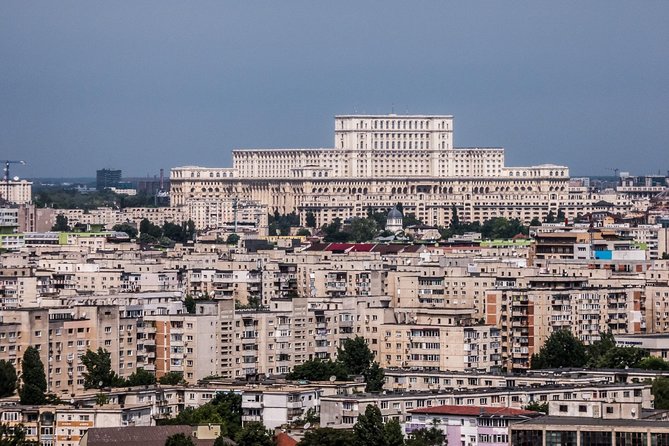
- Four hours on a bicycle: You cover far more ground than on a walking tour, but you need to be comfortable riding in city traffic.
- A clear communist-era route: The stops move from the old city and Coral Temple through Soviet occupation and Stalin-era housing to the 1989 Revolution.
- Casa Radio is an unfinished reminder: You see one of the largest incomplete communist urban projects, rather than a polished landmark.
- Revolution Square closes the story: The tour ends where Ceausescu made his last speech and the December 1989 uprising began.
- Useful equipment is included: Your ticket covers the bike, helmet, and lock, while food and drinks are your responsibility.
- Good value for history-minded visitors: At $53 per person, the tour combines transport, a live English guide, and four hours of city interpretation.
Why a bicycle works for Bucharest’s communist past
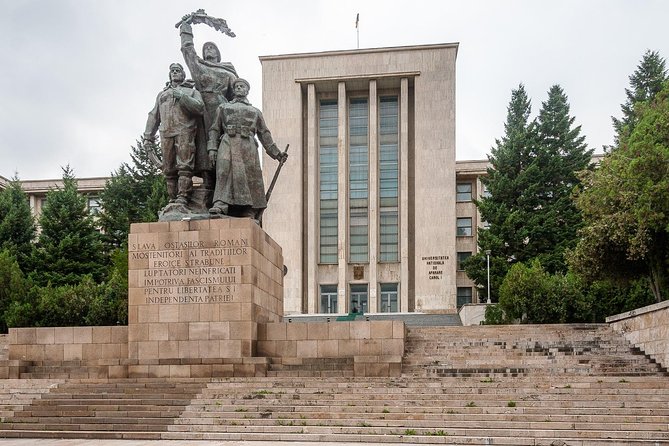
Bucharest is not a city where every important communist-era site sits neatly around one square. The story is spread between the old center, government buildings, residential districts, grand boulevards, and unfinished projects.
That makes cycling a practical choice. You can see how one part of the city relates to another instead of treating each stop as an isolated photo opportunity. The bicycle also gives the tour a stronger sense of scale. Communist planning reshaped large areas of Bucharest, and the distances help you understand the size of that change.
You should think of this as a history tour with a cycling component, not a relaxed ride through quiet lanes. The route passes through an active capital, so you need to pay attention, follow your guide, and feel at ease on a bicycle. Comfortable shoes are the only requested item, but practical clothing for several hours outside makes sense.
The tour lasts four hours. That is long enough to cover a substantial section of Bucharest without turning the day into an exhausting full-day activity. The live guide speaks English, and the equipment package includes a bike, helmet, and lock.
More bike tours in the world:
- Lion City Bike Tour of Singapore
★ 5.0 · 6,211 reviews - Big Bike tour Amsterdam – See all in 3 unforgettable hours
★ 4.7 · 4,929 reviews - 3-Hour Porto Highlights on a Electric Bike Guided Tour
★ 5.0 · 4,392 reviews
Starting in the old center and Coral Temple
The meeting point is just across from Hanu’ Berarilor, at Casa Oprea Soare. From there, the guide begins in Bucharest’s old city center, using the surrounding streets to explain how the communist period damaged or altered parts of the historical core.
This opening gives you useful context before the tour reaches its larger political sites. The old center is not just a place to admire older buildings and cafés. It also shows how city planning, demolition, neglect, and later change affected Bucharest’s historic fabric.
The next stop is Coral Temple, an important point in the tour’s explanation of Romania’s early communist movement. The guide discusses the Jewish community’s role among the initiators of the communist movement in the early 1920s.
That connection adds a human and social layer to the political story. Instead of presenting communism as something that appeared fully formed after the Second World War, the tour traces earlier movements and competing ideas. You get a more complicated picture than a simple Soviet takeover narrative.
Coral Temple also helps keep the tour grounded in real Bucharest communities. You are not only looking at state buildings. You are considering the people and political groups connected to the city before communism took control.
The first Romanian parliament and the early communist attack
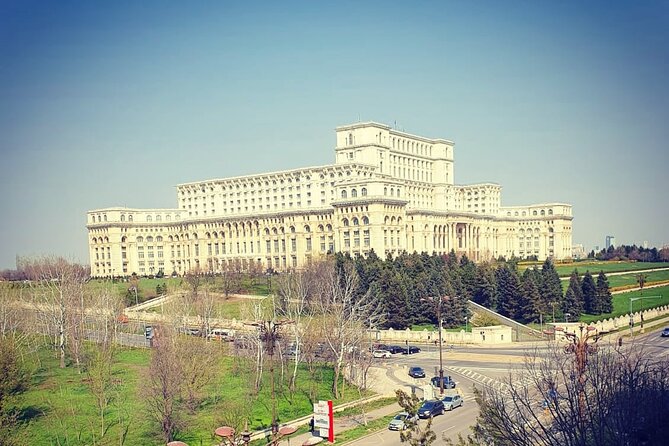
The route continues to the site of the communist bomb attack against the democratic Romanian government, described as the location of the first Romanian parliament.
This is one of the tour’s most unusual stops. It links the communist movement to a direct act against Romania’s democratic institutions, giving you a concrete place connected to the movement’s early struggle for power.
A guide is especially useful here because the significance may not be obvious from the street itself. There is no promise of a large museum display or a dramatic preserved scene. The value comes from understanding what happened at the site and how it fits into the wider political story.
I like this kind of stop because it asks you to read Bucharest as a historical document. The city does not always label every important location in a way that makes sense to a first-time visitor. A good explanation turns an ordinary-looking stretch of the city into part of the national story.
The tour also appears to leave room for questions and wider discussion. Guide Alex, for example, is described as covering historical, economic, and political context, along with the role of different populations. That broader approach suits this subject, since Romania’s communist period cannot be understood through architecture alone.
Soviet occupation and the Stalin-era elite neighborhood
The next stage moves into the period after the Second World War, when Romania was occupied by the Soviet Union for 12 years. The route passes through the neighborhood where Russian army generals who helped rule the country lived.
This section shifts the focus from the beginnings of the communist movement to the machinery of Soviet influence. You see how power was not only expressed through speeches and laws, but also through housing, security, privilege, and the physical separation of ruling figures from ordinary city life.
The neighborhood was built for communist elites during the Stalin era. That makes it a useful contrast with the working and historic parts of Bucharest visited earlier. You can look at the built environment and ask who it served, who had access to it, and how the city reflected the new order.
The guide’s role matters here. Elite housing can look like just another residential district if you do not know who lived there or why it was created. A clear explanation helps you notice the political meaning behind the buildings.
The cycling format works well during this part of the route because you are moving through a larger section of the city rather than standing in front of one monument. You get a sense of how communist authority occupied space. At the same time, you should expect the riding to demand attention. This is still an urban bicycle tour, not a protected cycle path experience.
Another way to spend a morning on two wheels:
- Ninh Binh Full-Day Tour from Hanoi to Hoa Lu, Tam Coc & Mua Cave Via Boat & Bike
★ 5.0 · 4,384 reviews - Small Group Guided Bike Tour of Amsterdam’s Hidden Gems
★ 5.0 · 3,936 reviews - 3-hour Complete Prague Bike Tour
★ 5.0 · 3,674 reviews - Bangkok: Temples, Canals & Local Life Bike Tour
★ 4.9 · 3,511 reviews
Casa Radio and the cost of unfinished ambition
One of the most striking stops is Casa Radio, described as the biggest unfinished communist urban project. The building is also connected with the former National History Museum area, whose buildings were reshaped by the communist regime during its strongest period.
Casa Radio offers a different kind of communist monument. It is not a finished palace that projects confidence and control. Its incomplete state reveals the gap between grand plans and what a government could actually complete.
Large communist building projects often aimed to reshape the city on a monumental scale. Casa Radio lets you consider that ambition without needing a polished interior or a formal museum visit. The unfinished structure becomes the subject itself.
The route also passes buildings that were completely reshaped by the regime. This is important because communist urban change was not limited to constructing new blocks. Existing buildings and civic spaces were altered to fit a new political image.
Do not expect this section to function like a traditional museum stop. The tour is about seeing the exterior setting and understanding its place in Bucharest’s urban story. If you want indoor exhibits, artifacts, or a long visit inside a museum, this experience will not provide that.
For me, this is where the bicycle format again earns its keep. You can compare different parts of Bucharest in one continuous ride: older streets, political institutions, elite housing, and giant unfinished plans. The changing surroundings help you grasp how broad the communist remaking of the city was.
Revolution Square and Ceausescu’s final speech
The final stop is in front of the former Communist Central Committee. This is where Ceausescu delivered his last speech and where the Romanian Revolution began in December 1989.
The stop gives the tour a strong ending because it brings the political story to its breaking point. You have moved from early communist activity, through Soviet control and elite privilege, to the later regime’s grand construction plans. At Revolution Square, the story reaches public revolt.
This is also the point where the tour connects national history with a very specific public event. Ceausescu’s final speech is remembered not simply as another official address, but as a moment when the authority of the regime began to collapse in front of the crowd.
You may find the square easier to understand after the earlier stops. A single visit can otherwise leave you with disconnected images: a government building, a public square, a memorial, or a large avenue. The four-hour route builds the setting piece by piece.
The tour ends here rather than returning you to the start. Make sure you are comfortable arranging your next stop from Revolution Square. The supplied information identifies this as the last stop, so do not assume you will finish back at the old center.
The guides and the style of explanation
The strongest part of this experience is the guide-led interpretation. Names connected with the tour include Horia and Alex, and one account also identifies a guide as Chorea. Horia is described as friendly and well informed, while Alex is noted for giving political, economic, and historical context.
The guide does more than explain communist buildings. The tour can also touch on Bucharest’s founding period, the Orthodox Church, and city life today. That wider frame is useful because communism did not erase everything that came before it, and modern Bucharest cannot be understood through the communist years alone.
You should expect an informative morning rather than a theatrical performance. The subject is serious, but the experience can still feel conversational and entertaining. If you enjoy asking questions, this format should suit you better than a self-guided ride.
The exact personality of the tour will depend on who leads your departure. Still, the guide is central to the value of the experience. Many of the locations do not offer enough obvious information on their own, so the quality of the explanation determines how much you take away.
Is $53 a fair price for four hours?
At $53 per person, this is not the cheapest way to see Bucharest. It is a reasonable price if you value the bicycle, the equipment, the live English guide, and the amount of ground covered in four hours.
You are not paying only for a rental bike. The cost includes a helmet, lock, and a structured route linking sites that would take more effort to connect independently. A self-guided ride might cost less, but you would need to research the history, find each location, and work out a practical route through the city.
The value is strongest for a first visit. One afternoon gives you a working map of Bucharest’s communist past and points you toward places you may want to revisit. It can also help you decide which museums, squares, or neighborhoods deserve more of your time later.
Food and drinks are not included. Plan accordingly, since four hours on a bike is a long stretch without water or a meal. The meeting point is near Hanu’ Berarilor, but the tour details do not promise a restaurant stop or refreshments. One account mentions a pit stop, yet you should not treat food as part of the ticket.
The booking terms are useful if your schedule is still moving. You can reserve now and pay later, and cancellation is allowed up to 24 hours before the tour for a full refund.
Who should book this bicycle tour?
I would choose this tour if you want political context, like active sightseeing, and feel comfortable riding in city traffic. It is a strong first-day option because it gives you both orientation and a clear account of how communism changed Bucharest.
It also suits anyone who finds ordinary buildings more interesting once they know the story behind them. Casa Radio, the elite neighborhood, and the former Central Committee are not simply photo stops. Their meaning comes from the explanation.
This is less suitable if you want a slow walking tour, a museum-heavy experience, or a quiet ride away from traffic. It is not recommended for people with mobility impairments, and comfortable shoes are advised.
The tour also works best for adults and older children who can manage four hours of cycling and stay alert around city streets. The available information does not provide a minimum age, group size, or detailed road conditions, so ask the provider if those points matter for your booking.
Final decision: book it for context and coverage
Book this Communist Bike Tour if you want to understand Bucharest as a city shaped by political power, not just admire its old center. The route covers a useful chain of places, from Coral Temple and the first Romanian parliament to Casa Radio and Revolution Square.
I especially like the balance between famous events and less obvious urban evidence. You see where leaders lived, how buildings were altered, what grand plans remained unfinished, and where the 1989 Revolution began.
Skip it if cycling in dense traffic makes you nervous or if mobility is a concern. For everyone else, $53 buys a practical four-hour introduction, solid equipment, and the chance to ask an English-speaking guide questions as the city passes beneath your wheels.
FAQ
How long does the Bucharest Communist Bike Tour last?
The tour lasts four hours.
What language is the tour conducted in?
The live guided tour is conducted in English.
Where is the meeting point?
Meet just across from Hanu’ Berarilor, at Casa Oprea Soare, in Bucharest’s old city center.
Are bicycles included in the price?
Yes. A bicycle, helmet, and bike lock are included in the ticket price.
Is food included?
No. Food and beverages are not included.
What should I bring?
Bring comfortable shoes. You should also be prepared for four hours of cycling in the city.
Is the tour suitable for people with limited mobility?
No. The tour is not recommended for people with mobility impairments.
Can I cancel the booking for a refund?
Yes. You can cancel up to 24 hours in advance for a full refund. You can also reserve now and pay later.
Latest bike tours added in the world
- Brooklyn Neighborhoods Small-Group Bike Tour★ 5.0 · 137 reviews
- Hudson Valley Craft Brewery Bike Tour★ 5.0 · 23 reviews
- The Best of Bristol Bike Tour★ 5.0 · 39 reviews
- A Day in Brooklyn Bike Tour★ 5.0 · 59 reviews
- 2 Hour Private Brisbane Mountain Bike Coaching Session and Ride★ 5.0 · 24 reviews
- Brisbane Kayak, Bike★ 4.5 · 23 reviews
- Brisbane Electric Mountain Bike Experience Tour★ 5.0 · 48 reviews
- Private Bike Tour with Olive Oil Tasting★ 4.5 · 15 reviews
Tours, compared.

Big Bike tour Amsterdam – See all in 3 unforgettable hours
Read our review →
3-Hour Porto Highlights on a Electric Bike Guided Tour
Read our review →
Ninh Binh Full-Day Tour from Hanoi to Hoa Lu, Tam Coc & Mua Cave Via Boat & Bike
Read our review →
Small Group Guided Bike Tour of Amsterdam’s Hidden Gems
Read our review →